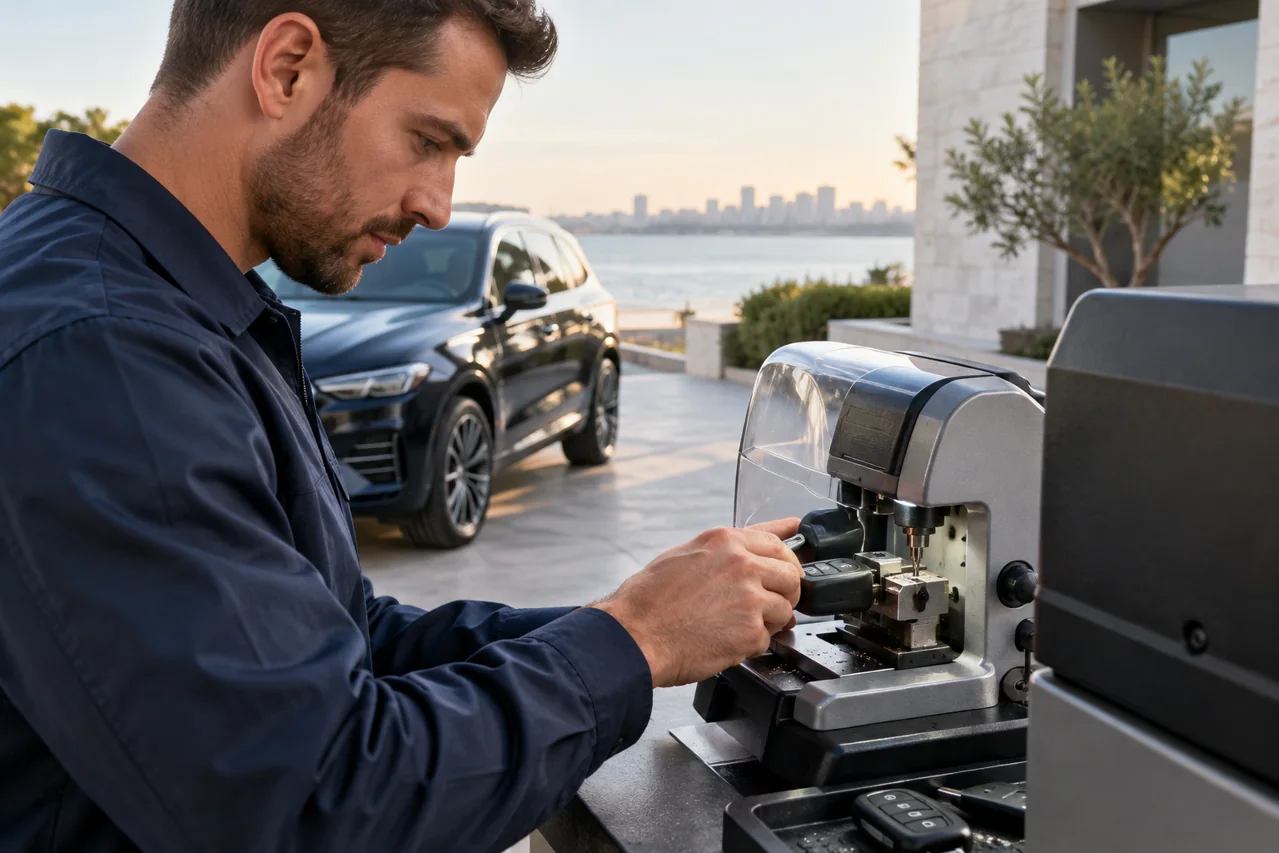
A workplace district with its own parking habits
The Energy Corridor is largely a daytime place. Office campuses sit among landscaped grounds, and each has surface lots and garages sized for a large workforce. Many employees drive in from suburbs to the west and north, park for eight or ten hours, and drive out again. Others arrive by park-and-ride bus, leaving a vehicle at a lot at dawn and returning at dusk.
This changes how key problems appear. A lost key is often discovered when the shift ends, when the person is tired and wants to get home. A dead fob shows up at the end of a long day. A key locked inside a vehicle is noticed at the lot rather than at home. Because the vehicle has been sitting for hours, it may also have heated up significantly in a Houston afternoon, which makes any delay more uncomfortable.
The area has a high share of professionals who drive newer vehicles, and many company vehicles pass through as well. That means smart keys, push-button start and sealed fobs are common. A mobile technician can handle these on site, which matters when a tow would take the vehicle away from a lot where the owner has a long commute ahead. This page explains what to expect and how to prepare.
Lunchtime and end-of-day key trouble
Most key trouble at a workplace falls into a few patterns. At lunch, a person walks to a restaurant or a food truck area, sets a key down at the table, and walks back without it. At the end of the day, a person reaches the vehicle and realizes the key is not in the usual pocket. Others find that the fob that worked in the morning now does nothing.
If you reach this point, retrace your steps methodically. Check your desk, your bag, your jacket and any shared spaces such as a break room, a locker or a conference room. Ask the front desk or building security whether a key has been turned in. Many office buildings keep a small lost-and-found, and security staff can often check a camera feed or a log if you can describe where you were.
If you recently used a restroom, a gym on campus or a cafeteria, ask there too. A key with a distinctive fob is easy to recognize and honest finders usually hand it in. Give the building a contact number so they can reach you if the key surfaces later.
- Check your desk, bag, jacket and any lockers or shared areas.
- Ask building security or the front desk about a lost-and-found.
- Check the restaurant, cafeteria or gym where you spent time.
- Check inside the vehicle through the windows without forcing anything.
- Ask a coworker to look at your desk if you are already at the vehicle.
Company vehicles and shared fleet keys
Many vehicles around the Energy Corridor belong to businesses rather than individuals. Sales teams, field engineers, inspectors and service crews use company cars, vans and trucks, and keys are passed between drivers. In this setting, a lost key brings paperwork and responsibility along with the practical problem.
If a company vehicle key is lost, start by notifying the fleet manager or the person who controls the vehicle. Many companies have rules about who can authorize a replacement and may require an approval before a technician is called. They may also have a record of the vehicle identification number and ownership documents that will be needed.
When a technician works on a company vehicle, expect to be asked for proof of ownership or authorization, such as a registration in the company name along with a letter or a call from an authorized person. This is a normal safeguard. Our page on fleet vehicle key service explains how this kind of job works, and the guide on workplace parking lot key safety has habits that reduce loss.
Park-and-ride lots and long absences
Park-and-ride commuters leave a vehicle in the same lot for the day, sometimes for several days if they travel for work. When a key is lost, it is usually lost on the bus, at the office or in transit. The vehicle itself sits waiting, and the owner may be far from it when the loss is noticed.
If you realize the key is lost while you are at work, you have time to plan. Call a technician, explain where the vehicle is parked, and arrange a time when you can be there. Remember that the technician will need to confirm that you are the owner, so you must be present with identification and registration.
If you find the key is missing when you arrive at the lot at night, the plan is similar, but you may be in a darker, quieter place. Stay in a well-lit area, keep your phone charged and tell someone where you are. If you feel unsafe, move to a lit public spot and wait there. You can describe the vehicle and the lot to the dispatcher when you call.
Large surface lots and finding the vehicle for the technician
A large surface lot can be hard to describe. Rows look alike, and a sign on a light pole may not mean much to someone who has never been there. When you call, give the name of the building or campus, the lot or section, the nearest entrance and any visible landmark. A photo of the vehicle with a nearby sign or pole number can be useful.
Some campuses require that service vehicles register at a gate or notify security. If your building has this rule, tell the dispatcher. If you can, meet the technician at the lot entrance so you can guide them to the vehicle. That saves time and avoids confusion.
In summer, the lot can be extremely hot. If the vehicle is baking in the sun, wait in an air-conditioned building until the technician is close. If a pet or a person is inside a hot vehicle, call 911 first. Everything else can wait.
Smart keys, fobs and the reality of daily wear
Professionals who drive daily often carry a smart key in a pocket or bag for years. The key is exposed to heat, moisture, drops and the pressure of being carried against other objects. Over time the case cracks, the buttons soften and the battery weakens. A fob that sits next to a phone, a laptop and a badge can also be affected by interference, though the more common issue is a plain weak battery.
If your fob starts to respond slowly, or if you need to press a button several times, change the battery before it fails completely. Our page on key fob battery replacement explains the process. If the case is cracked, see key fob shell repair, which describes how the electronics can be moved into a new case.
A weak vehicle battery can also make a good fob seem faulty. Our page on dead car battery and fob problems describes how to tell the difference. If the vehicle has been sitting for a long period, such as during a business trip, this is a likely cause.
Security for people who leave a vehicle in the same lot every day
A vehicle parked in the same lot every day is a known target. A lost key in this setting is more than an inconvenience. If a key is dropped in a public area, someone could find it and, in principle, work out which vehicle it fits. Many smart keys carry no obvious label, but a key with a dealer logo and a recognizable vehicle in a known lot is a risk.
If you have lost a key and cannot be sure it was safely left in a closed office, consider asking a technician to disable it. For many vehicles this can be done during the same visit in which a new key is added. The old key then no longer starts the engine. It is a sensible step when you cannot be sure where the key has gone.
Our page on key reprogramming after theft explains the process, and the guide on relay attack protection describes a different risk, in which the signal from a smart key is captured by a device near a parked vehicle. A pouch that blocks the signal can be a simple precaution if you leave the key at home or at your desk.
What a technician needs from you on a workday
Because you are probably at work, the technician needs to be able to meet you quickly and verify who you are. Have photo identification and your registration or title ready. If the vehicle is in your name, that is simple. If it is a company vehicle, have a supervisor available by phone.
Tell the dispatcher what you need, such as a spare, a replacement or a key for a vehicle with no remaining keys. Mention if you have any working key at all. A key that no longer starts the engine can still help the technician, because it may hold data used in the process.
Be ready to walk through the condition of the vehicle. Does it start? Are there any warning lights? Is the battery strong? Has any other work been done recently? These answers help the technician bring the right equipment.
- Gather photo identification and the registration or title.
- Locate the vehicle and note the lot, section and nearest landmark.
- Tell the dispatcher about gate or security rules at your campus.
- Bring any working or old key with you to the vehicle.
- If it is a company vehicle, make sure an authorized person can be reached.
Quotes, service call charges and clear expectations
Quotes are given only by phone. The cost of a key job depends on the vehicle, the type of key and the amount of work. We cannot give a figure without knowing the details, and we do not post prices.
Complicated jobs may need an on-site visit before a final quote is possible. There is a service call charge, and we explain it on the phone before a technician is dispatched. If you would rather think it over, you can hang up before anyone is sent.
We do not promise arrival times, since traffic on the freeway and in the district can change quickly. We will be honest about what to expect when we speak. For a quick explanation of the general process, see how quotes work for key jobs.
Habits that keep a workday from being derailed
A few habits reduce the chance of a bad afternoon. Keep your key in the same place each day, preferably in a zipped pocket or the same section of a bag. Do not leave it in a jacket that hangs on a chair in a shared area. Make a spare and keep it at home, not in the vehicle, and tell a family member where it is.
If your workplace allows it, leave a note with building security about how to reach you if a key is found. Keep a photo of your registration on your phone, and know your vehicle identification number. These small preparations make a call shorter and a visit simpler.
When key trouble does happen, call and describe the vehicle and where you are. We will explain what is possible and what to have ready, and we will help you get back on the road from wherever you are in the Energy Corridor.
Business travelers, visiting colleagues and rental vehicles
Energy Corridor campuses host many visitors: consultants, contractors, engineers and colleagues from other offices who fly in and rent a vehicle for the week. A rental key is easy to misplace, because it lives in an unfamiliar bag or pocket and moves between hotel, office and restaurants. When it goes missing, the visitor has a deadline and no local contact.
If the vehicle is a rental, call the rental company before anything else. The company owns the vehicle and the key, and most have a process for lost keys, which may include sending their own help or authorizing a local technician. Ask what they require, and ask whether they accept a locksmith visit. Our page on rental car key lost explains why this order matters.
If the vehicle is a personal one registered in another state, a technician can usually still help. Bring your registration and photo identification. Be prepared to explain where the vehicle is and who owns it. If your employer supplied the vehicle, a call from the fleet office may be needed.
For hosts, a simple courtesy goes a long way. If a visitor loses a key on your campus, point them to security and the lost-and-found, and give them the number of a reliable provider. A calm first hour makes the rest of the visit easier for everyone.
Questions people ask
Can a technician come to an office campus lot?
Yes, in most cases. Some campuses require that service vehicles check in at a gate or with security, so tell the dispatcher if yours does. Give the building name, lot or section and a nearby landmark. If possible, meet the technician at the lot entrance so you can guide them to the vehicle.
I have a company vehicle and lost the key. Who should I call first?
Notify your fleet manager or supervisor first. Many companies require approval before a replacement is made and may need to provide ownership papers. A technician will usually ask for proof of authorization before working on a company vehicle, and may want to speak with an authorized person by phone.
My fob stopped working during the day. Is it lost?
Not necessarily. A weak fob battery is a common cause, and a weak vehicle battery can also make a fob seem faulty. Try the mechanical key blade in the door if your fob includes one, and try a fresh fob battery. If the problem continues, a technician can inspect the fob and the vehicle.
I parked at a park-and-ride lot and lost my key. What now?
Plan a visit when you can be at the vehicle with identification and registration. Tell the dispatcher which lot you are in and any marker nearby. If it is dark and the lot is quiet, wait in a well-lit public area until the technician is close, and keep your phone charged and your location shared with someone.
Should I disable the old key?
If you cannot be sure the key is safe, such as when it was lost in a public place, it is a reasonable precaution. For many vehicles a technician can remove the old key from the system while adding a new one. Ask about it when you call, and we will explain what is possible for your model.
How do I find out the cost?
Quotes are given only by phone, because cost depends on the vehicle, key type and work required. Some jobs need an on-site visit first. There is a service call charge, and it is explained on the phone before a technician is dispatched, so you understand the arrangement before anyone arrives at your location.
Describe the situation by phone and we will tell you what the job involves. Quotes are given by phone. Jobs that cannot be quoted without seeing them need a technician on site, and the service call charge is explained on the phone before anyone is dispatched.
(713) 574-7660Related pages
Written by Claude (AI) (AI) for Houston Car Key Locksmith.