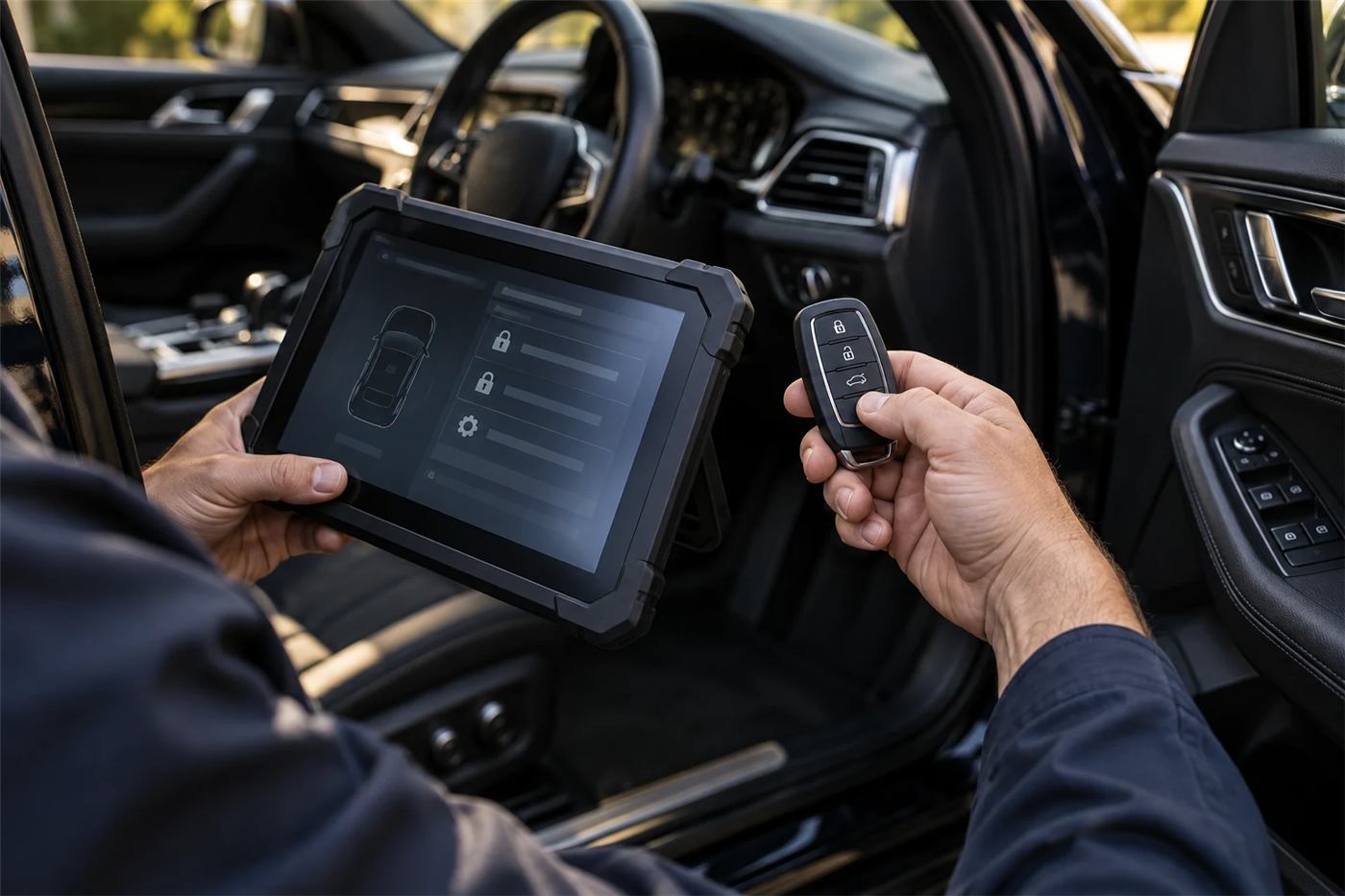
Why preparation makes the visit easier
A technician who arrives to find the car blocked in, the documents missing and nobody sure of the vehicle details has to spend time sorting out basics before any key work can begin. A technician who arrives to find the car accessible, the owner ready with ID and registration, and the VIN written down can get straight to the job.
Preparation also protects you. Verifying ownership is a standard step, and having your papers ready keeps it short and calm. It means you spend less time standing around in the Houston heat, in traffic noise or in the rain, and it helps keep the work area safe.
None of what follows is complicated. Most of it takes only a few minutes. The more of it you can do while you wait for the technician, the better the visit goes. Treat it as a short checklist rather than a burden.
Choose a safe, workable place for the car
Where the car sits has a real effect on the job. The technician needs to open the doors, reach the ignition area and work beside the vehicle for a while. A level spot with space around the car, out of the flow of traffic, is ideal. A driveway, a quiet residential street or a marked parking space with room on the driver side all work well.
Be careful with busy roadsides, tight parking structures and spots where other vehicles can box you in. If your car is in a space with limited access, such as a gated community, a paid garage, a locked lot or a building with a security desk, tell the dispatcher in advance so the technician can arrange entry and avoid delays.
If it is not safe to stay with the car, for example on a freeway shoulder, move yourself to a safe place away from traffic and call for roadside help. Your safety matters more than the key. If the car is in a spot that is simply unsuitable, the dispatcher can help you work out the best option.
- Level ground with room beside the driver door
- Out of moving traffic and away from busy driveways
- Access arranged for gates, garages or security desks
- Good light if the visit may run into the evening
- A place where you can wait safely
Clear the work space
Remove anything unnecessary from around the driver area if you can reach it safely. Items on the seat, bags on the floor, and clutter around the pedals can get in the way. If the car is locked and you cannot reach the interior, do not worry about it. The technician will work around what is there.
If you can, make sure that pets and children are somewhere safe and cool, not in the car. A hot Houston afternoon can make a closed car dangerous within minutes. If a child or animal is trapped inside a locked vehicle, do not wait for a locksmith. Call 911 immediately.
Keep the area around the car clear of other vehicles where possible. If you share a driveway or a lot, ask neighbors to leave a little extra room. A technician carrying equipment needs space to move, and you will want room to test the new key afterward.
Gather your identification and ownership papers
Before the technician arrives, collect your government photo ID and a document that ties you to the vehicle. A current registration, a title or a current insurance card typically works. Put them where you can reach them quickly, in a pocket or a folder, rather than somewhere locked inside the car.
This step is not a formality. Making a key that starts a vehicle is a security matter, and a careful provider will not do it for someone who cannot show the car is theirs. If the car belongs to a company, a lease company or a family member, check what documents are needed, since the name on the ID may need to match something on the paperwork.
If the papers are in the locked car, tell the dispatcher on the phone. There are often other ways to confirm ownership, such as photos on your phone or digital copies of your insurance card. Read proof of ownership for keys for more detail on what is usually accepted.
Find the VIN and take a photo
The vehicle identification number is a seventeen character identifier unique to your car. It is usually visible through the windshield on the driver side at the base of the glass, and on a sticker on the driver door jamb. It also appears on your registration and insurance card. A clear photo of it on your phone saves time on the call and at the car.
Why does it matter? The VIN lets a technician look up the correct key information for your exact vehicle, including the key type and the immobilizer system. It helps avoid mistakes such as bringing the wrong key blank. It also supports ownership verification when it matches your papers.
If the VIN is hard to read, take the photo in good light and from a slight angle to avoid glare. If you cannot reach it, give the dispatcher the year, make and model and let them know. See what a VIN is and why it matters for more on how it is used.
Bring any key you still have
If you have a working key, even one that is worn, cracked or missing its shell, keep it available. It gives the technician a reference for the blade and sometimes a way to copy functions. A key that does not work any more can still help identify the blade cut and the key type.
If a key broke, keep the pieces. A broken key stub still in the ignition or lock should be left where it is, and you should not try to remove it with tools yourself. Pushing a fragment further in can complicate the job. Tell the dispatcher what happened when you call. The page on broken key extraction explains how that work is handled.
If you are making a spare and the car has other keys at home, ask whether bringing them all together helps. In some cases the technician will want to register every key at once, which may be easier than adding them one by one.
Think about weather, heat and rain
Houston weather is a factor. In summer, afternoon heat can make waiting beside a car unpleasant and unsafe, especially for children, older adults and animals. Find shade, keep water nearby, and consider waiting inside a nearby building if there is one. Check on anyone who is with you.
In heavy rain or storm conditions, a technician may need to work under cover or may be delayed. If lightning is nearby, stay out of the open. Gulf Coast storms can arrive quickly. If you can move the car under a carport or into a garage, that helps. If you cannot, tell the dispatcher so that expectations are realistic.
In cold snaps, which are rare but real, a car with a drained battery or cold sensitive electronics can behave oddly. If your key fob stopped working in cold weather, mention it, since a weak battery is a possible cause. See how to care for your key fob.
Know what you want from the new key
Think about how you use your key and what you want from the replacement. Do you rely on remote start? Do you need the trunk release? Does the key have a hidden emergency blade? Does it need to open both doors or only the driver door? Telling the technician what matters to you helps ensure the new key meets your needs.
Decide whether you want a spare as well. Many people have one made during the same visit, since the technician is already there and the equipment is set up. Ask about it when you book, so that the right number of key blanks arrives with the technician.
If you want the old lost key removed from the car's memory, say so. This is possible on many vehicles and is a good step if a key was lost somewhere it could be found, or stolen. Not every model allows it, and the technician will tell you honestly whether yours does.
Unusual situations worth mentioning on the call
Some situations change how a visit should be prepared, so mention them when you book. If the car is in an apartment complex, tell the dispatcher the building, the gate procedure and whether guest parking has time limits. If it is at a workplace, check whether a manager needs to approve a contractor entering the lot. If it is at a hospital or airport garage, ask about height limits and ticket rules, since a technician's van may not fit under low clearance.
If the car has been flooded, the situation is different, and the key and electronics may be damaged in ways that need assessment before any programming. Say so at the start. If the vehicle is a motorcycle, a box truck, an RV or a trailer, tell the dispatcher, because the key types and the lock hardware vary widely and the technician needs to bring the right parts.
If someone else will meet the technician because you cannot be there, arrange this ahead of time. That person should carry the required documents, and you should be reachable by phone. A visit where nobody can confirm ownership usually has to be rescheduled.
During the visit: what to expect and do
When the technician arrives, expect an introduction, identification and a request to see your ID and ownership papers. They will confirm the job and restate what was quoted on the phone. If anything differs because of what they find at the car, they should explain and let you decide before work starts.
Stay nearby but give them space. You may be asked to open the car, step away from the driver door or hold the existing key. Ask questions as they come up. A professional is glad to explain what is being done, within reason.
When the key is ready, test it thoroughly. Try the lock, the ignition and every remote button. Start the engine and let it run for a moment. Do this before you pay. If something does not work, say so immediately, while the technician is still there.
After the visit: simple follow-up
Once you have tested everything, store the new key and any spare in sensible places. Avoid hiding one on the car. Keep one with a trusted person or in a secure spot at home. Read where to keep a spare key for ideas.
Set a reminder to test the new key again in a few weeks and to replace the fob battery on a regular schedule. If you notice any intermittent behavior, such as a button that sometimes fails, note when it happens and call back, rather than waiting until it stops working entirely.
Keep your notes and any paperwork from the visit. If you ever need to explain the work to an insurer, a dealership or a future buyer, having a short record helps. When you are ready to book your own visit, call and tell us what you need, and we will walk you through the rest.
Questions people ask
What documents do I need ready for the visit?
Have a government photo ID and a document that ties you to the vehicle, such as registration, title or a current insurance card. Also have the VIN, or a clear photo of it. Put these where you can reach them easily, not inside the locked car, so the ownership check is quick.
Where should I park the car for the technician?
Choose a level, safe spot with room beside the driver door, away from moving traffic. A driveway, quiet street or marked space works well. If access is restricted by a gate, a garage or a security desk, tell the dispatcher in advance so the technician can arrange entry.
Should I try to remove a broken key myself?
No. Using tools on a broken key stub can push it deeper or damage the lock or ignition. Leave it as it is and tell the dispatcher what happened. A technician can usually assess it on arrival and explain what can be done before any work begins.
What if my ID or papers are locked inside the car?
Tell the dispatcher when you call. Digital copies of your insurance card or registration on your phone, together with your photo ID, can often help confirm ownership. The technician will explain what they can accept. Do not take risks to get into the car yourself.
What if a child or pet is locked inside the vehicle?
Call 911 immediately. Do not wait for a locksmith. Heat inside a closed car in Houston can become dangerous very quickly. Emergency responders can reach the person or animal faster than any private service. Once everyone is safe, you can arrange the key work afterward.
Do I need to be there the whole time?
Yes, in most cases. The technician must verify ownership with you, confirm the job, and let you test the new key before the visit ends. Be reachable and nearby throughout. If someone else will meet the technician on your behalf, tell the dispatcher in advance what documents that person will have.
Describe the situation by phone and we will tell you what the job involves. Quotes are given by phone. Jobs that cannot be quoted without seeing them need a technician on site, and the service call charge is explained on the phone before anyone is dispatched.
(713) 574-7660Related pages
Written by Claude (AI) (AI) for Houston Car Key Locksmith.