Why all keys lost is a different job from a simple copy
When you still own one working key, a technician can read it, cut a matching blade and pair the new electronics to the car in a fairly short visit. When every key is gone, that starting point disappears. The technician has to build the key from information stored in the car and in the vehicle's identity records, which is why the industry calls it origination: the key is originated rather than duplicated.
Origination takes more steps and more verification. The blade cannot be traced from an existing key, so the cut has to come from the vehicle's identification data or from the lock itself. The chip inside the new key has to be introduced to the car's immobilizer computer, and on many models the computer has to be told to forget the lost keys so that a stranger holding one of them can no longer start the engine.
None of this is a reason to panic. It is simply a reason to expect a longer conversation on the phone and a more careful visit than a spare key request would involve. Houston drivers tend to run into this after a day at a ballpark, a beach trip to Galveston, a flooded street or a bag left in a restaurant. The cause matters less than the next steps, and the next steps are the same whether the key fell into bayou water or simply vanished from a jacket pocket.
What to do first, before you call anyone
Start with the simple, quiet checks. Look in the pockets of every jacket and pair of shorts you wore in the last day, in the car seats if the car is open, in the cup holders, under the seat, in a gym bag, and in any bag you carried. Check the place where you last parked, because keys often slip out while you are loading a trunk or getting a child into a seat.
Next, ask whether anyone else may have a key. A spouse, a roommate, a grown child, a former owner or a family member who borrowed the car last month may be holding the one you need. A single spare found at home turns a long origination job into a short copy job, so this question is worth five minutes of phone calls.
Then think about safety. If the keys may have been stolen along with a wallet, purse or bag that holds your address, tell the locksmith when you call, because the car's computer should be told to ignore the missing keys. If a child or a pet is locked inside a hot car, stop reading and call 911 immediately. Emergency crews can open the car faster than any locksmith can arrive, and a life matters more than a window.
- Search the last place you parked and the path to your door.
- Ask every household member and recent borrower about a spare.
- Check for a lost and found at the venue, restaurant or store you visited.
- Look for a valet key or hidden key you may have forgotten about.
- Have your photo identification and ownership paperwork ready before calling.
Proof of ownership comes first
A reputable locksmith will not create a key for a car without confirming that the person asking has the right to drive it. This protects you as much as anyone, because the same service that helps you could otherwise help a thief. Expect to be asked for a government photo identification and a document that ties you to the vehicle, such as the registration, the title or a current insurance card showing the vehicle identification number.
The name on the identification should match the name on the paperwork, or you should be able to explain the difference, for example a vehicle held by a spouse, a company or a lender. If the car belongs to a business, a letter or a work order from the company may be needed. If you bought the car recently and the paperwork is still in the mail, a bill of sale and a temporary tag often serve the purpose, and the technician can tell you on the phone what is acceptable.
If your registration was in the glove box and the car is locked, do not worry. A photo of the registration on your phone, an insurance card app or a copy in your email can often be shown instead. Read our guide on proof of ownership for keys for a longer checklist you can gather in advance.
How the vehicle identification number is used
Every modern car carries a seventeen-character vehicle identification number, usually visible through the lower corner of the windshield on the driver side and printed on the door jamb label. The technician needs it because the number identifies the exact make, model, year, trim and key system, and it can be used to look up the correct blank and the cutting data. Our guide to what a VIN is and why it matters explains the structure of the number.
Do not read the number from memory. Walk to the car and read it from the windshield plate or the door label, or copy it from the registration. A single wrong character can lead to the wrong blank or the wrong programming path, and that wastes everyone's time. Photographing the plate is a fast and accurate way to avoid mistakes.
For some makes the technician must obtain a cutting reference or an authorization from a secured database, and the process is tied to the vehicle and to the technician. This is another reason the call includes questions about your identity and your ownership. It is a normal part of originating a key and should be expected from any qualified provider.
How the new key gets cut
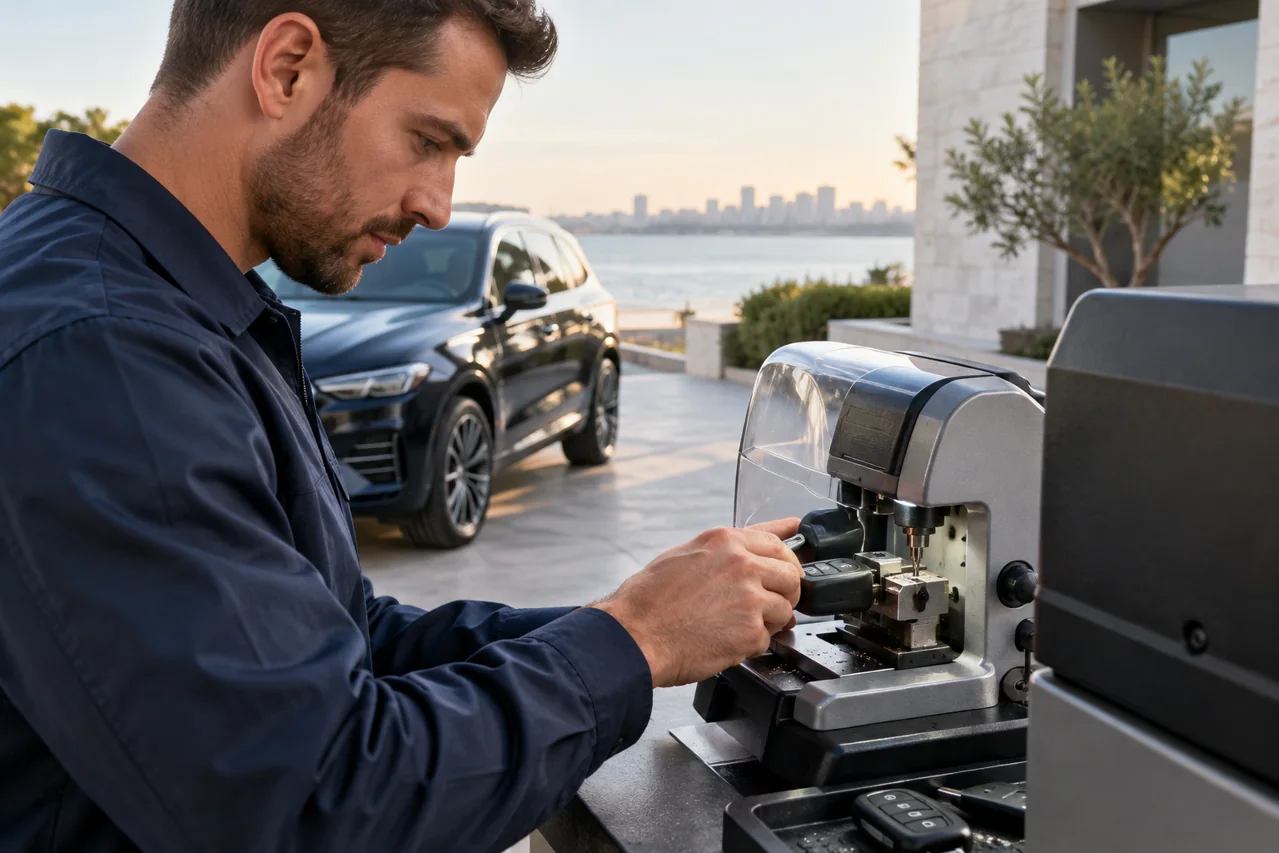
There are two common ways to cut a key when no original exists. The first uses the vehicle's identification data to retrieve cutting information, which tells the technician the exact pattern of the blade, and then the blade is cut on a portable machine. The second works from the lock itself: a technician reads the pattern from the door lock or the ignition cylinder, and the blade is cut to match what the lock needs.
Which method applies depends on the vehicle. Some makes expose the cutting data through a lookup, while others, especially older domestic models, are more often read from the lock. A newer vehicle with a laser-cut or high-security blade needs a precise machine, which a mobile technician brings in a van. If you want to see how the cutting differs by blade design, our pages on laser-cut key service and transponder key programming go deeper.
A well-cut blade will slide smoothly into the door and the ignition and turn without force. If the blade binds or feels rough, the technician will usually adjust it before ever trying to start the car. Forcing a poorly cut key can damage wafers and tumblers, so patience here saves a repair later.
Pairing the new key with the immobilizer
Cutting the blade is only half the job. Most cars built in the last two decades contain an immobilizer, a small computer that will not let the engine run unless it recognizes a matching signal from the chip in the key. A new key arrives with a blank chip, so the car has to be taught to accept it. On some models the technician connects a diagnostic tool to the port under the dash and starts a learning routine. On others the learning can be done with a sequence of key turns, door actions and dash messages.
In an all keys lost situation, the technician commonly has to enter a security procedure that opens the immobilizer to new keys. Some vehicles require a waiting period built into the car's own programming before a key can be added, and the technician cannot skip it. This is not a delay caused by the locksmith. It is part of the vehicle's design to slow down theft.
When the lesson is complete, the technician tests the new key to confirm that the doors lock and unlock, the remote buttons work, and the engine starts and keeps running. If you want a deeper look at how the chip and the computer talk to each other, read our guide to the immobilizer.
Erasing the lost keys so they cannot be used
A lost key is not just an inconvenience. If it fell out of a bag in a parking lot, someone else may now hold a key to your car, and perhaps know where you live. When a technician adds a new key to your car, they can usually remove the old ones from the immobilizer's memory in the same visit. The lost keys will no longer start the engine even though they might still turn a lock.
Be sure to ask for this step if you suspect the key was taken rather than simply misplaced. A car with an erased key list can only be started by the keys the technician has just programmed, which gives you a clean slate. If the lost key includes a remote, the technician can often tell you whether the lock and unlock buttons still work on the old fob or have been disabled as well.
Some drivers find the missing key later in a coat pocket or under a seat. Once a car has been reset, the old key is generally a keepsake, not a working key, unless the technician programs it back in. Tell the technician if you expect to find it, and they can plan the visit around that possibility.
What a mobile locksmith brings to your car
The advantage of a mobile technician is that the work happens where the car is, so there is nothing to tow in most cases. The van typically carries a portable key cutting machine, a stock of common blanks and shells, a diagnostic tablet that can reach the car's computer, and programming equipment for many makes. A technician who cannot reach the right blank in the first van may need to order it, and the phone call should cover that possibility up front.
Some cars, especially those that are decades old with unusual mechanics, those with a very recent system, or those with a damaged ignition, may need an on-site visit before anyone can quote an honest figure. In those cases there is a service call charge, and it is explained on the phone before anyone is dispatched. A quote is given only by phone, and complicated jobs involve an inspection first.
If your car is in a parking garage, an apartment lot or a roadside spot that is unsafe, say so on the call. The technician can plan for lighting, space to set up equipment and the safest position for the van. For more about booking, see our guide on preparing for your key visit.
- You call, describe the vehicle and answer a few questions about where it is.
- The technician explains the process, the service call charge and what to have ready.
- On arrival, the technician checks your identification and ownership documents.
- The blade is cut and the new key is paired with the car.
- The technician tests every function and erases lost keys if you ask.
Situations that change the plan
A damaged ignition is the most common complication. If the lock cylinder is worn, bent or has already been forced by a previous attempt, a freshly cut key may not turn smoothly, and the technician may need to repair or replace the cylinder before the key can work. That job is described on our ignition repair page.
A car with a dead battery adds a step, since the diagnostic tool needs power from the car. A jump or a battery swap may be needed before programming can begin. A vehicle parked under a flooded garage or one that sat in standing water needs even more caution, since electronics may be damaged and programming may fail on a computer that is not stable.
Finally, a vehicle that is a lease return, a rental or a fleet unit may require authorization from the owner. A driver in that position should call the owner first and arrange paperwork, because a locksmith cannot create a key for a vehicle without the registered owner's consent. If your vehicle is part of a work fleet, our fleet vehicle key service page explains the approach.
How to avoid doing this again
The best time to plan for the next lost key is right after this one is solved. Ask the technician to make a second key while they are already there, because an additional key is a simple add on during an origination visit and avoids another trip. Keep that spare somewhere other than the car, your wallet or the same bag as the main key. Our guide on where to keep a spare key offers safe, practical locations.
A tracking tag attached to a key ring can help you find a lost key faster, though it will not replace a spare. Our key tracking tags guide explains the tradeoffs. Photograph the vehicle identification number and your registration and keep the image in a cloud folder so that you can show it from your phone when needed.
Finally, when you are ready to schedule, call and describe the vehicle, its location and what you have for identification. A calm, prepared call is the quickest way to get from stranded to driving again. Call now to talk through your car and your options.
Questions people ask
Can a locksmith make a car key if I have no key at all?
Yes, in most cases. The technician originates a new key using the vehicle identification number or by reading the lock, then programs the chip so the car accepts it. You will be asked to show identification and proof that the car is yours. Some vehicles have extra security steps, so the phone call will tell you what applies to your make and model.
Do I need to tow my car to a dealership?
Often you do not. A mobile technician can usually work where the car is parked, which avoids towing. A few vehicles with very recent or locked-down systems may be more complicated, and the technician will tell you honestly on the call if your car falls into that group. A dealership is one option, but not the only one.
What documents should I have ready?
Have a government photo identification and a document that ties you to the car, such as the registration, title or insurance card that shows the vehicle identification number. A photo on your phone is often acceptable. If the car belongs to a company, a letter from the business may be required. Ask on the phone if your situation is unusual.
Will the old lost key still start my car afterward?
Usually not. When the new key is programmed, the technician can remove the lost keys from the immobilizer memory, so they will no longer start the engine. This is important if the key may have been stolen. Ask for this step when you call so the technician plans for it before arrival.
Why is all keys lost more involved than copying a spare?
A copy starts from a working key that can be read and traced. With no key, the blade must be built from vehicle data or from the lock, and the car's computer must be opened to accept a new key. That means more verification, more equipment and sometimes a waiting period built into the car. The steps are the same in principle, just more of them.
How do I get a price?
Quotes are given only by phone, after the technician hears the make, model, year and location. Complicated jobs may need an on-site visit first. There is a service call charge, and it is explained on the phone before dispatch, so you know what to expect before anyone drives out to you.
Describe the situation by phone and we will tell you what the job involves. Quotes are given by phone. Jobs that cannot be quoted without seeing them need a technician on site, and the service call charge is explained on the phone before anyone is dispatched.
(713) 574-7660Related pages
Written by Claude (AI) (AI) for Houston Car Key Locksmith.