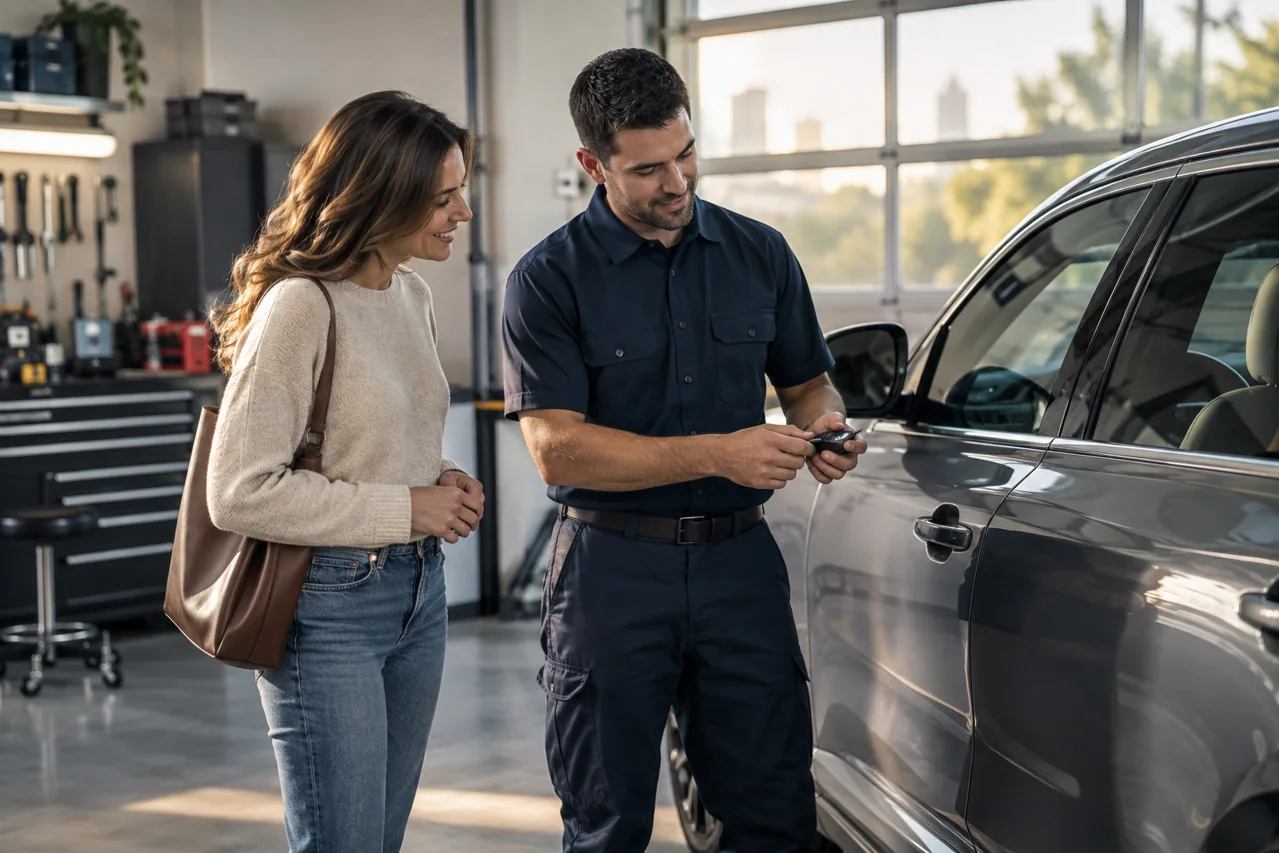
What stuck or phantom buttons look like
Fob trouble comes in several forms, and it helps to name which one you have. A stuck button is one that stays pressed down or returns slowly, so the fob keeps sending a signal. A mushy button needs several presses before the car responds. A phantom button seems to press itself: the doors unlock while the keys sit in your pocket, the trunk opens on the way to the store, or the alarm sounds with nobody near the car.
Each of these behaviors has a different set of likely causes, though they overlap. A stuck button often comes from a swollen or sticky rubber pad. A mushy button usually means a worn pad or a dirty contact. Phantom activations tend to come from pressure on the case, a failing circuit board, or a button that has partly collapsed and now touches its contact all the time.
Whatever you are seeing, the behavior matters for security and for the car. A fob that keeps transmitting can unlock your vehicle while you are away from it, which leaves valuables exposed. It can also run the fob battery down quickly, which leaves you with a dead remote at the worst time. Treat it as a repair to schedule, not something to live with.
Worn pads and aging rubber
Most fobs use a rubber or silicone button mat with small carbon pills on the underside. When you press a button, the pill touches a pair of contacts on the circuit board and completes the circuit. Over thousands of presses the carbon wears away and the rubber loses its spring. The result is a button that needs hard presses, sticks halfway, or never fully releases.
Heat and sunlight accelerate this. A fob left on a dashboard or in a hot car through a Houston summer will have its rubber dry out, harden or turn tacky. Some rubber breaks down into a sticky film that you can feel on the surface. The printed symbols on the buttons may wear off at the same time, which is a visible clue that the pad has seen a lot of use.
Replacing the pad is sometimes possible, and sometimes the whole shell is easier to swap. A technician can tell by looking at the fob. If the circuit board is healthy, a new shell with a fresh button mat can make the fob feel like new, and the original electronics and chip are kept, so the key does not need to be programmed again in many cases. See key fob shell repair for how that works.
Dirt, lint and sticky spills
Pockets, purses and cup holders are not clean places. Lint, sand, sugar from a soft drink, coffee, sunscreen and hand lotion all find their way into the gaps around a fob's buttons. Once inside, they can glue a button down, interfere with the contacts, or create a bridge across the board that acts like a permanent press.
If a drink spilled on the fob, treat it seriously. Sugary liquids dry into a film that is hard to remove and that keeps attracting moisture, and the contacts underneath can corrode over days or weeks. Our page on key fob water damage covers what to do right after a spill and why speed matters.
For light dirt on the outside, a dry soft cloth or a lightly dampened one is fine. Do not soak the fob. Do not run it under a tap. Do not use harsh solvents that can soften the plastic and the rubber. If the button still sticks after wiping the surface, the problem is probably inside the case, and that is a job for someone who can open it without damaging the board.
Battery drain caused by a button that will not release
A button that stays partly pressed keeps drawing small amounts of power. A coin cell that should last a long time may run flat in a few weeks. If you are replacing the battery again and again, that is a strong hint that a button is stuck, a contact is shorted or the board has a fault.
A weak battery can also create confusing symptoms of its own. As voltage drops, some fobs behave erratically: they respond slowly, work only at close range or send an unreliable signal. People sometimes read that as a stuck button when the real fix is a fresh cell. It is reasonable to replace the battery first if the case opens easily and the cell type is marked inside.
If a new battery fixes the symptoms for a day or two and then they return, the root cause is not the battery. Look for a button that does not spring back, or ask a technician to inspect the board. For routine replacement see key fob battery replacement, and for a fob that has stopped working altogether see key fob stopped working.
Phantom unlocks and trunk openings in pockets and bags
Some of the most annoying cases are the ones where the fob presses itself. A fob in a tight pocket or a crowded bag can have a button held down by keys, a phone, a wallet or the pressure of sitting. On many vehicles, pressing and holding certain buttons performs a function: the panic alarm, the trunk release, the windows lowering, or a remote start.
If this keeps happening, check whether the buttons sit proud of the case. A fob that has lost the raised lip around its buttons is easier to press by accident. Some owners use a thin silicone cover to guard the buttons, which works if the cover is sized correctly and does not itself press on a button.
Also consider the vehicle side. A fob that works properly in one place and triggers actions in another may be affected by something else in the area. But the usual explanation is mechanical: a button with a worn mat that now stays slightly depressed, or a case that has been squeezed and warped. Sorting out which one you have is exactly what a technician does at the fob.
What you can safely try yourself
Start with the least invasive steps. Wipe the outside of the fob with a dry cloth. Press each button several times, slowly and firmly, to see whether a sticky film loosens. If your fob has a small mechanical key blade, remove it and make sure it is not catching on the buttons inside the case.
If the case has a clear seam and a slot designed for opening, you may be able to open it with a plastic tool and replace the coin battery. Note the orientation of the cell before you remove it. Take a photo of the interior before you touch anything. Keep small parts on a clean tray so they do not roll away. If the case is sealed, glued or screwed in a way you do not recognize, stop there.
Avoid these common mistakes:
- Do not use water, alcohol soaked cloths or spray cleaners inside the case.
- Do not bake, microwave or dry the fob with a heat gun or hair dryer.
- Do not press the buttons repeatedly while standing near the car if you suspect a stuck signal, since it can repeat actions you did not intend.
- Do not pry hard at a seam; cracked plastic can pinch the board and add a new fault.
- Do not buy a random replacement shell without checking that it matches your fob's exact model.
What a technician looks for inside the fob
Once the case is open, the diagnosis is visual and straightforward. The technician checks the battery and its contacts for leakage or green deposits. The button mat is examined for tackiness, tears and worn carbon pills. The circuit board is inspected under good light for residue, cracked solder joints or traces that look burned. The chip, which is usually a small component attached to the board or embedded in the key blade area, is checked to see if it is intact.
Then the fob is tested. The technician can often read the signal it sends, which shows whether it transmits when no button is pressed. If it does, the board or a button contact is at fault. If it does not and the buttons simply feel poor, the mat is the likely cause.
The findings lead directly to a repair path. Dirt can be cleaned. A worn mat or case can be replaced. A damaged board may mean a replacement fob. Because every fob model is different, the technician can explain which parts of your key can be reused. Details on what is possible are in our pages on key fob programming and smart key replacement.
Case swap, repair or full replacement
There are three realistic outcomes. The first is cleaning and a battery: the fob works again after the technician removes a sticky film, cleans contacts and fits a fresh cell. This works when the electronics are fine and the buttons are only dirty.
The second is a shell or mat swap. When the plastic is cracked, the rubber is worn or the fob has lost its button symbols, the internal board can be moved into a new housing. The result looks and feels new. Whether the key needs reprogramming afterward depends on the system. In many cases it does not, since the chip and board stay with the key, but the technician will test every function before leaving.
The third is a new fob. If the circuit board is corroded, the buttons are failing electrically, or the fob has been through water, replacement is often more reliable than patching. A new fob is cut if needed, programmed to the vehicle and tested. Ask whether the old fob will be removed from the car's memory, since a fob that behaves erratically is better off no longer authorized. Quotes are given only by phone, and the service call charge is explained before dispatch.
Security considerations for a misbehaving fob
A fob that sends signals on its own is a security concern as well as an annoyance. If it unlocks your car while you are in a store, anyone nearby could open the door and take items. If you often park in a busy lot, a bag left on the seat is a target. Until the repair is done, consider keeping the fob away from pressure, and lock the car with the mechanical key blade if your vehicle allows it.
Keep in mind that a fob in a pocket can also activate the alarm or the remote start at awkward moments. On some models, a remote start with a stuck button can run the engine while the car sits in a closed garage. That is a real safety issue. If your fob has ever started the car without you meaning to, stop using it until it is inspected, and never leave a vehicle running in an enclosed space.
For general advice on protecting your key signal, see our guide on relay attack protection. It covers a different threat, but the habits around where you keep a fob at home overlap.
Preparing for the call and the visit
When you call, describe the behavior in plain words. Say whether the buttons stick, feel soft or press themselves. Mention when it started, whether anything was spilled on it, and whether the battery has been changed lately. The more precise you are, the more accurately the dispatcher can plan the visit.
Have the vehicle make, model and approximate year ready, along with the identification number if you can read it through the windshield. Keep every key you have available, including spares, because the technician may use a working key as a reference. Bring photo identification and registration or title, since proof of ownership is required before a key is programmed. If the car is parked in a garage or gated lot, arrange access in advance.
Do not worry if the fob looks scruffy. Technicians see worn, cracked and sticky fobs all the time. What matters is whether the board and chip inside are healthy, and that is determined with the right tools in a few minutes.
Habits that make a fob last longer
Treat the fob as a small electronic device. Keep it out of hot cars, away from damp pockets and off the dashboard. Avoid hanging a heavy bunch of keys from it; the weight stresses the key ring hole and the case seams. Consider a thin cover that protects the buttons from accidental presses, and make sure it does not hold a button down.
Keep a spare in a safe place and test it from time to time, so that you have a working backup while the main fob is being repaired. Replace the battery when the remote range starts to shrink, not when it fails completely. Wipe the fob now and then, and never let a spill sit.
If your fob is already sticking, acting on its own or draining batteries, the best time to fix it is before it fails completely. Call and describe what is happening. We will explain what the technician will check, arrange a visit and make sure the fob works properly again.
Questions people ask
Why does my fob unlock the car by itself in my pocket?
The most common reason is a button being held down by pressure from other items or by a worn pad that no longer springs back. A worn or swollen rubber mat can also leave a button slightly pressed all the time. A technician can open the fob, check the pads and the board, and recommend a fix.
Can I clean a sticky fob with water or alcohol?
It is best not to. Liquids can get inside the case and corrode the circuit board, and strong solvents can soften plastic and rubber. A dry or very lightly dampened cloth on the outside is fine. If the buttons are still sticky, have the case opened and cleaned properly by someone with the right tools.
My fob battery dies every few weeks. Is that normal?
No. A healthy coin cell usually lasts far longer. Frequent drain suggests a button that stays slightly pressed, a shorted contact or a faulty board. Replacing the cell again will only repeat the problem. A technician can inspect the fob and find the cause.
Do I need to reprogram the fob if the case is replaced?
Often not, because the board and chip move into the new shell and keep their identity. It depends on the key system, so the technician tests all functions after the swap. If anything does not respond, programming can be done in the same visit.
Is a fob that sends signals on its own a safety risk?
It can be. It may unlock the car while you are away, sound the alarm, or on some models start the engine remotely. Never leave a running vehicle in a closed garage. Stop using the fob until it is inspected, and call so a technician can repair or replace it.
Will the locksmith ask for proof that I own the car?
Yes. Expect to show photo identification and a registration, title or similar document that ties you to the vehicle. This is a normal safeguard before any key is programmed. If the car belongs to an employer, bring an authorization letter.
Describe the situation by phone and we will tell you what the job involves. Quotes are given by phone. Jobs that cannot be quoted without seeing them need a technician on site, and the service call charge is explained on the phone before anyone is dispatched.
(713) 574-7660Related pages
Written by Claude (AI) (AI) for Houston Car Key Locksmith.