What programming means and why it is needed
A car does not accept just any key. Each vehicle keeps a list of the keys it has been taught to recognize, and it refuses to start for a key that is not on the list. Programming is the process of adding a new key to that list, or replacing the list with a new one. Without programming, even a perfectly cut key with the right chip type will not start the engine.
Programming can also cover the remote. The buttons that lock and unlock the doors send coded signals that the car has to recognize, so the remote usually needs to be paired as well. On many cars, the key and the remote are programmed in the same session. On others, they are two separate steps.
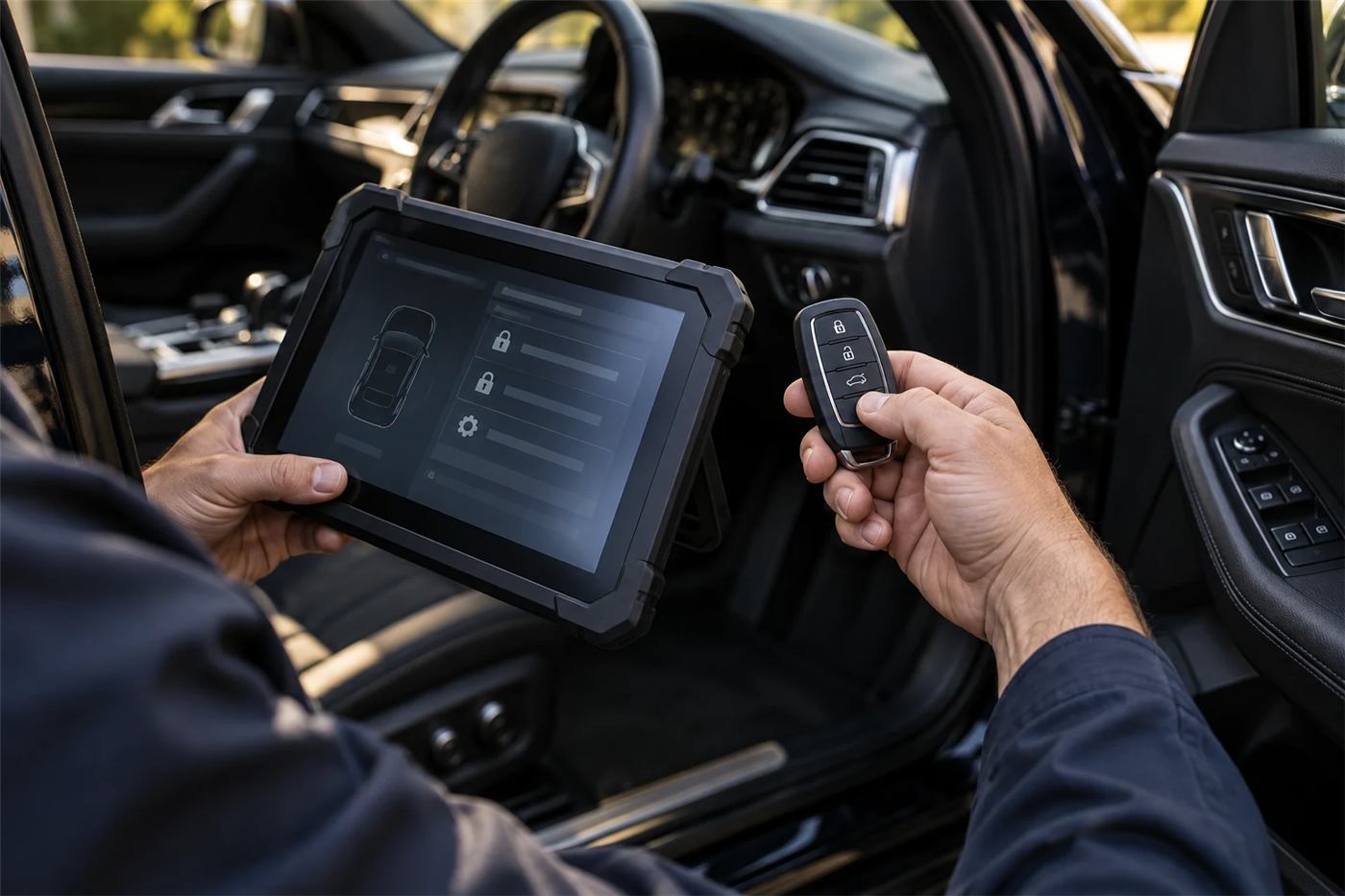
All of this is done by a technician with equipment that can communicate with the vehicle. The equipment reads information from the car, sends commands to it and confirms the result. The overall process is routine for a trained professional, but it is specific to each make and sometimes to each model, and that is why a technician asks careful questions before starting.
Step one: confirming the vehicle and the owner
The first step is not technical. It is confirming that the person asking for the key is entitled to have it. The technician checks photo identification and proof that you own the vehicle or are authorized to use it, such as registration or title. This protects owners, because a replacement key is as powerful as the original.
The technician also notes the make, model, approximate age and the vehicle identification number. These details determine which key type, which tools and which procedure apply. Two cars of the same make and model can differ by trim and production date in ways that change the programming steps.
If any of these checks cannot be completed, a responsible technician will not proceed. That may feel frustrating in the moment, but it is a protection for every owner, including you. Our guide on proof of ownership for keys explains what to bring.
Step two: connecting to the diagnostic port
Almost every modern car has a diagnostic port, a standard socket usually found under the dash on the driver side. It is the same port used by mechanics to read fault codes. The technician plugs equipment into this port, and the equipment begins a conversation with the vehicle computers.
The first thing the equipment does is identify the car and read its status. It can see which computers are present, whether the security system is active and, on many vehicles, how many keys the car currently knows. This information shapes the next steps. For example, it tells the technician whether the car is in a normal state or whether a security lockout has been triggered by earlier failed attempts.
A healthy car battery matters at this stage. Programming equipment draws power, and the vehicle computers need steady voltage. A technician may connect a small power supply to keep voltage stable during the job. If the car battery is weak, programming can fail or leave the car in a confused state, and a careful technician will check the battery first.
Step three: the security handshake
Cars protect their key lists. To add or change keys, the equipment must prove to the vehicle that it is allowed to do so. This exchange is sometimes called a security handshake or authorization. Depending on the make, it may use a code tied to the vehicle identification number, a code supplied by the manufacturer through an authorized channel, or a procedure that requires an existing key to be present.
On some cars, the process is quick. On others, it includes a waiting period during which the vehicle will not accept further commands, often measured in minutes. This waiting period is a deliberate security feature, and a technician simply waits it out. It is not a sign that anything has gone wrong.
On certain models, the handshake requires access that is controlled by the manufacturer, and not every technician can complete it. That is why we are honest on the phone when a model may need a dealer. A technician who says yes to everything without asking questions may not be telling you the whole story.
Step four: learning modes, adding versus replacing
Once the equipment is authorized, the car is put into a mode that allows it to learn a new key. There are two broad approaches. In the first, the new key is added to the existing list, and the old keys keep working. In the second, the list is wiped and rebuilt, and every key that should work, including existing ones, must be presented during the session.
Adding is simpler when you still have a working key and want a spare. Replacing is common after a loss, because a technician may choose to erase the lost key so that it cannot be used. In that case, all keys you want to keep must be programmed in the same session, which is why you should bring every key you have.
Some cars limit the number of keys they can learn, so there may be a maximum. Others need a specific sequence, such as turning the ignition on and off a certain number of times, or pressing a button on the key at a certain point. The technician handles those details.
Step five: pairing the remote and any extras
After the chip is accepted, the remote functions are paired. The technician teaches the car to recognize the remote code so that the lock, unlock, trunk and panic buttons work. On cars that have remote start, that function may need its own pairing or a check.
Smart keys include extra features. Proximity unlocking, trunk release by foot motion or by button, and memory settings for seats and mirrors may all be tied to the key. A replacement key may start with default settings, so you may need to set seat and mirror positions again. This is normal and not a sign of a problem.
If the car has a key-linked feature that you rely on, such as a personalized driver profile, mention it on the phone. The technician can tell you what the new key will and will not carry over, so there are no surprises after the visit.
Step six: testing every function
A job is not finished when the equipment says it is. A careful technician tests the key as an owner would use it. That means unlocking and locking the doors from outside, opening the trunk or hatch, starting the engine, driving the car a short distance if safe, turning it off and starting it again. On smart key cars, testing includes unlocking by the door handle and starting with the fob in different places inside the car.
The technician also looks for warning lights or messages on the dash. A security light that stays on after programming is a sign that something is not quite right. If the car has other keys, each is tested to make sure the session did not disturb them.
You should expect a clear explanation at the end. The technician should tell you how many keys the car now knows, whether any lost keys have been erased, and whether anything else needs attention, such as a weak car battery or a worn ignition. If you want to understand the result, ask.
- Verify the owner and the vehicle.
- Connect equipment to the diagnostic port.
- Complete the security handshake.
- Put the car into a learning mode and add or replace keys.
- Pair the remote and any extra functions.
- Test every function and explain the result.
What can go wrong and why caution matters
Programming looks simple from the outside, and that appearance leads some owners to try it themselves with inexpensive devices. Mistakes can have real consequences. A failed attempt can trigger a security lockout, corrupt data in a control module or leave the car unable to start. Some of these problems require expert repair.
Another risk is a poor-quality key. A key that is the wrong frequency, the wrong chip type or a low-quality copy may appear to program and then fail later, or may not program at all. Using the right blank from the start saves time and avoids a second visit.
We do not give instructions for bypassing or defeating vehicle security systems. If you are curious about how programming works, ask a technician to explain it. If your car refuses to start after a failed attempt, do not keep trying. Repeated attempts can lengthen a lockout. Call for help and describe what happened.
Examples of how the same steps play out in real situations
Picture a family with a pickup truck that has one key left after the other went missing at a job site. They still have a working key, so the technician can add a new one without erasing anything. The visit is short: ownership is confirmed, equipment is connected, the new key is added, the remote is paired and everything is tested. The family leaves with two working keys and a better plan for where to keep the spare.
Now picture a driver whose only key was in a purse that was stolen. There is no working key, and there is a real concern about who might hold the missing one. The technician connects to the car, completes the security steps, rebuilds the key list with the new keys only and confirms that the stolen key no longer starts the engine. The job takes longer, and the owner is also advised to consider a police report and to have the door locks checked if the vehicle supports it.
Finally, picture a used car bought with a single key and a note saying a spare is somewhere in a drawer. The technician finds that the spare in the drawer was never programmed to the car. Programming it during the visit turns an unknown object into a working spare, which is often the most economical outcome of all. The steps are the same in each case, but the choices made within them differ, and that is why a conversation on the phone comes first.
Planning your own programming visit
To get the most from a visit, prepare a few things. Gather all the keys you have, working or not, because they help the technician identify the system. Have identification and proof of ownership ready. Know the vehicle identification number. Park the car where the technician can reach it and where it is safe to work, and tell us if it is in a garage or gated area.
Decide beforehand how many keys you want. Adding a spare during the same visit is simpler than returning later, and the quote can cover it. Our page on key fob programming and the one on transponder key programming explain what is involved.
Quotes are given only by phone, and a service call charge is explained before a technician is dispatched. Complicated jobs may need an on-site visit first. When you are ready, call the number on this page, describe your car and ask any questions. We would rather answer them before the visit than after.
Questions people ask
What does it mean to program a car key?
It means teaching the car to recognize a new key. The technician connects equipment to the diagnostic port, completes a security check and puts the car in a learning mode so the new key is added to the list the car accepts. The remote buttons are also paired. Without programming, a new key will not start most modern cars.
Does programming a new key stop my old keys from working?
Not necessarily. Adding a key leaves existing keys working. Replacing the key list erases keys that are not presented during the session, which is useful after a loss. Tell the technician which keys you want to keep, and bring every key you have, so none are erased by accident.
Why does programming sometimes include a waiting period?
Some vehicles require a delay during the security process, often several minutes, before they accept new commands. It is a deliberate feature that slows down unauthorized attempts. A technician simply waits it out. A delay by itself does not mean something has gone wrong with the job.
Can I program a key myself with a device I bought online?
It is possible on a few older vehicles, but we do not recommend it for most cars. Errors can lock out the security system or leave the car unable to start, and some faults need expert repair. Cheap devices and low-quality keys are a common source of problems. A technician can do the work safely.
Why do I need to show identification?
A replacement key has as much power as the original, so technicians confirm that you own the vehicle or are authorized to use it. This protects every owner, including you. Bring photo identification and registration or title, and for company vehicles, paperwork showing your authority.
How do I know the new key works properly?
A careful technician tests everything: door locks, trunk, remote buttons, starting and stopping the engine, and any smart key features. They also check the dash for warning lights. Ask for an explanation of what was tested and how many keys the car now knows before the technician leaves.
Describe the situation by phone and we will tell you what the job involves. Quotes are given by phone. Jobs that cannot be quoted without seeing them need a technician on site, and the service call charge is explained on the phone before anyone is dispatched.
(713) 574-7660Related pages
Written by Claude (AI) (AI) for Houston Car Key Locksmith.