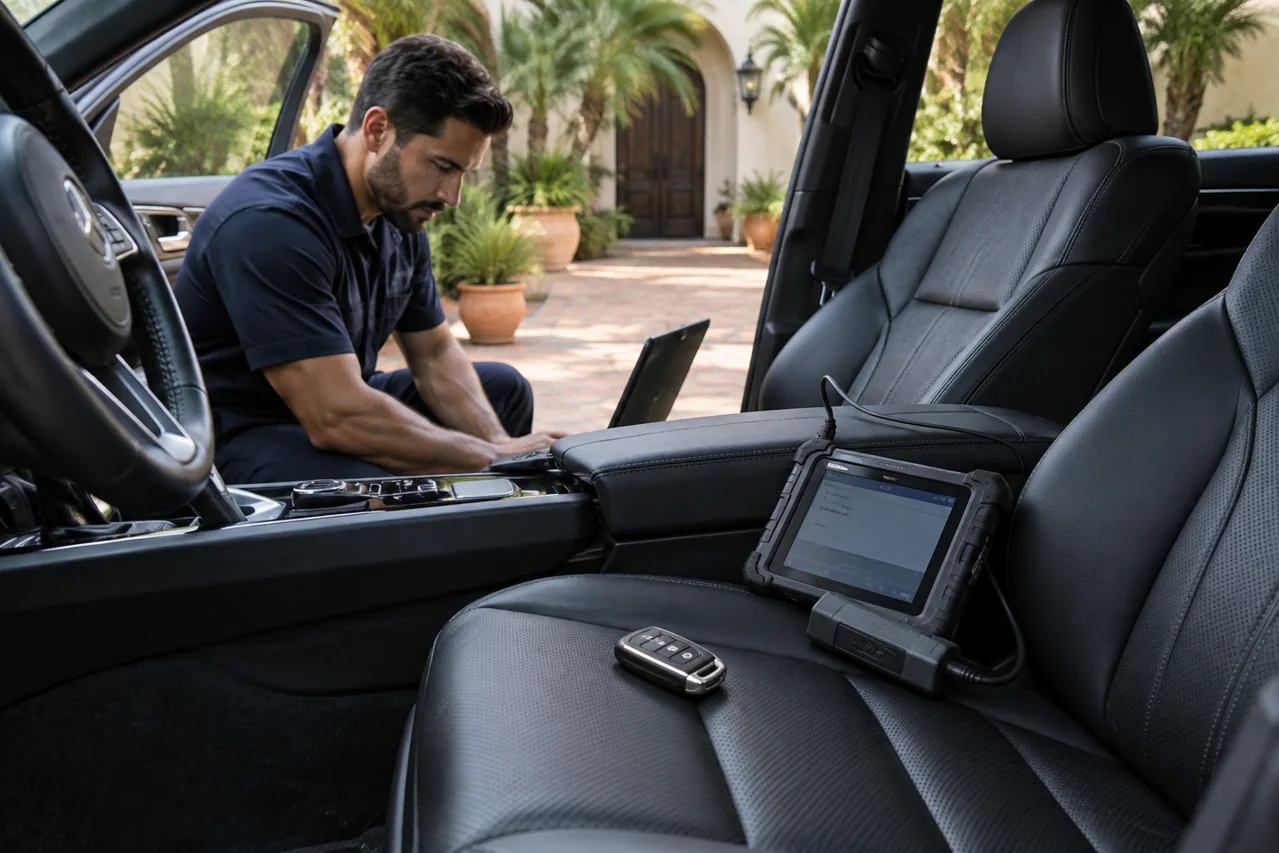
A retail and residential crossroads
The Willowbrook area, in northwest Houston near Highway 249 and FM 1960, is known for its large shopping center, its nearby restaurants and stores, and the many apartment communities that fill the streets around them. It is a place where people shop, work in retail, eat out and live, often all within a few miles. Traffic is heavy on weekends and during holiday seasons, and parking lots are large.
That setting shapes the key calls. Shoppers carry bags, push strollers and juggle phones, and a key can slip away without a sound. Retail and restaurant workers arrive for shifts, put their keys in a locker or a bag, and leave long after dark. Apartment residents park in shared lots where a car may be far from the front door.
Below, we describe the common situations, the safe first steps, and the way a mobile technician works in a big lot or an apartment complex. We do not publish any method for defeating a lock, and nothing here replaces a conversation with a technician who can see your vehicle.
The big lot problem: where did I park?
Before you decide the key is lost, make sure you are looking at the right car. In a large retail lot, many vehicles share a color and a shape, and people sometimes walk to the wrong row. Look at the entrance you used, the light pole numbers and the store you visited. Press the lock or panic button on your fob and listen, since the car may answer from a distance.
If the fob does not respond, the key may be lost, or the battery may be weak, or you may be out of range. Walk toward where you think the car is, and try the button again. If you can see the car and the fob does nothing, check whether the vehicle's lights respond when you use the physical key in the driver door.
A frequent cause of confusion is a car that has been moved or towed. If your vehicle seems to be gone, do not assume theft right away. Check signs for tow notices and call the property office. If you believe the car has been stolen, call the police. This is separate from a lost key, and it needs a different kind of help.
Retracing your steps through a mall
Keys in a shopping area are lost in predictable places. They are left in fitting rooms, set down on a food court table, dropped beside a stroller, or put into a shopping bag that later goes into a trunk. A key left on a counter at a store is a common finding for staff.
Walk back through the stores you visited, starting with the last one. Ask the staff at the register. Many stores and shopping centers keep a lost and found at a customer service desk, and a polite description of the key and its keychain helps. Ask staff to hold the item if it turns up, and leave a phone number only with a person at a staffed desk.
Check the places where you sat to eat or rest. Check the restroom. Check the car, since some people lock the key in the vehicle after loading bags and walking away. If the key is visible inside the vehicle, you have a lockout, not a lost key, and that is a different job. See keys locked in the car.
- Check the last store you visited first, then work backward.
- Look inside shopping bags and under items you set down.
- Press the fob buttons as you walk, in case the car responds.
- Ask at the customer service desk about found items.
- Look inside the car through the window for a key on a seat or console.
Apartment communities and shared lots
Apartment communities around the area are home to a large share of residents, and their parking lots bring their own challenges. Cars are parked in numbered or open spaces, sometimes at a distance from the unit. Lots may be gated, and permit systems may restrict visitors. A technician arriving at a complex needs to be let in, and needs somewhere safe to work.
If you rent, tell us the complex name, the gate method and the location of your car. If the property office has rules about outside service vehicles, check them. Some complexes prefer that vendors check in at the office. A short call can save a long wait at a gate.
Roommates who share a car are in a tough spot: one key, several drivers, a high chance of loss. Agree on who owns the car and who holds the paperwork. If you rely on a vehicle for work, a spare is not a luxury. See spare car key duplication for what the process involves.
Retail workers and late shifts
People who work at the stores and restaurants in the area often park in employee lots at the edge of a property, which are less lit and further from the building. After a closing shift the lot is quiet, and a missing key becomes a safety question, not just an annoyance.
If you cannot find your key at the end of a late shift, do not wander an empty lot alone. Ask a manager or a coworker to walk out with you. If you feel uneasy, stay inside until a ride arrives. If anything seems threatening, call 911 first. A key can be replaced tomorrow.
Lockers and break rooms are the usual hiding places for keys. Check your locker, the break room table and your coat. Ask a coworker whether they saw you set the key down. When you call a technician, give the exact location of the vehicle, including the name of the store it sits behind, so that we can describe the way in. Employee lots sometimes have a separate entrance.
What kind of key do you have, and why it matters
Vehicles around this area range from older compact cars to late-model SUVs and pickup trucks. The key type shapes the job. A simple metal key with no chip can be cut without programming. A transponder key needs both cutting and programming. A smart key or push-button fob needs programming and sometimes a more involved process.
If you are not sure which type you have, look at the key. Is there a plastic head with a visible blade? Is it a flip key that folds out? Is it a fob with buttons and no blade, or a small blade hidden inside? Does your car start with a key turn or with a button press? Describe what you see when you call.
Our page on transponder key programming explains the chip, and our page on push-button start keys explains the smart system. The guide how car keys work covers the basics in plain language.
Proof of ownership and what to bring
A technician must confirm that the person asking owns the vehicle or has permission. This is a safety measure. If anyone could request a key for any car, the car would not be safe. Have your photo identification ready, along with a registration, title or insurance card showing the vehicle.
If the car belongs to a relative, a friend or an employer, the registered owner may need to confirm by phone or send a photo of the registration. If the vehicle is a rental, the rental company has its own rules. For a vehicle in a business name, an authorized person must approve the work.
If your documents are in the car, tell us. A photo of your registration on your phone often works. The more you can show, the faster the process moves. See proof of ownership for keys for the full explanation.
- Photo identification.
- Registration, title or insurance card showing the vehicle.
- The vehicle identification number.
- Make, model and year, and the number of keys you have ever had.
- Exact location, including lot name, store name or apartment gate.
Heat, rain and the lot after a storm
Parking lots in Houston heat up fast. A black asphalt lot in August is hot enough to affect a fob that sits on a dashboard. Plastic cases can warp, and batteries can weaken. If your fob began to act up after a hot day, move it somewhere cool and test it again after it returns to normal temperature.
Sudden storms create their own trouble. A fob in a wet pocket or a bag with a leaking drink can stop working. Dry it thoroughly before testing and try a fresh battery. If water has gotten into the fob, it may not recover, and a replacement may be needed. See key fob water damage.
In heavy rain, flooded parking areas can strand cars. If your car has stood in water, do not try to start it, because water in the engine or the electronics can cause damage. Our guide on flood damaged vehicle keys offers more information.
Parents, strollers and keys in the wrong hands
Families with small children make up a large part of the shopping crowd, and children love keys. A fob handed to a toddler to keep them calm often ends up in a stroller basket, a diaper bag or a gap between seat cushions. A fob chewed or dropped in a puddle may not work later.
If a child has had your key, check the stroller, the car seat, the diaper bag and the floor of the car. Look under the seats. Check the pockets of any jacket that was draped over the stroller handle. Keys in this situation are rarely gone for good, but they can hide well.
A related concern is a child locked in a vehicle. If a child or a pet is inside a locked car, especially in the heat, call 911 at once. Do not wait for a locksmith. Emergency services can act immediately. For what to do and what not to do, see child locked in car.
To prevent the problem, keep the key out of a child's reach and never leave the fob inside a car with a child when you step out, even briefly. A spare key kept at home helps if the original is lost during a busy family day.
Holiday seasons and the crowded calendar
Retail areas swell during the holidays, with more cars, more bags and more distraction. A shopper with an armful of gifts is more likely to set a key on a counter or drop it into a bag. A driver who is in a hurry is less likely to check the pockets before leaving a store.
Plan for this by choosing a single place for your key and using it every time. Many people clip the key to the inside of a bag, or keep it in a zipped jacket pocket. If you carry a fob that must stay near the car to start it, be careful not to give it to a child to hold or to set it in a shopping cart.
Parking far from the entrance is common during busy weeks. Note your row and take a photo of a nearby light pole. If you lose a key during a rush, stay patient, check the obvious places and call if it does not turn up.
Quotes, service call charges and the phone call
We give quotes only by phone. The cost depends on the key type, the vehicle, whether a working key remains and where you are, so a printed number would not be honest. When you call, we ask for the vehicle details and a description of the situation. You hear the quote before anyone is dispatched.
Simple jobs can be quoted entirely over the phone. Complicated jobs, such as an unusual security system or a damaged ignition, may need an on-site visit before a final quote. There is a service call charge for the technician to come to you, and it is explained before dispatch.
We do not promise arrival windows or availability at every hour, and we say what is realistic for your location. If you are comparing providers, ask what the service call charge is and what it covers. Our guide on questions to ask before booking has a full list.
Simple habits for a busy part of town
Most key calls from this area could be avoided with small habits. Keep a spare at home. Replace a weak fob battery before it fails. Take a photo of your parking spot. Keep your key in a zipped pocket instead of a loose bag. Consider a tracking tag that rings or shows a map location. Our key tracking tags guide explains what they can and cannot do.
If you are in a large lot and cannot find your key, do not panic. Stay safe, check the obvious places and gather your documents. Then call and describe the situation. We will ask for the vehicle details, give a quote by phone and explain what happens next.
Whether the problem began in a department store, a restaurant or a stairwell outside your apartment, the steps are the same: we come to the vehicle, confirm ownership, prepare the key and program it. Call when you are ready, and we will walk you through it.
Questions people ask
Can you come to a mall or store parking lot?
In general yes, because the work is done at the vehicle. Tell us the lot, the store you are near and any lot rules you know about. Large lots can be confusing, so give a landmark such as a store entrance. We do not promise arrival windows, but we will say what is realistic for your location.
My fob does nothing in a big lot. Is the key lost?
Not necessarily. You may be out of range, the battery may be weak, or you may be at the wrong car. Walk closer and try again, then try the hidden mechanical blade in the driver door. If the fob still does nothing, call and describe what happens. A technician can tell whether it needs a battery or reprogramming.
I live in an apartment complex. Does that change anything?
It can affect access. Gated lots and permit parking may require your help to let the technician in, and some properties limit outside vendors. Tell us the complex name, the gate method and where your car is parked. If you rent, check your lease or ask the office about service vehicles.
What if my key was in my work locker and I cannot get in tonight?
Ask a manager whether the locker can be opened. If it cannot be reached, a new key can often be made at the vehicle once ownership is confirmed. Do not wander an empty lot alone. Stay near the building or arrange a ride, and call us to schedule the key work for a time that is safe.
Do you need my documents before making a key?
Yes. A technician must confirm that the vehicle is yours or that you have the owner's permission. Bring photo identification and a registration, title or insurance card showing the vehicle. A photo of the registration on your phone often helps. If the car is not in your name, the owner may need to confirm by phone.
How do I get a quote for a key near Willowbrook?
Call and describe the vehicle, the key type and your location. Quotes are given only by phone, and a service call charge is explained before dispatch. A complicated job may need an on-site visit before a final quote. Have the make, model, year and vehicle identification number ready to speed up the call.
Describe the situation by phone and we will tell you what the job involves. Quotes are given by phone. Jobs that cannot be quoted without seeing them need a technician on site, and the service call charge is explained on the phone before anyone is dispatched.
(713) 574-7660Related pages
Written by Claude (AI) (AI) for Houston Car Key Locksmith.