Why a fob can fail so suddenly
A key fob is a small radio transmitter with a battery, a circuit board, a set of button contacts and, in many designs, a transponder chip. When it stops working, it can look as if everything failed together, because from the outside there is no sign of which part gave up. In practice, the failure is almost always in one place, and the symptoms give you clues.
A fob that fails completely and instantly, with no light and no response, often points to power. A fob that works from close range but not from a distance suggests a weak battery or an antenna problem. A fob that works on some buttons and not others points to worn contacts. A fob that works but the vehicle ignores it points to a synchronization or programming problem. A fob that started to act up after a drop, a spill or a swim in a pocket points to damage.
It also matters what the fob does. Two functions are involved on most vehicles. The remote functions, such as lock, unlock and trunk, use a radio signal to the vehicle body. The immobilizer function uses a short range transponder signal so the engine will start. A fob can lose one without the other. A dead remote with a working start function is common, and it is why many people can still drive even when the buttons are silent.
Before panic, check the physical key too. Most fobs hide an emergency blade that opens the driver door and sometimes the ignition on older systems. Knowing the blade is there gives you a way in while you work out the electronic side. Our page on the emergency key blade explains where yours may be.
Start with the battery, the most likely cause
The coin cell battery inside the fob is the most common cause of a dead remote. These batteries have a limited life, and when they get low the symptoms appear gradually: reduced range, a need to press the button several times, a dash message about the key battery, or a vehicle that no longer unlocks as you approach. Then one day it simply stops.
Replacing the battery is a modest job on most fobs. You open the case along a seam or through a small slot, note which way the old battery sits, and replace it with the same type, which is printed on the cell. The risk lies in the details. Pry gently and with the right tool, because a hard pry can crack the case or tear the circuit board. Keep the board clean and avoid touching the contacts with oily fingers. Fit the battery the right way round, since a reversed battery will do nothing. Make sure the contacts are not bent.
If you are uncomfortable opening the case, a technician can do it in moments, and can check the contacts and the case at the same time. Our page on key fob battery replacement explains what is involved.
If a fresh battery does not revive the fob, do not keep swapping cells. Test the new battery in another device if you can, since a bad cell out of the packet does happen. If the cell is good and the fob is still dead, the problem is elsewhere, and the next sections cover it.
A note about timing. Some vehicles need the fob to be re-synced after a battery change, while many do not. If the buttons work but the vehicle does not respond, resynchronization may be the next step.
Water damage and corrosion
Fobs and water do not mix well. A fob that went through the wash in a pocket, fell in a puddle, sat in a beach bag or met a spilled drink can fail immediately or weeks later. Moisture gets into the case through the seam, the battery door and the buttons, and then corrodes contacts and the board.
The signs are familiar. Buttons that feel sticky or do not click, a faint green or white crust where the battery sits, a battery that leaks, or a fob that works intermittently and then dies. If you see crust, the battery may have leaked, and the leaking material damages the board quickly.
What you do in the first hour matters. Remove the battery as soon as you can. Do not press buttons. Do not heat the fob with a hair dryer or leave it in a hot car, since heat can warp the board and drive moisture into parts that were still intact. Let it air dry in a dry, room temperature place. A technician can open the case, clean the board with a suitable solvent and test it, and in some cases revive a fob that looks hopeless.
If the board is badly corroded, a replacement is the practical answer. Often the shell and the buttons can be reused with a new board, or the whole fob replaced, and the replacement is programmed to your vehicle. Houston humidity, hurricane season and flood risk make this a more frequent issue than in dry regions. See our page on key fob water damage for more detail, and our guide to flood-damaged vehicle keys.
Desync and programming problems
Many fobs use a rolling code system. Each press sends a different code, and the vehicle expects the next one in the sequence. If the fob is pressed many times out of range of the vehicle, it can get ahead of the sequence, and the vehicle no longer recognizes it. Children playing with a fob in the house, a fob pressed in a bag or a pocket, or a long period of fob use out of range can cause this.
A desynchronized fob is not broken. It simply needs to be resynchronized with the vehicle. On some vehicles, there is a simple procedure that involves the ignition and the fob. On others, a diagnostic tool is needed. Procedures vary by make and model, and some are not available without equipment, so do not trust a random internet recipe. A wrong procedure on some vehicles can wipe other fobs from memory.
Another cause is a vehicle-side change. A new battery in the car, a computer update or a repair involving the body control module can lose the stored fob data. In that case none of your fobs may work, which is a good clue. If a spare fob also fails, the vehicle side is a suspect rather than the fob.
If you recently bought a used car, the previous owner's fobs may have been removed from the system. If you have a fob that never worked, ask whether the vehicle was ever programmed to it. Our page about key fob programming explains how it works, and the guide on how key programming works offers a plain explanation.
Interference and range problems
Sometimes the fob is fine and the environment is the problem. Radio interference can block the signal between fob and vehicle. Strong transmitters, such as broadcast towers, some parking structures, industrial sites and certain high power equipment, can swamp the fob signal. If your fob does not work in one particular place but works elsewhere, interference is a suspect.
You can test this quickly. Walk to another location, even a few streets away, and try the fob near the vehicle. If it works, the problem is the place. If the vehicle is parked at work, in a dense parking structure or near a radio mast, try again later or from a different position, perhaps closer to the driver door where the antenna sits.
Another cause is a nearby metal object or a phone pressed against the fob. Keep it away from large metal items when you press. A fob in a metal pouch, a purse with a magnetic clasp, or a Faraday pouch will not transmit. If you use a signal blocking pouch to protect against relay theft, remember to take the fob out before expecting it to work. Our guide on the Faraday pouch covers the use.
Weak range can also come from a failing battery, a loose antenna wire inside the fob or a damaged board. If the fob worked only from a few feet before dying, the battery is the first suspect. If range remains short after a fresh battery, the fob may need repair.
Finally, check the vehicle itself. A vehicle with a weak battery can have trouble receiving. If lights are dim and the car feels sluggish, the problem may be there rather than the fob.
Worn buttons and damaged boards
Fobs live hard lives. They are dropped, sat on, kept in pockets with coins and keys and carried for years. The rubber button pad wears through, the conductive carbon under each button wears away, and the contacts on the board stop touching. One button, usually the most used, fails first.
You can sometimes spot this. The button feels mushy, you need to press at a specific angle, or the fob works only if you squeeze the case. A fob that responds to pressure on the case may have a cracked solder joint or a cracked board. This is common after drops and is not fixed by a battery.
A technician can open the fob and inspect it. Worn pads can be replaced in some designs. Cracked solder joints can sometimes be repaired. If the board is damaged beyond reasonable repair, the best answer is to transfer the working parts into a new shell or to supply a new fob. Our key fob shell repair page explains when a new shell fixes a worn fob, which it often does when the electronics are intact but the case is cracked.
If you have a stuck or non-responsive button, see also our page on stuck fob buttons. These are related issues, and the fix may be as simple as cleaning under the pad.
A simple order of checks an owner can do
If none of these steps restore normal function, stop. Do not try to force a reset procedure from the internet, do not open the vehicle's electronics, and do not buy a random replacement without checking it fits. Many online fobs look identical to the original but have the wrong chip or frequency and will not program.
At this point, describe what you tried to a technician and let them take over. The checks you have done are valuable, because they narrow down the cause.
- Try the fob close to the vehicle, near the driver door, and press once with a firm, steady press. Watch for any light on the fob, if it has one.
- Try every button. Note whether none work or only some.
- Try the spare fob if you have one. If the spare works, the problem is your main fob. If the spare fails too, the vehicle side is suspect.
- Check the dash for a key battery warning. Some vehicles show it when the fob is placed in a particular spot or when the engine is started.
- Check the vehicle battery. If the dome light is dim and the dash is weak, the car may be the problem.
- Replace the fob battery with the exact type, being careful with the case. Make sure it sits the right way round.
- Move to a different location to rule out interference.
- Use the emergency key blade to enter, and use the backup start method in your owner manual, such as holding the fob against the start button on push-button vehicles.
When the vehicle will not start with the fob
A fob that no longer opens the doors is an inconvenience. A fob that no longer starts the engine is a bigger issue. On push-button systems, a dead fob battery does not always stop you from starting, because most vehicles have a backup method. Typically you hold the fob against a marked spot on the steering column or center console, or place it in a pocket slot, and press the start button. The vehicle reads the transponder chip at very short range without the battery. Check your owner manual for the exact location.
If the backup method works, you can drive and then address the battery. If it does not work, the transponder chip may be damaged, the fob may not be programmed to the vehicle, or the vehicle antenna may have a fault. A flashing security light on the dash points to the immobilizer. Our page on the flashing security light explains what the light patterns can mean.
If you are stranded, a mobile technician can program a replacement at the vehicle, which avoids a tow. For vehicles that have lost all keys, a different process applies, covered on our all keys lost page.
Whatever the case, try not to keep cranking and pressing. Repeated attempts will not help, and they may drain the vehicle battery. Take a breath, check the dash for messages, and use the order of checks above.
What a technician does and how to prepare
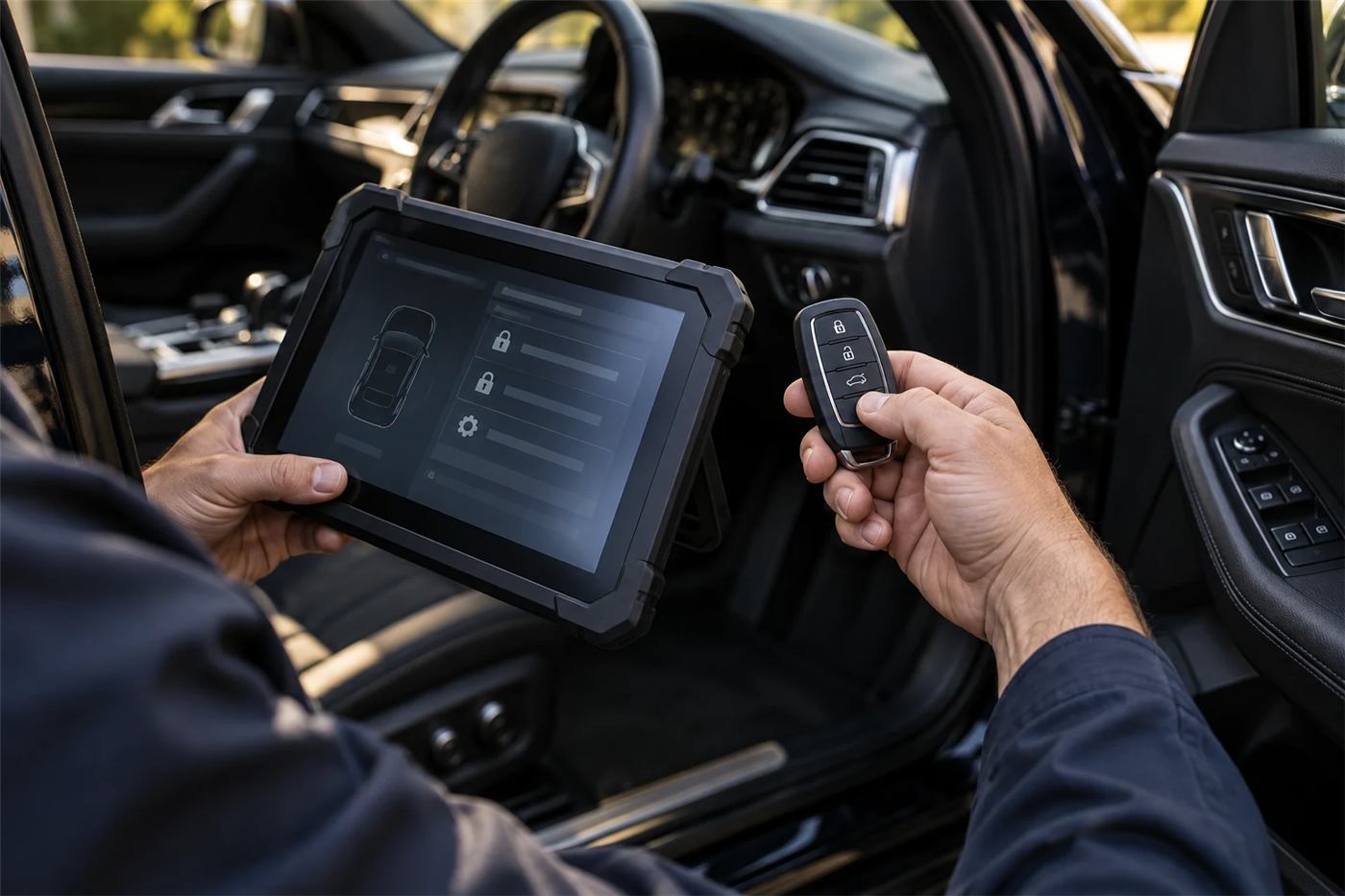
A technician arriving for a fob problem will first confirm the symptoms, then test the fob with a diagnostic device that reads its signal and chip. This quickly shows whether the fob transmits, whether the chip is readable and whether the battery voltage is adequate. Then the vehicle side is checked, including the receiver and the stored fob list if the tool allows.
Depending on the result, the fix may be a battery, a cleaned board, a new shell, a resynchronization, a new fob programmed to the vehicle, or a repair on the vehicle receiver. You will be told which and why.
To prepare, have the make, model and year, the vehicle identification number, any spare fobs and the original fob even if damaged. Note what happened before the failure: a drop, water, a new battery, a repair visit. Have identification and proof of ownership ready, since any new fob needs authorization.
Quotes are given by phone. If your description allows a quote, you will hear it before dispatch. If it does not, an on-site visit is required, and the service call charge is explained on the phone before anyone is sent. Our guide to how quotes work for key jobs explains why.
A final point: keep the old fob, even if it is dead. It may carry a chip or a shell that is useful, and it helps the technician identify the exact type. When you are ready, call and describe what your fob is doing.
Questions people ask
Why did my key fob stop working with no warning?
Sudden failures usually come from a depleted battery, water damage, a cracked board after a drop or a desynchronized rolling code. Check the battery first, then try a spare fob. If the spare works, the original fob is at fault. If neither works, the vehicle side may have a problem that needs diagnosis.
Will changing the battery fix a dead fob?
Often, yes, since the coin cell is the most common cause. Use the exact type printed on the old cell, fit it the right way round and open the case gently. If a fresh battery does not help, the fob may be damaged, desynchronized or not recognized by the vehicle, and it needs testing.
Can I reprogram a fob myself?
Some vehicles have an owner procedure involving the ignition and fob, but many need a diagnostic tool. Procedures vary by make, model and year, and a wrong attempt can erase other keys from memory. Check your owner manual for a documented procedure, and if there is none, ask a technician.
Can I still start the car if the fob buttons are dead?
Often yes. The immobilizer chip works without the battery at very short range on many vehicles. On push-button systems you typically hold the fob against a marked spot and press start. Check the owner manual for your vehicle. If it still will not start, the chip, antenna or programming may be the problem.
Does water damage always mean a new fob?
Not always. If you remove the battery quickly and let the fob dry, a technician may be able to clean the board and restore it. Corroded boards or leaked batteries can be beyond repair, in which case a new board or fob is needed. Avoid heat or pressing buttons while it is wet.
How do I know if it is the fob or the car?
Try a spare fob. If the spare works normally, the first fob is the problem. If both fail in the same way, the vehicle receiver, vehicle battery or stored fob data may be at fault. Also test in a different location to rule out radio interference around your usual parking spot.
Describe the situation by phone and we will tell you what the job involves. Quotes are given by phone. Jobs that cannot be quoted without seeing them need a technician on site, and the service call charge is explained on the phone before anyone is dispatched.
(713) 574-7660Related pages
Written by Claude (AI) (AI) for Houston Car Key Locksmith.