An area of many households and many drivers
Alief covers a wide stretch of southwest Houston, and it is one of the most varied parts of the city. Streets of single-family homes sit next to large apartment complexes. Bellaire Boulevard and other main roads carry shopping centers, restaurants, markets and service businesses. People of many backgrounds live and work here, and households are often large, with several adults and teenagers sharing one or two vehicles.
That pattern matters for keys. In a household with several drivers, one key often passes through many hands in a day. It is dropped in a bag, set on a counter, loaned to a cousin, left in a jacket at a relative's house. When it goes missing, it is hard to know where to start. The vehicle itself may be parked in a driveway, a carport, an apartment lot or the shoulder of a street.
This page covers the most common situations: lost and only keys, worn keys on older vehicles, fobs that stopped working, keys lost at work or at shopping centers, and what to do when several people share a car. It also explains how the technician works, what to prepare and how to avoid repeating the problem.
Older Hondas and Toyotas and the keys that wear out
Reliable older Hondas and Toyotas are common across Alief. Many have been driven for a decade or more and are still very useful. That long service has an effect on the keys. A key that has been used thousands of times, hung on a heavy ring and copied from a copy can lose its shape. The cuts that once matched the cylinder precisely become rounded, and the key begins to stick, turn with effort or need a wiggle.
The ignition cylinder wears too. Small metal parts inside, called wafers, can wear and let a worn key turn when it should not, or fail to let a good key turn at all. When a key and a cylinder wear together, the car may start only when the key is in a particular position, which is a sign that trouble is near.
Replacing a worn key is far easier than recovering from a snapped one. A technician can cut a fresh key from the vehicle information and test it in the cylinder. If the cylinder itself is worn, the technician will tell you, and the repair or replacement is explained on the phone. Our pages on key worn out, worn ignition cylinder signs and ignition repair describe the signs and the solutions.
- A key that sticks, needs a wiggle or turns only part of the way.
- A key whose edges look rounded or polished compared to a newer copy.
- A car that starts only when the key is held in one position.
- A key bent or cracked from years of use.
- A heavy bunch of keys hanging from the ignition.
Transponder keys and the chip inside the plastic
Most vehicles built since the late 1990s have a transponder chip in the key head. The chip sends a coded signal to the vehicle when the key is near the ignition, and the engine will only start if the signal is right. This is a good security feature, but it means that a copy cut at a hardware counter will turn in the lock without starting the car.
A technician with the right equipment can cut the blade and program a chip so the vehicle recognizes the new key. In many cases this can be done at your home or at a parking lot. If you still have a working key, the process is straightforward. If you do not, the process takes longer but is still possible for most makes.
Many Hondas and Toyotas have keys that are widely available and well supported by programming tools, which is helpful when a key is lost. Details vary by model year, and some newer vehicles use smart keys instead. Our pages on transponder key programming, Honda key replacement and Toyota key replacement explain what to expect for these popular makes.
Apartment complexes and strip center lots
Many Alief residents live in large apartment complexes with open lots, and many errands take place at strip centers with shared parking. These are the places where key trouble appears. A key is lost between the unit and the vehicle. A fob goes dead in a parking space far from home. A key is locked in a vehicle while loading groceries.
If you are in an apartment complex, tell the dispatcher about gates, permits and whether the office requires service vehicles to check in. If you are in a strip center, note the name of the business nearest to you, which helps a technician find the right lot. A photo of the vehicle in its space and a nearby sign can be useful.
If you believe a key was stolen or could be found by a stranger, consider asking for the vehicle to be reprogrammed so the missing key no longer works. Our page on key reprogramming after theft explains how it works, and the page on stolen keys or purse covers the added steps, such as reporting the theft.
Households that share one car
In many households a single vehicle is the center of the family schedule. One person drives to work, another takes the vehicle for school pickup, and a third uses it in the evening. When a key is lost, everyone is affected at once, and the stress is high.
The best protection is a spare. Make a spare key for each vehicle, keep it at home in a known place and agree on who can use it. If the family relies on one vehicle, consider making two spares so that one can be kept at home and one with a trusted relative nearby.
If a key is already lost and no spare exists, call and explain the situation. We will talk through what the work involves and what documents are needed. If more than one person has a claim on the vehicle, make sure the person who is on the registration is present or reachable, because the technician must confirm ownership. See our why you need a spare key now guide and the page on what to do if you lose your only key.
Fobs that stopped working and what to try first
A fob that stops working is one of the most common calls. In many cases the cause is simple. The battery is weak, the case is cracked, the buttons are worn or the vehicle battery has drained. Before assuming the fob is broken, try the mechanical key blade in the driver door if your fob has one, and check that the vehicle battery is healthy.
If a fresh fob battery does not help, the fob may need to be reprogrammed or replaced. Sometimes a fob loses its connection with the vehicle after a battery change, or after being dropped or exposed to water. A technician can test the fob, tell you whether it is working, and either reprogram it or provide a new one.
Our pages on key fob stopped working and key fob programming describe the process. If you suspect water exposure, see key fob water damage. Do not try to open a fob with force, because the circuit board is delicate.
Keys lost at work, school and the shopping run
Many Alief residents drive to jobs across the city, and many do errands along Bellaire Boulevard and other corridors. Keys are lost in the routine: in a restaurant kitchen, at a school pickup line, in a store, on a bus seat. The first response is the same in each case: stay calm, check your bag and pockets, ask the last place you were and look inside the vehicle through the glass.
If you are at work and the key is missing, ask your supervisor or the front desk whether a key has been turned in. If you are at a store, ask guest services. If you are at a school or a place of worship, ask the office. Many keys are found within a few hours, but you should plan in case they are not.
If the key is lost and the vehicle is somewhere you cannot easily leave, such as a lot far from home, arrange a visit at the vehicle. Bring photo identification and registration. Tell the dispatcher how to find the vehicle. Our page on preparing for your key visit lists what to gather.
What happens during a mobile visit
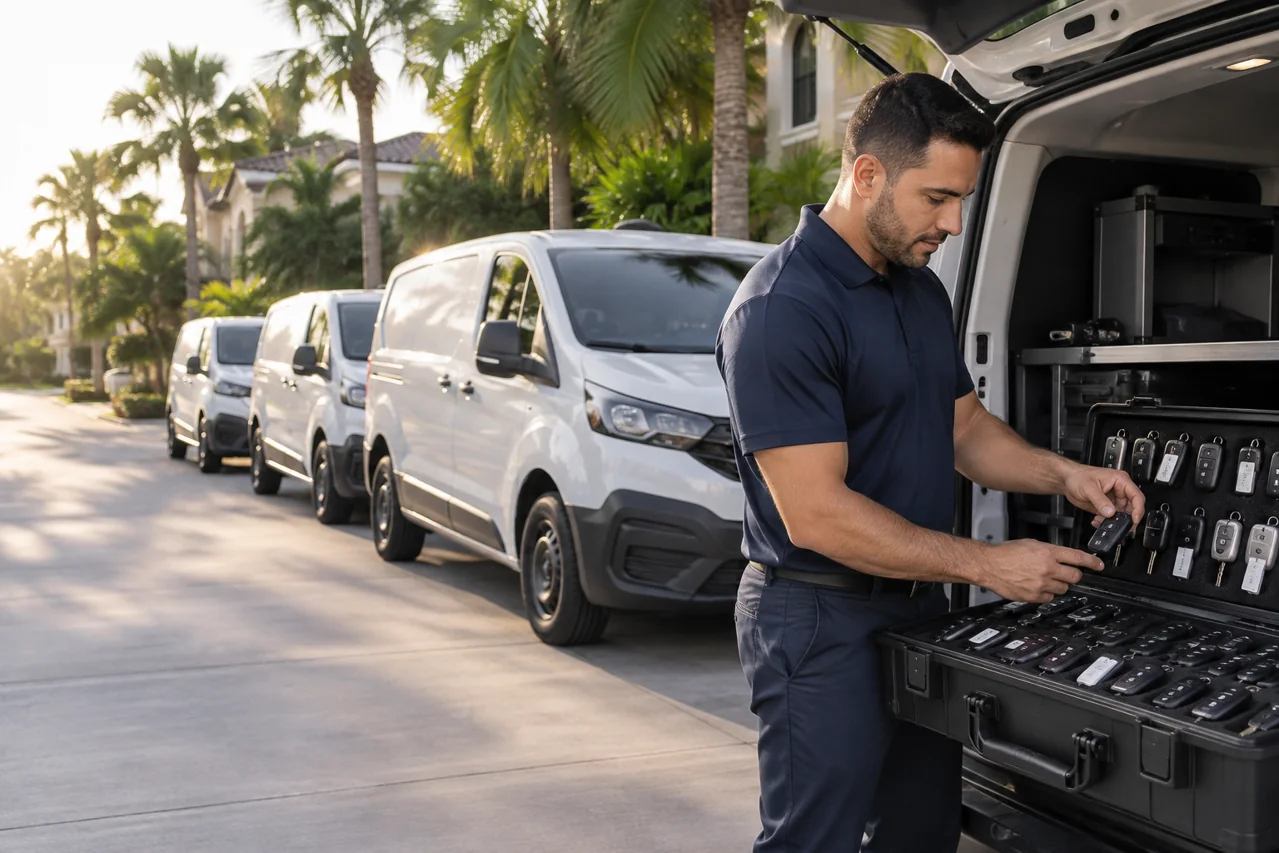
The technician arrives at the vehicle, confirms who you are and checks that the vehicle is yours. Next the technician identifies the key type, which can often be seen from the vehicle and any remaining key. A new blade is cut if needed, and the key is programmed to the vehicle through a diagnostic connection.
For vehicles with no remaining key, the process may include extra steps, but it is still done on site for most makes. The technician will tell you honestly at the start if your vehicle is one that needs a longer approach or a dealership visit.
Once the work is done, you test the key together. Lock and unlock the doors, open the trunk, start and stop the engine, and try the remote buttons. If you have a spare key, test it as well. A good technician will not hurry this step.
- Dispatcher gathers vehicle details and location by phone.
- A quote is given by phone and the service call charge is explained.
- The technician arrives and confirms identity and ownership.
- The key is cut and programmed.
- All functions are tested with you present.
- You review the work and ask questions.
Quotes and service call charges
Quotes are given only by phone. The cost of a key depends on the vehicle, the type of key and the work involved, so we do not publish prices. A spare for a common vehicle is a different job from an all keys lost situation, and a smart key is a different job from a simple transponder key.
For more complicated work, an on-site visit may be needed before a final figure is given. There is a service call charge, and it is explained on the phone before a technician is dispatched. You can decide whether to continue once you understand the arrangement.
We do not promise arrival times, because traffic and conditions change. We will tell you honestly what to expect on the call. For more on how this works, see how quotes work for key jobs.
Habits that keep a family on the road
A few small habits make a large difference. Choose one place at home for keys and teach everyone to use it. Keep spares out of the vehicle and out of the main key bag. Change fob batteries when they start to weaken. Avoid hanging heavy keychains from the ignition, because the weight wears the cylinder. Keep a photo of your registration on your phone.
If a key goes missing, tell the household right away. A quick report makes it easier to decide whether to reprogram the vehicle. Teach teenage drivers to treat the key as something valuable, and to tell a parent at once if it is lost.
When you need help with a key anywhere in Alief, call and describe the vehicle and the situation. We will explain what is possible and what to have ready.
Language, clear communication and avoiding misunderstandings
Alief is home to many languages, and a stressful key problem is not the time to struggle through a confusing call. If you are more comfortable in another language, ask a family member or friend to join the call, and have them stay with you during the visit. A technician will explain the work in plain terms, and you should always ask for it to be repeated until it is clear.
It also helps to write down what you know before you call. Note the make, model and year of the vehicle, the color, the plate number and the place where it is parked. Write down what happened and when you last had the key. If you can, photograph the registration and your identification, so you can read details off your phone while talking. Having these facts in front of you shortens the call and reduces mistakes.
At the visit, ask the technician to explain each step before it is done, and ask what will be tested at the end. You should never feel pressure to agree to work you do not understand. If something changes from what was explained on the phone, such as a different key type or an extra step, the technician should stop and discuss it with you before continuing. That kind of openness is a good sign of a reliable provider.
Finally, keep any written note or message about the work. If you later have a question about a key, having a record of what was done and when helps. When you are ready to arrange a visit, call and tell us what is happening, and we will take it from there.
Questions people ask
My old Honda key sticks in the ignition. Should I worry?
Yes, a little. A worn key or a tired ignition cylinder can get worse, and a key can snap in the cylinder. Replacing the worn key early is usually simpler than dealing with a break. A technician can look at the key and the cylinder and tell you which one is the cause.
Can a copy made at a hardware counter start my car?
Often it will turn in the lock but not start the engine, because most vehicles built since the late 1990s need a programmed transponder chip. A basic copy lacks that data. A technician can cut the blade and program the chip so the vehicle recognizes the new key.
Our family shares one vehicle and the only key is lost. What should we do?
Call and describe the situation. A technician can make a new key once ownership is confirmed, so the person on the registration should be present or reachable. Consider having the old key disabled, and make at least one spare once the new key works so you are not stuck again.
My fob stopped working after a battery change. Why?
Some fobs lose their connection to the vehicle after the battery is removed, or the battery was inserted the wrong way. Check the battery orientation first. If it still does not work, the fob may need reprogramming, or it may be damaged. A technician can test it and explain which it is.
Do you work at apartment complexes?
Yes. Tell the dispatcher about any gate, permit or office check-in that applies, and where the vehicle is parked. A photo of the vehicle in its space and a nearby sign can help. If you share the space or the vehicle, mention that, since it affects how ownership is confirmed.
How do I get a price for a key?
Quotes are given only by phone, because the cost depends on the vehicle, key type and work needed. Complicated jobs may require an on-site visit. There is a service call charge, and it is explained on the phone before a technician is dispatched. You will know the arrangement before anyone arrives.
Describe the situation by phone and we will tell you what the job involves. Quotes are given by phone. Jobs that cannot be quoted without seeing them need a technician on site, and the service call charge is explained on the phone before anyone is dispatched.
(713) 574-7660Related pages
Written by Claude (AI) (AI) for Houston Car Key Locksmith.