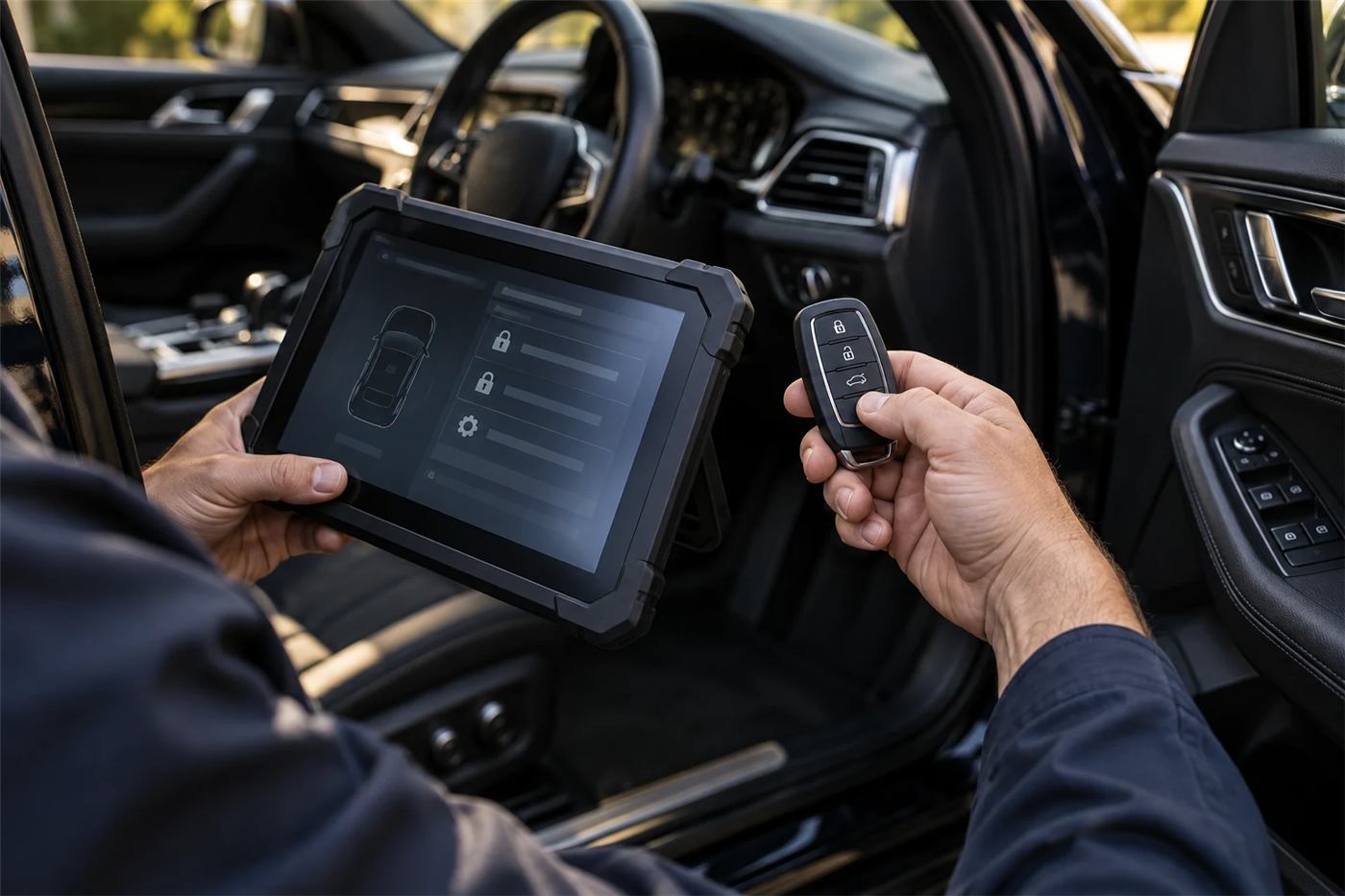
Why the two problems look the same
A modern car depends on two separate batteries working together. The big battery under the hood runs the starter, the lights and the computers. The small coin battery inside the fob powers the transmitter that talks to the car. When either one fails, the first symptom is the same: pressing the button does nothing and the car does not wake up.
The confusion deepens because the symptoms overlap. A weak car battery can leave the central locking too sluggish to respond, and a dead fob battery can leave the car looking dead even though its own battery is perfectly healthy. Add a push-button start car that needs the fob to be detected before it will run, and the effects become even harder to separate.
Fortunately, a few quick checks tell you which one you are dealing with. None of them need tools, and none of them put the car at risk. The aim of this page is to walk through those checks, then explain what to do whichever answer you get. If the fob turns out to be the problem, our page on a key fob that has stopped working goes deeper.
Quick checks that separate the two
Start with the car, not the fob. Open the door using the metal blade if your fob has one, or by hand if the car is already unlocked. Look at the interior light. Does it come on? Does the dashboard light up when you press the brake or turn the key to the on position? If the interior is completely dark and the dash is dead, the car battery is the likely culprit.
Next, try the horn or the headlights. If they are weak or silent, that supports a flat car battery. If they work normally but the car will not start with the key, the car battery is probably fine. In that case the key, the starter or something else is at fault.
Then test the fob. Hold it close to your face and look at its small indicator light when you press a button, if it has one. A light that does not flash suggests a dead fob battery. Try a second fob if you have one. If the spare locks and unlocks the car and the first does not, the first fob is the problem. If neither works and the car is also dead inside, the car battery is the more probable cause.
- Interior light and dash dead: suspect the car battery.
- Headlights and horn weak: suspect the car battery.
- Spare fob works and first does not: suspect the first fob.
- Car lights fine but remote silent: suspect the fob battery or fob.
- Click but no crank: the battery may be too weak to turn the starter.
Getting in when the remote will not unlock the car
Car makers know that fobs and batteries fail, so there is almost always a mechanical way in. Many fobs contain a hidden metal blade. Look for a small switch or release button on the fob. Slide it and pull out the blade. The driver door usually has a lock cylinder, but on many cars it is hidden behind a small plastic cap on the door handle. The cap can be gently levered off with the blade, exposing the keyway.
Use the blade as you would any key. Do not force it. If the cap or the cylinder resists, stop. On some vehicles the owner manual shows exactly where the cap sits and how to remove it. If you cannot find it, read the manual or call a technician rather than prying at the door, since scratched paint and broken clips are a more expensive problem than the one you started with.
Be aware that opening a door with the blade may trigger the alarm on some cars when the battery is weak or when the fob is not detected. If the alarm sounds, it usually stops once the car recognizes the fob or once the key is turned in the ignition. Our page on the emergency key blade guide explains how these blades work and how to care for them.
Hidden key slots and backup start positions
Push-button cars have a backup for a dead fob battery. The car cannot always detect a fob with a flat battery from a distance, but it can detect one that is placed very close to a specific spot. That spot is often marked on the steering column, on the start button itself, in the center console, or inside a storage bin. A passive coil there powers the chip in the fob by induction, so the car can read it even without a working battery.
To use it, hold the fob against the marked area, then press the brake pedal and the start button. Some cars want the fob nose against the start button, others want it in a cup holder slot or a marked tray. The manual shows the location for your model. If you cannot find it, search for a small key icon in those areas. A technician can also show you in a minute.
This trick helps only with a dead fob battery. If the car's own battery is flat, the system has no power to read anything. In that case the car needs a jump start or a new battery before the fob matters. Knowing the difference saves you from standing in a parking lot pressing the start button with a fob that is not the problem. For more, see push-button start keys.
If it is the fob: battery, shell or chip
A flat fob battery is the most common fob failure and the easiest to fix. Most fobs use a small coin cell, and the battery type is usually printed on it. Opening the case may need a thin tool at a seam. Care is needed because the plastic clips are delicate and the circuit board can be damaged by rough handling. Note the orientation of the old battery before removing it.
If a fresh battery does not revive the fob, other causes need considering. Contacts inside may be corroded, a common issue in humid climates. The board may be cracked from a drop. Moisture may have entered the case. The transmitter may simply have worn out. In those cases the fob needs repair or replacement.
A replacement fob usually needs programming to the car, which a mobile technician can do. Before that, check whether the fob's battery change affected the programming. On some vehicles a battery change does not erase the fob's link to the car. On a few, a very long gap without power can require the fob to be resynchronized. See our page on key fob battery replacement for what that involves.
If it is the car battery: what is safe to do
A flat car battery is common, particularly in a hot climate, after a long idle, or after a light was left on. A jump start can revive it, but modern cars are packed with electronics that do not like voltage spikes or reversed connections. The safe approach is to consult the owner manual for the correct jump points. Many cars have remote terminals under the hood, separate from the battery itself, intended for jump starting.
If you use a jump starter pack or another vehicle, connect cables in the order the manual shows, keep clamps from touching each other, and do not let the engine of the donor vehicle rev wildly. Remove the cables in the reverse order. If anything is unclear, or the battery is cracked, leaking or swollen, stop and call a professional. A damaged battery can be dangerous. If you smell rotten eggs or see fluid, stay clear.
After a jump, the car may lose some settings, such as the clock, radio presets, window auto functions or the learned position of power windows. Occasionally, key or fob features need a short resync. If the fob still behaves strangely after the car is running normally again, it may need to be re-registered. A battery that died once without an obvious reason should be tested by a battery shop or a mechanic. We handle keys, not batteries, but we can tell you whether a symptom looks like a key issue or a power issue.
Jump start cautions with electronics and keys
Keys and jump starts interact in a few ways worth knowing. First, never use a jump start as a way to force a car to accept a failing key. If the car does not crank because of an immobilizer problem, extra power will not help. It will only make you think the battery was at fault when it was not.
Second, avoid repeated attempts. Many cars lock out the starting system briefly after several failed tries, and a weak battery combined with repeated cranking can leave the whole system unstable. Try once or twice, then step back and think. Third, do not disconnect the battery to reset things unless the manual says so. On some vehicles that erases learned data and can lead to extra steps, such as relearning throttle position or radio security.
Finally, if the car has an aftermarket alarm or remote starter, tell the person helping you. Those add-ons can drain a battery or react oddly to a jump. A visit from a technician may include a look at those parts. Our page on aftermarket remote start conflicts explains the overlap with keys.
Heat, humidity and Houston batteries
Houston's long hot season is hard on both batteries. High temperatures shorten the life of car batteries and speed up internal wear, so they often fail without warning on a warm morning. Coin cells in fobs also weaken in heat, particularly if the fob lives on a dashboard or in a hot car. A fob left in direct sun can lose battery capacity faster than one kept in a bag.
Humidity adds corrosion. Moist air gets into fobs through seams and button gaps and corrodes the battery contacts, leaving a fob that works sometimes and not others. Our guide on humidity and key care has practical steps to slow that down.
Storms bring their own risks. Flooded streets can drown a car and its keys, and the aftermath can look like a dead battery when the damage is more extensive. If your car or fob has been wet, read flood damaged vehicle keys before attempting a jump start, since power applied to wet electronics can cause further harm.
When both are failing at once
It is quite possible for both batteries to be weak at the same time, particularly in older cars or cars that sit a lot. The result is confusing: the remote seems dead, the car is sluggish, and a jump start helps the car but the fob still does not respond. Treat the two as separate problems and solve them in order.
Start by restoring the car's power with a jump or a new battery, then check the fob with a fresh battery. If the fob works with a new cell, you are done. If it does not, the fob itself may be faulty. Test with a spare if you have one. If neither fob works with the car healthy, the problem may lie in the car's receiver, which is a different repair.
Do not assume the fob needs replacement just because it was silent while the car battery was dead. Many fobs are fine and simply could not be detected by a car with no power. Eliminate the car battery first, then judge the fob. That order avoids paying for a new fob you did not need.
- Get the car's power restored and healthy first.
- Replace the fob battery with a fresh one of the right type.
- Test the fob close to the car, then at a distance.
- Try a spare fob if available to compare.
- If still silent, call a technician about the fob or the car receiver.
What a technician can do for you
A mobile technician cannot replace your car battery, but can help with the key side of the problem. If the fob is dead and a battery swap does not work, the technician can test it, replace the shell or the board, or supply a new fob and program it. If the car will not recognize any fob, the technician can check whether the chip and the reader are communicating.
If you are unsure whether the issue is a key or a battery, describing the symptoms on the phone helps. We will ask whether the interior lights work, whether the dash lights up, and what the fob does when pressed. From that, we can usually tell whether to send a technician or whether you should look at the battery first.
We would rather say the problem is probably the car battery than send someone to a car that needs a battery shop. Quotes are given by phone, complicated jobs may need an on-site visit, and the service call charge is explained before dispatch. When you call, give the make, model and year, and describe what you have tried.
Habits that prevent a repeat
A few habits reduce the chance of being caught out. Replace the fob battery before it dies. Many fobs show a dim indicator light or a reduced range as the battery weakens. Treat those as warnings. Keep a spare coin cell in a drawer, not in the car.
Keep a spare key and keep it somewhere accessible, separate from the main one. If your fob dies, the spare gets you moving. Know where your car's backup start position is and try it once while nothing is wrong, so you are not learning it at night. Check the car's battery health when it gets old, particularly before summer.
Finally, know your emergency blade. Pull it out once, find the hidden lock, and confirm the key fits. Replace the cap if you remove it. A little practice turns a stressful moment into a minor one. If you want a spare programmed, read about key fob programming and call when ready.
Questions people ask
How can I tell whether the problem is the car battery or the fob?
Check the car first. If the interior light, dash and horn are weak or dead, the car battery is the likely cause. If the car shows normal power but the remote is silent, suspect the fob. A spare fob is a quick test. If the spare works, the first fob is at fault.
Can I still start a push-button car with a dead fob battery?
Often yes. Most such cars have a backup spot, such as a marked area on the steering column, the start button or a console tray, where holding the fob lets the car read its chip without battery power. Check your manual for the location, then press the brake and the start button.
Is it safe to jump start a car with modern electronics?
It can be, if done correctly. Use the jump points the manual shows, connect cables in the right order, and keep clamps apart. If the battery is cracked, leaking or swollen, do not attempt it. If you are not sure, call a professional, since mistakes can damage computers and key systems.
Will changing the fob battery erase its programming?
On most cars it does not. The fob keeps its identity in memory that does not depend on the coin cell. On a few vehicles a very long period without power may require resynchronizing the fob. If the fob does not work after a fresh battery, a technician can check whether it needs to be reprogrammed.
Why did my fob stop working after a jump start?
The jump itself rarely damages a fob. More often the car reset some settings, or the fob battery was already weak and the trouble was only noticed when the car came back to life. Try a new fob battery first. If that fails, the car may need the fob re-registered.
Do you handle car batteries?
No. We handle keys, fobs and ignition problems. We can help work out whether the symptom looks like a key issue or a battery issue. Quotes are given by phone only, and a service call charge is explained before dispatch, so describe the situation when you call and we will point you the right way.
Describe the situation by phone and we will tell you what the job involves. Quotes are given by phone. Jobs that cannot be quoted without seeing them need a technician on site, and the service call charge is explained on the phone before anyone is dispatched.
(713) 574-7660Related pages
Written by Claude (AI) (AI) for Houston Car Key Locksmith.