How beach keys go missing
Most keys lost at the beach were not dropped in one dramatic moment. They slip out of a pocket while someone runs into the surf, fall out of a bag when a towel is shaken, get buried when a chair is dragged over them, or are left on a cooler that is later carried to another spot. By the time the owner notices, the group has walked a long way, the tide has moved and the sand has been turned over by hundreds of feet.
The Texas Gulf coast adds a few habits of its own. People drive down from Houston for the day and park along the seawall in Galveston, in a lot near Surfside, or at a boat ramp on the bay. The car is locked, the key is in a swim bag, and the group disperses to swim, fish and walk. Keys are shared around for convenience, and the one person who held the only key is the one who goes into the water.
Boat days have a similar pattern. Keys left on a boat, dropped between a dock and a hull, or lost in a launch ramp parking area are common. A key that falls into bay water is very hard to recover, because the bottom is soft and the water is rarely clear.
Whatever the cause, the situation is the same: you are some distance from home, your ride is locked, the sun is going down and you do not have a way to get in or start the car.
Look first, and look methodically
Before assuming the key is gone, spend a short, focused stretch retracing your steps. Panic searches tend to cover the same spot three times and miss the obvious one. Start with the most likely places and work outward.
Check every bag, pocket and cooler lid. Many keys are found in the pocket of a different pair of shorts, inside a shoe, wrapped in a towel or sitting in a cup holder in another car. Ask everyone in the group who handled the key last. Check the car itself, because a key left on a seat or the floor behind a locked door is a lockout rather than a lost key, which is a quicker and simpler job. The key may be visible through the window.
If you were swimming, walk the line you took from the towels to the water and back. In soft sand, a keychain with a bright float or a colored fob can show up when the surface is scanned in low light from an angle. A metal detector helps, and people who walk the beach with one often have a good chance of finding a key. Some beach visitors ask them. Treat that as a favor rather than a service.
Ask staff at the nearest beach office, parking booth, lifeguard stand or concession. Keys that get turned in end up in a box somewhere, and people at a beach tend to know where. Leave a phone number and a description of the key.
- Check every pocket, bag, shoe and towel before widening the search.
- Look through the car windows in case the key is inside.
- Ask each person who held the key last.
- Walk the path from towels to water slowly, looking low across the sand.
- Ask the nearest beach staff or concession whether anything has been turned in.
- Leave a phone number and a clear description with them.
What salt and sand do to a fob that is found
Sometimes a key is recovered after hours in the sand or a dunk in the Gulf. It may look fine, and it may even work. That does not mean it is safe to rely on.
Salt water is far more corrosive than rain or tap water. It leaves behind a crust of salt crystals that attracts moisture from humid air and keeps the circuit board damp for days. The contacts on the battery and the little switches under the buttons are the first things to go. A fob that works at the beach can stop working in the car a few days later.
Sand is abrasive and gets into every seam. In a smart key or remote head key, grains can lodge under the button pads and make buttons stick or press themselves. Sand in a metal key's grooves wears the cuts and can scratch the inside of a lock cylinder when the key is used. If you push a gritty blade into the ignition, you are scraping the wafers inside that the car depends on.
If you recover a key that has been in salt water, rinsing the outside with fresh water is reasonable, but do not run water into a fob case or try to open it with a coin. Remove the battery if it comes out easily, avoid pressing buttons and have a technician look at it. Water inside, even fresh water, is better dealt with by someone who can open the case without breaking it.
For related background on water damage, see our page on key fob water damage.
What waterproof really means on a key fob
Some fobs and some after-market key cases are sold as water resistant. That label deserves some caution. Water resistance usually means a fob can survive splashes, rain or a short immersion in clean water. It does not mean it will survive a long soak in salt water, repeated dunking, or pressure from a wave.
Real waterproofing is a matter of seals. A fob case that is glued, has a rubber gasket or is potted in resin can handle more than one that is held with clips. But every case has to be opened for a battery change, and a seal that has been opened before may not seal as well the second time. A key that has been in the sun, in a hot car and then in cold water is also stressed in ways the label does not cover.
Most factory fobs are not designed to go in the sea. The simplest protection is to leave the main key out of the water. If the key must come to the beach, a floating key holder, a waterproof pouch with a roll top or a lockable container in the car trunk are all better than a pocket. A small dry bag costs far less than a replacement key.
Note that a waterproof pouch only protects the fob if it is closed correctly and has no tears. Check the seal before every trip. Also remember that a pouch that floats is only helpful if you see it float away.
Getting a replacement when you are far from home
If the key does not turn up, the problem is that you are a long way from a spare. The spare is at home, perhaps in a drawer in Houston, and the car is in a beach lot. You have a few options and it is worth thinking about them calmly.
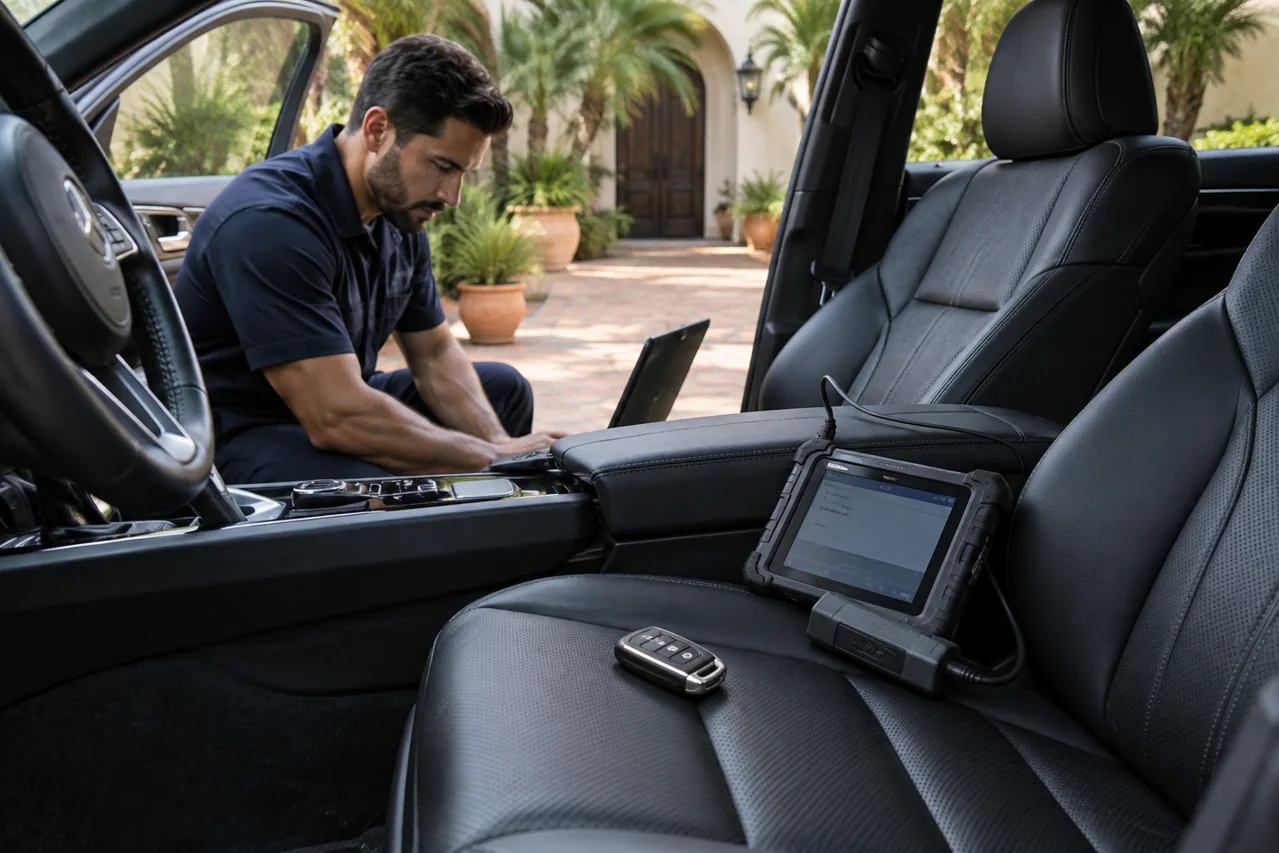
One option is to have someone bring the spare to you. This is often the simplest and least costly solution if a friend or family member can make the drive, provided the spare is a working key. Another option is to call a mobile locksmith to come to the car, cut and program a new key on site and let you drive home. For most vehicles this can be done at the roadside or in the lot, with the right equipment, once ownership is shown. The service area of our mobile work covers much of the Houston and Galveston County region, and the phone call decides what is possible for your location and car. You can read about the process for a missing key in our guide to car key replacement.
A third option is to tow the car to a dealership. Tow costs and the wait for an appointment make this the slowest route in most cases. Our guide to the dealer versus locksmith choice compares the two.
Whichever way you go, remember that the car may still be locked with your belongings inside, and the clock is ticking on parking. Park-and-wait is not a plan. Call early, give the location and let the technician tell you what is feasible.
What a technician needs to know about the location
Beach and shoreline jobs have practical details that can decide whether a visit works. When you call, give the exact place: the street or seawall block, the lot name, the nearest landmark, or the boat ramp name. Say whether the car is on public sand, a paved lot, a private lot or a street. Some lots have restrictions on vehicle access or parking time, and the technician needs to know whether they can park close to the car.
Tell them about the car. Make, model and year, whether it uses a turn key or a push button, and whether you have any other key. If the car is locked with the keys inside, say so. If the key is lost and the doors are locked, a technician will talk you through how entry and key making happen in that order.
Also tell them about the conditions. Wind, sand and heavy rain make some jobs slower and mean the technician may want to work inside a sheltered place. If the car has been standing in sun for hours, the cabin can be very hot, and a child, pet or vulnerable passenger inside is an emergency. If anyone is locked inside, call 911 first.
Technicians do not promise arrival times, because distance and traffic around the Galveston causeway, the Gulf Freeway and the seawall on busy weekends can change quickly. You will be told what is reasonable when you call.
What ownership proof you will need
Making a key for a car is a security matter, so a legitimate technician will ask you to show you own or are authorized to use the vehicle. At the beach, you may not have your wallet or a folder of papers. That is a common problem and is easy to plan for.
A photo identification is the usual starting point. Alongside it, the technician will look for a registration, title, insurance card or a lease or loan document that shows the vehicle and your name. If these papers were in the locked car, a copy on your phone, a photo of the registration or a digital insurance card often works. Some people keep a picture of the registration and insurance card in their phone's photo library for exactly this reason.
If you are not the registered owner, for example a family member's car or a company vehicle, the technician may ask for further proof, such as the owner's permission and a way to confirm it. Rental cars are another separate case, covered on our page about a lost rental car key.
For more on this, see proof of ownership for keys. A technician who does not ask for any proof at all is a warning sign, not a convenience.
Boats, jet skis and trailers
A day on the water raises key questions beyond the car. Boat ignition keys, jet ski keys with floating tethers and trailer lock keys are different from car keys, and they are not all covered by the same service. Our work focuses on car, truck and similar vehicle keys. If your lost key is for a boat engine or a personal watercraft, the best contact is usually the marine dealer or service shop for that brand.
What we can often help with is the tow vehicle. If the key to the truck that pulls the boat trailer fell into the bay at the ramp, a mobile technician can cut and program a replacement for the truck. Many pickup trucks and SUVs have transponder or smart keys, and the process is much like any other. See our notes on truck keys for the specifics.
If the trailer has its own lock, such as a coupler lock or a hitch pin lock, that is a different matter and may need other tools. Ask on the call and the technician will tell you what is within the service.
A practical tip for anyone who launches boats: keep the truck key on a different ring from the boat key and trailer lock key, and keep both away from the dock edge. A key that falls between a hull and a dock is almost always gone.
Habits that keep beach days from turning into key emergencies
A few simple habits take most of the risk out of a day by the water. None of them are expensive and all of them are easy to do before leaving home.
Leave the main key out of the water if you can. Many people hide a spare in a magnetic box under the car, but beach cars get washed by spray and that is not secure. A better option is to give the key to someone who will stay on the sand, or lock it in a small waterproof container in the trunk. Some modern cars allow a valet mode or a limited key; check your owner's manual.
Take a photo of your registration and insurance card before you go. Put a copy of the spare key's details in your phone, such as the make and model, in case you have to call from the beach. Check your phone is charged enough to make a call.
Think about a second key you can reach. A spare that lives at home does little if you are an hour away. See where to keep a spare key for ideas that work for people who travel to the coast. Also consider a small tracker, covered in our key tracking tags guide, though trackers have limits in water and at a distance.
Finally, when you do lose a key, do not wait until dark. The sooner you call, the easier it is to arrange a visit while there is still daylight and the lot is open. If you are ready to talk it through, call and describe where you are and what the car is.
Questions people ask
My key fell in the surf and I found it. Is it safe to use?
It may work, but salt water is corrosive and can damage the circuit board, battery contacts and button switches over the following days. Rinse the outside with fresh water, remove the battery if it comes out easily, and avoid pressing buttons. Have a technician open and inspect it. A fob that works at the beach can fail later, so consider having a backup key made.
Can a locksmith come to a beach parking lot or boat ramp?
A mobile technician can often work at lots, seawall parking and ramps around the Houston and Galveston area, depending on the location and vehicle. Give the exact place, the car details and whether the car is on a public or private lot. The phone call decides what is possible, and the quote and service call charge are explained by phone before anyone is dispatched.
What if my wallet and papers are locked in the car?
That is common at the beach. A photo of your registration, insurance card and a photo identification on your phone often works as a starting point, and other documents showing your name and the vehicle can help. Tell the technician on the call what you have so they can say what they will accept. Proof of ownership is required for key making.
Is it better to have my spare brought to me?
If someone can safely bring a working spare, that is often the simplest route, especially if the drive is short. If no one can, or the spare is also unreliable, a mobile locksmith can cut and program a new key on site for most cars. It is worth asking the technician for both timing and the situation, because neither option is always faster.
Do you make keys for boats and jet skis?
Our work centers on car, truck and similar vehicle keys. Boat engine keys and personal watercraft keys are usually handled by the marine dealer or service shop for that brand. We can help with the tow vehicle, such as a truck or SUV, if its key is lost at the ramp. Ask on the call, and the technician will say what applies to your case.
Is a waterproof key fob case worth buying?
A good case can protect against splashes and short exposure, but few cases are designed for long salt water immersion, and seals can fail after repeated opening. The safest approach is to keep the main key out of the water, in a sealed dry bag or a locked container, and carry a spare at home. A case helps, but it is not a replacement for care.
Describe the situation by phone and we will tell you what the job involves. Quotes are given by phone. Jobs that cannot be quoted without seeing them need a technician on site, and the service call charge is explained on the phone before anyone is dispatched.
(713) 574-7660Related pages
Written by Claude (AI) (AI) for Houston Car Key Locksmith.