Why powersports keys are not just small car keys
People sometimes assume a motorcycle key is a simpler version of a car key, and for older bikes that can be true. A plain steel blade, a single ignition switch, and a steering lock were the whole system for decades. But modern motorcycles, scooters, and ATVs vary widely, and the variation is what makes replacement tricky.
A single machine may use more than one key or more than one lock pattern. The ignition and steering lock may use one cut, while the seat latch, the fuel cap, and a trunk or top box use another. Some models use a transponder chip in the key head that the bike's computer must recognize before the engine will run. Others use a proximity fob, a flip key, or a plain key with a rubber head that conceals the chip.
Because of that, a hardware store copy is not always enough. A key that turns the switch may still fail to start a bike that expects a chip. And a key that is cut slightly off can wear the switch quickly. Replacement starts with identifying exactly what system your machine uses, and that depends on the make, model, and model year.
The key types you are likely to see
Powersports keys fall into a few families. Knowing which one you have makes the phone call much faster, and helps explain why quotes differ between machines.
| Key type | Common on | What replacement needs |
|---|---|---|
| Plain metal key | Older bikes, small scooters, basic ATVs | Cutting by hand or machine from the lock or a code |
| Chipped key (transponder) | Many newer motorcycles and scooters | Cutting, then chip programming to the bike's computer |
| Rubber-head or valet key | Some sport and touring models | Cutting plus matching the head type; some limit power or speed |
| Flip or switchblade key | Select scooters and street bikes | Blade cutting and fob or chip handling |
| Proximity fob | Newer scooters and premium bikes | Fob programming, similar to a smart key on a car |
What to do first when the key is gone
Start by looking in the places a key actually goes. Check the pockets of the jacket or riding pants you wore last, the bottom of a tank bag, a saddlebag, and the gear in a trunk. Many lost motorcycle keys are found in a glove or a helmet. If you rode somewhere and parked, retrace the stops.
If the key is truly gone, protect the bike. A motorcycle with a missing key and an unlocked steering lock is easy to lift into a truck. If the steering lock is engaged, leave it that way. Cover the bike if it is outside, and avoid forcing anything. Prying at a locked switch or a seat latch can break the part that a clean key replacement would have saved.
Then gather what a technician will need: the make, model, and year, the VIN from the frame or the title, and proof that the bike is yours. A registration, title, or bill of sale usually works. We never cut a key to a vehicle without checking ownership first, because the same step that helps you protects you from someone else doing the same to your bike.
How a replacement key is made
When the original key is gone, there are two paths to a new one. The first is to cut a key from a code. Some makes can be looked up using the VIN or a number on the lock, and the key is cut to match. Our page on key cutting by code and VIN explains how that works and where it does not apply.
The second path is to read the lock itself. A technician can decode the ignition or other lock and cut a key to match what is inside, without any original key. This takes more time and skill than a simple copy, and the lock must be accessible and in decent condition.
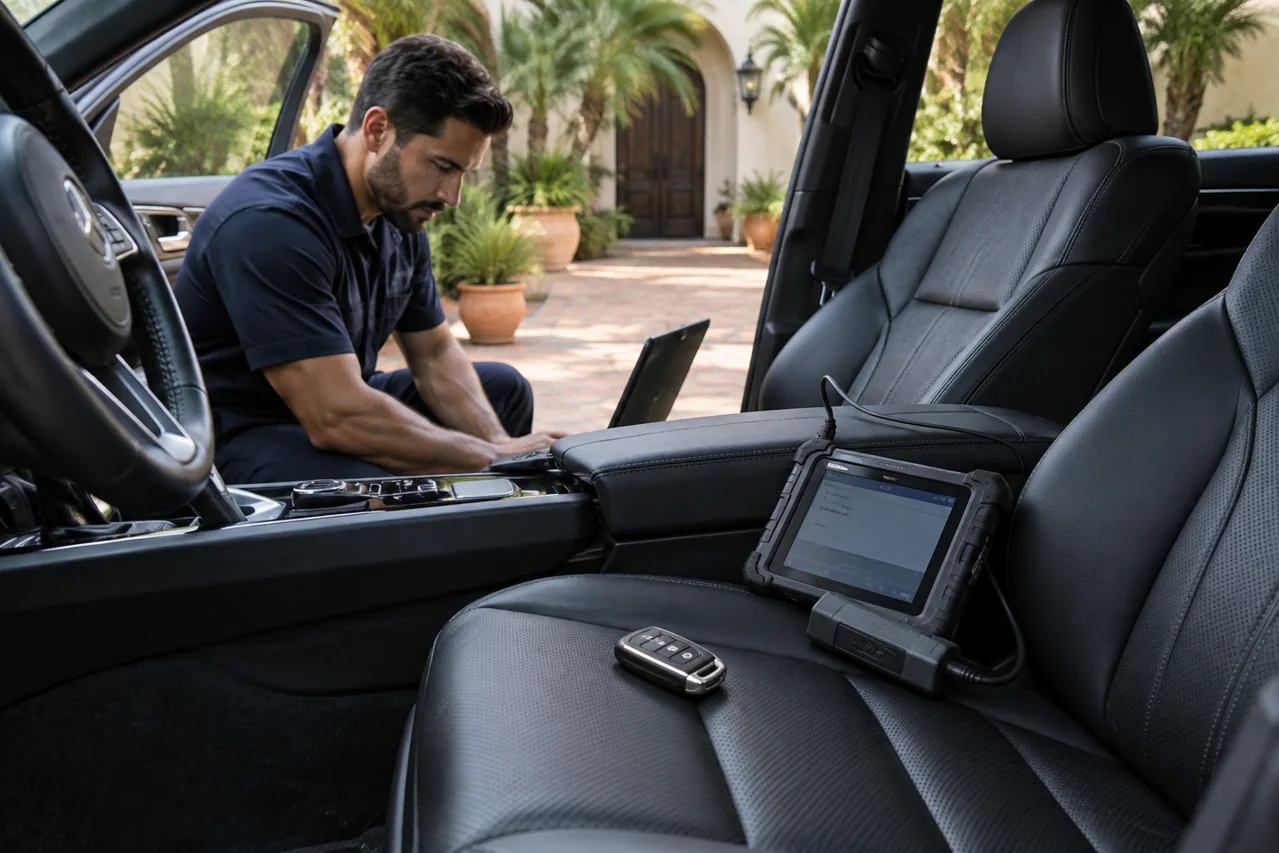
After the key is cut, a chipped key needs one more step: the chip must be recognized by the bike. Depending on the make, that is done with a diagnostic tool connected to the bike's computer, or through a learning procedure that the owner and technician perform together. Not every make allows every method, and some systems need a dealer-level tool or an existing key to authorize a new one. A technician will tell you early if your bike falls into that category, so you do not wait around for something that cannot be done at the curb.
Duplicating a spare before you lose the only one
If you still have one working key, copy it. A duplicate cut from a good key is faster and simpler than any lost-key job. It also gives you a decision about where the spare goes. A spare in the same bag as the original is no spare at all.
A better habit is to keep one key in a place that has nothing to do with the bike: a drawer at home, a lockbox, or a trusted person's house. For riders who travel or ride long distances, a spare tucked in a wallet or a sealed pouch inside a pannier can save a trip. For chipped keys, a spare means more than a cut, since the copy has to be programmed too, and that is much easier while an existing key is available to authorize it.
If you are buying a used bike, ask how many keys came with it and whether the previous owner kept any. A bike sold with a single key and a story about the other one being somewhere is a good reason to have a fresh key made and the old one removed from the system, where the bike allows it.
Humidity, heat and the coast
Houston's climate is hard on small metal parts. High humidity keeps moisture on the ignition switch and the steering lock, and for riders near Galveston Bay, Kemah, Seabrook, or Galveston Island, salt in the air adds corrosion on top. A key that sits in a coastal garage or on a bike parked outdoors can develop a thin film of corrosion in the keyway that makes turning stiff.
Heat matters too. A black seat and a hot dashboard can bake a key left in the switch, and rubber key heads harden and crack in the sun. A cracked head can hide a chip that is about to fail, and a bent blade can damage the switch the next time it is turned.
A few simple habits help. Do not leave the key in the switch when the bike is parked outside. Keep the keyway clean and dry, and avoid spraying heavy oil into it, since oil attracts grit. If a key has begun to stick or turn hard, replace it before it breaks off in the switch. A broken key stuck in a switch is a larger job than a new key, and our page on broken key extraction explains what that involves.
Seat, fuel cap and top box locks
Ignition keys get all the attention, but the other locks on a motorcycle are just as likely to go missing. A locking fuel cap, a seat latch, a helmet lock, a side case, and a top box can each use a different key, and each one stays locked when the key is somewhere else.
Riders often discover this at the worst moment. The bike starts fine with the ignition key, but the seat will not release because the seat key is in a jacket at home, and the registration and tool kit are under the seat. Or the fuel cap lock sticks and the key snaps off in it at a gas station.
Most of these locks can be handled the same way as the ignition: cut a key from a code if the lock has one, or read the lock and cut a key to match. If you have aftermarket cases, look at the lock face for a brand name and a number, since the maker's code can speed things up. If a lock is already damaged, replacement of the lock body may be better than trying to save it.
If you are going to have one key made, ask whether the ignition and other locks can be matched. On some bikes the locks can be keyed alike so one key does everything, which means fewer keys to lose. On others the locks are fixed at the factory and cannot be changed without replacing the parts. A technician can tell you which applies.
Scooters and ATVs
Scooters are among the most common small vehicles in the Houston area, and their keys are a mix of plain and chipped. Many import scooters use simple keys that can be cut readily. Newer models from established brands often use chipped keys or flip keys, and a few use a proximity system. The right route depends on the model and year, so give those details when you call.
ATVs and side-by-sides add their own wrinkles. Many have a simple ignition key and a separate key or tether for a speed limiter, and some have a switch that sits low and collects mud and water. Keys on these machines wear fast, and the ignition itself can fail before the key does. If your key works but the machine starts intermittently, the switch may be at fault, not the key.
Powersports vehicles that live on trailers or in storage units can also develop lock problems from sitting. A lock that has not been turned in a long time may need cleaning before any new key will move it smoothly. If you pull a machine out of storage and the key will not turn, do not force it. Describe what happened on the phone.
Storage, theft risk and the key you leave behind
Motorcycles are easy targets, and the key is only one part of keeping one safe. A bike parked at an apartment complex, a bar, or a trailhead is exposed for hours. The most common mistakes are small ones: leaving the key in the ignition while stepping into a store, hanging a spare on a hook near the garage door, and parking with the steering lock unlocked.
If your keys are lost or stolen along with a wallet, bag, or jacket, treat the bike as at risk. Someone who has the key and knows where you ride may know where you live. In that case, consider having the lock changed or the key reset, so that the old key no longer works. For chipped bikes, a technician can often erase old keys from memory and program new ones. For older plain-key bikes, replacing the ignition switch or the lock cylinder is the equivalent step.
It also helps to separate the key from anything that identifies the bike or your home. A tag with an address tells a thief where to go. A small, plain key ring with only the bike key on it is easier to keep track of and harder to misuse.
Riders who store a bike for the winter or through hurricane season should leave a spare with someone reliable and note the VIN and key details somewhere safe. After a storm, a bike that sat in a flooded garage may have corroded locks, and a key that worked before may no longer turn. That is a good time to have the locks looked at and a fresh key cut.
What cannot always be done at the curb
Honesty about limits matters more than a promise. Some motorcycles use systems that require dealer-only equipment to program a new key, and some require the bike's computer to be reset by a procedure that cannot be done outside a shop. A technician will tell you if your model is in that category, and will not charge you to find out that a thing cannot be done.
Other limits are practical. A vehicle with a damaged ignition switch, a bent steering lock, or a seized cylinder may need a repair before any key will work, and that can mean parts. A bike with no accessible VIN and no paperwork cannot have a key cut until ownership is established.
When a job cannot be finished on the spot, the technician will explain what the next step is, whether that is ordering a part, moving the bike, or involving the dealer for a specific step. Not every key problem ends in one visit, but you should leave the call knowing exactly what is needed.
What to have ready and how the quote works
The more precise you are, the faster the call goes. Have the make, model, and year, the VIN, and a photo of the ignition switch and any key you still have. Note whether the bike has any other locks, such as a seat, fuel cap, or top box, and whether you want those keyed as well.
Quotes are given only by phone. We do not publish prices on this site, and we do not offer number ranges without knowing the machine. For a simple job, the phone quote is the number. If a bike needs a closer look, for example a lock that must be decoded or a system we have not seen, an on-site visit may be needed and a service call charge applies. That charge is explained on the phone before dispatch.
We come to the bike, so you do not need to ride it anywhere or trailer it to a shop. Service is available across the Houston area, and our service areas page lists where we work. Call with the make, model, and what happened, and we will tell you what can be done.
Questions people ask
Can you make a motorcycle key if I have no original key?
Often yes. Depending on the make, a key can be cut from a code looked up by VIN or from the lock itself, then programmed if the bike uses a chip. Some models need dealer-level equipment for the final step. A technician can tell you which applies once you give the make, model, and year.
Does my motorcycle key have a chip in it?
Many newer motorcycles and scooters do. Signs include a thicker plastic or rubber head, a model year in the last several years, or a dash light that flashes when the wrong key is used. If you are unsure, give the make, model, and year on the phone and the technician can confirm.
Do you work on scooters and ATVs too?
Yes, within what the machine allows. Scooters and ATVs use a range of plain and chipped keys. Some are easy to cut on site, while others need programming or parts. Tell us the make, model, and year, and we will say what can be done at your location.
Why do you ask for proof of ownership?
Because a key can start and steal a vehicle. A registration, title, or bill of sale shows the bike is yours, and an ID shows who you are. The same check protects you from someone else having a key made to your motorcycle. It is a normal step for any careful key technician.
My key is stiff in the ignition. Should I replace it?
Possibly. A worn or bent key can stiffen the switch and eventually break off inside. A stiff switch may also need cleaning or repair. Stop forcing it, and describe how it behaves on the phone. A technician can tell whether the key, the switch, or both need attention.
Do I need to bring the bike anywhere?
No. Service is mobile, so the technician comes to where the bike is parked. If the bike has a problem that needs shop equipment or a part, the technician will explain the next step. You will know what is needed before any work begins.
Describe the situation by phone and we will tell you what the job involves. Quotes are given by phone. Jobs that cannot be quoted without seeing them need a technician on site, and the service call charge is explained on the phone before anyone is dispatched.
(713) 574-7660Related pages
Written by Claude (AI) (AI) for Houston Car Key Locksmith.