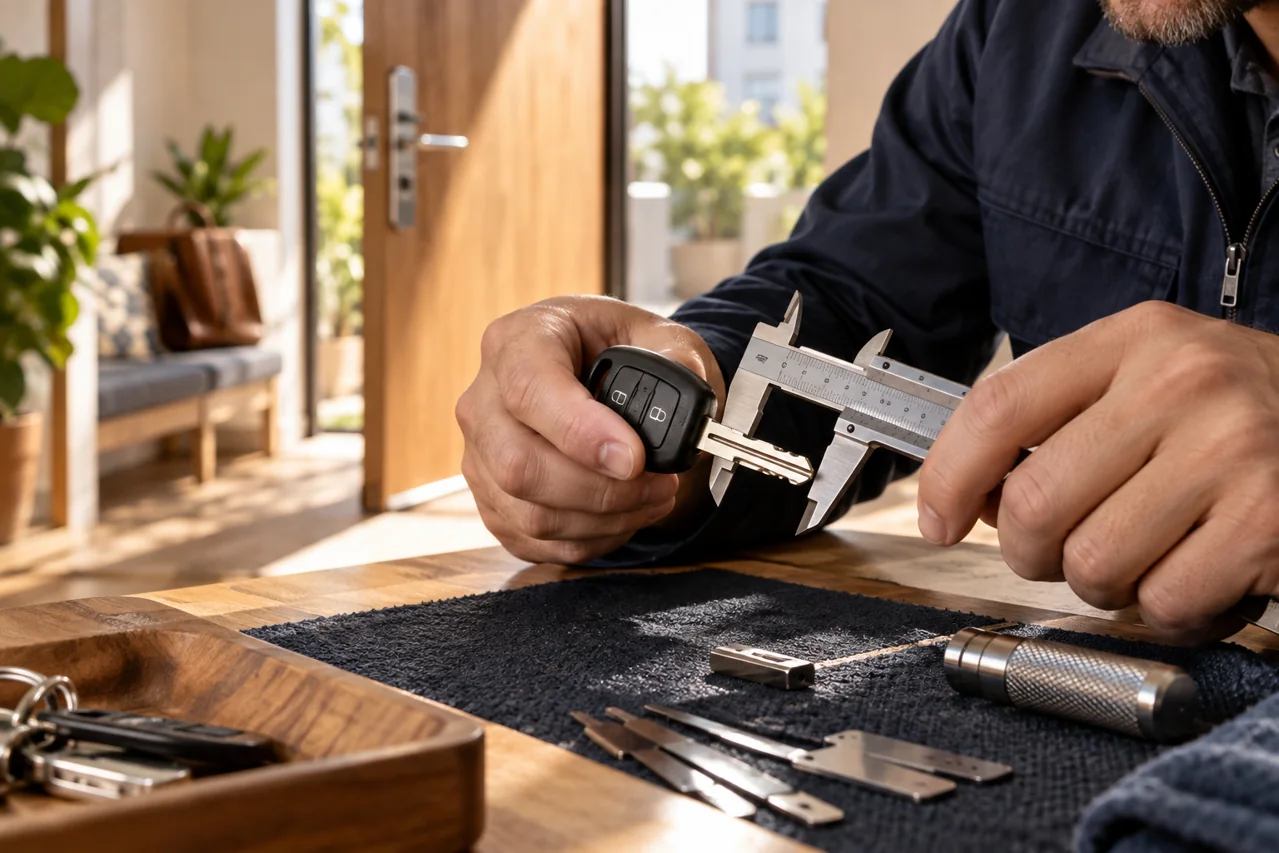
How keys get bent and cracked
Most damaged keys have an ordinary story. A key in a back pocket gets bent when its owner sits down. A key left in the ignition is knocked by a knee or a heavy keychain. A key in a door lock is hit by the door of another car. A key is used to pry something open, to scrape a label or to turn a stiff screw. A key falls from a bag to a parking lot and a tire rolls over it.
Cracks usually start in the plastic head. Many modern keys have a metal blade set into a plastic or rubber head that holds the chip and remote. That plastic gets brittle with age and heat. A key that has spent summers on a Houston dashboard can have a head that has been cooked and chilled through many cycles, and a small knock then splits it. Cracks often start at the corner where the head meets the blade, or at the ring hole where the key hangs on a chain.
Metal fatigue is another cause. A brass or nickel silver blade can be bent a little without breaking, but each bend weakens it. A key that has been bent and straightened a few times is likely to have a hidden crack along the bend line. The key may look straight and still be on the verge of snapping.
Whatever the story, the question is the same: is it safe to keep using?
The main risk: the key snaps while it is in the lock
The reason to take a bent or cracked key seriously is what happens when it fails. A key that breaks in the air is an annoyance. A key that breaks inside a lock or an ignition is a repair. The blade tip stays lodged in the cylinder, the head comes off in your hand and the car may be locked, unlockable or stuck in the wrong state.
A broken key in an ignition is particularly awkward. If the key snaps in the on position, the car may be running with no way to turn it off with the key. If it snaps in the off position, the car cannot start. If it snaps in a door, you may have no way in. Our pages on a key that broke in the ignition and broken key extraction describe the repair work.
A cracked head can also separate the key from the chip. In a transponder key, the chip sits inside the head. If the head splits, the chip can fall out, and the key may no longer start the car even though the blade is fine.
The risk is highest when you are forcing the key. If a bent key does not turn smoothly and you push harder, you are placing stress on a weakened part, and that is when snaps happen. Gentle use of a damaged key is safer than forcing, but neither is a solution. The sensible step is to replace it before it breaks.
Can a bent key be straightened?
People ask this because it seems the easiest fix. The short answer is that you can sometimes straighten a slightly bent blade, but it is a gamble and often a poor one.
Straightening is done by bending the metal back against its curve. That adds another stress cycle at exactly the place that already bent. Brass keys harden as they work, so the metal at the bend becomes more brittle each time. A key that was a little bent and has been straightened once may last for years or may snap in the next week. There is no way to tell by looking.
A key that is bent enough to affect how it enters the lock is already beyond a safe fix. Metal that has been bent far enough to see has already stretched. The cuts on the blade may also have shifted, which changes how the key lifts the wafers. A straightened key that looks correct may still not turn smoothly.
If you try to straighten a key at all, do it slowly on a flat surface with the blade supported near the bend, and do not use pliers on the cut edge. Better still, do not rely on the result. Treat a straightened key as a temporary backup and have a new one made.
Do not try to straighten a transponder key's head or a remote key's plastic. Bending the head can break the chip, the circuit board or the seal around the battery.
Using a damaged key in the meantime
If you have no other key and must keep driving for a day or two, a few cautions reduce the risk. These are not a repair. They only help you avoid making the damage worse until a replacement can be arranged.
Insert the key gently and straight. Do not twist it while it enters the lock. If it needs force, stop. Turn the key slowly and without a jerk. Take the weight off the key by removing heavy keychains and fobs, because the weight pulls the key at an angle in the ignition and strains the damaged part. Hold the key by the head, not by pulling on the ring.
Avoid using the key in the door when you can. If the car has a remote or a keypad, use those for the door, and save the key for the ignition. Do not use the key as a tool. Do not leave it in the ignition when you are out of the car.
Keep your spare nearby if you have one. If the damaged key is your only key, consider making a plan for a replacement soon. The time to call a technician is before the key breaks, when the work is a simple key cut and program, not after, when it includes extraction and a possible lock repair.
If the key is partly broken, for example a head that is cracked but still holding the blade, avoid using it in the ignition at all. A head that is held together by hope can come apart in your hand.
- Insert the key straight and turn it slowly, without force.
- Remove heavy keychains and charms while the key is damaged.
- Use the remote or keypad for doors when possible.
- Do not use the key to pry, scrape or turn anything else.
- Keep a spare nearby, and plan the replacement soon.
Taping, gluing and other repairs
A cracked key head invites repairs. Glue, tape, rubber bands and heat-shrink tubing all appear in drawers across Houston. Most of them do not hold up, and some make things worse.
Glue can seep into the key's circuit board or the seam around the battery. Strong adhesives can melt some plastics. Tape adds bulk and can catch in the ignition. A key head that is held together with tape will separate when it is under load, and the load comes at the moment you turn the key.
A cracked head also lets in moisture, dirt and sweat. If the chip or the circuit board is exposed, it can corrode. A key that works today can fail next week once humidity has done its work.
A better repair for some keys is a new shell. Many remote keys can have their chip and electronics moved into a new case, a job described under key fob shell repair. This works well when the electronics are fine and only the plastic is broken. It does not suit every make, because some chips are tied to the head in ways that cannot be moved. A technician will tell you whether the electronic parts of your key can be moved to a new shell or whether the whole key needs to be replaced.
For a plain metal key with a cracked plastic cover, a new key is usually the cleaner answer.
What a replacement involves
Replacing a damaged key is usually straightforward, especially if the key can still be read. A technician can cut a new blade, either from the original specification or, if the damaged key is intact enough, by checking the cuts against the specification. For cars with transponder chips or remotes, the new key also needs programming so the car accepts it.
Because the damaged key is still available, you are in a better position than someone who has lost a key. The technician can see exactly what you have, test the chip and decide whether any part can be reused. If the chip in the old key is good, it can sometimes be moved to a new key shell, which saves a step. If the chip is damaged or the key is a type that cannot be reused, the technician will program a new one.
The work is often done at your home or workplace. A mobile technician brings the cutting and programming equipment, checks your proof of ownership, cuts and programs the key and tests it in the door and the ignition. If the car is a push button model, the test happens in the cabin with the car's reader. Our pages on car key replacement and remote head key replacement give more detail on the process.
The quote is given by phone. A service call charge is explained before dispatch. Complicated jobs may require an on-site visit first.
Do not forget the lock
A bent key may have been bent because the lock is stiff, or the lock may have been damaged by the bent key. Either way, it is worth checking both parts.
If the key bent when you forced it into a lock, the lock may have a problem: a worn cylinder, a dirty mechanism, a stuck wafer or a latch that is not releasing. In that case a new key might bend too. Replacing a key without looking at the lock can lead to the same problem again.
If the key bent in your pocket and the lock is fine, a new key should work well. The technician will test it and confirm.
A key that has been forced into a lock may have left metal shavings or bent a wafer. If the key now feels different in the lock, say so on the call. The technician may recommend a check of the cylinder. See our page on door lock cylinder repair for the possible fixes.
In some cases, a cracked key is a symptom of a lock that has been stressed for years by a heavy keychain or by rough use. Fixing the lock is as important as replacing the key. A technician will often suggest both.
Spare keys and the next time
A damaged key is a good moment to make sure you have a working spare. If the damaged key is your only key, it is a reminder of the risk of having just one. If you have a spare, test it now and keep it somewhere safe. If the spare is old, it may also be worn or damaged.
Have the spare made from the car's original information rather than from the damaged key. A copy of a bent key will carry the bend into the copy. A key cut from the specification is accurate. Our page on spare car key duplication explains the options, and the guide on why you need a spare key now explains the reasoning.
Protect the new key. A hard key case or a small pouch keeps the blade from bending in a pocket. A light keychain keeps weight off the ignition. A habit of taking the key out of a back pocket before sitting costs nothing. Keep the key away from heat on the dashboard and out of direct sun in a parked car.
If you recognize your own key in this description, do not wait for the break. Call, tell the technician what damage you see and what car it is, and ask what a replacement involves. The call is the quickest way to learn whether your key can be reused or should be replaced.
Examples that show where the line sits
It helps to see how this plays out. Suppose a driver sits on a key in a back pocket and finds the blade has a faint curve. The key still enters the ignition but needs more pressure to turn. That is past the point of a safe fix. The key has stretched, the cuts have shifted and the metal is weakened. Replace it.
Suppose instead that the plastic head has a hairline crack near the ring hole, and the blade is perfectly straight. The key works, and the crack looks cosmetic. The risk here is different. The crack may spread, the head may separate, and moisture may reach the chip. A new shell, or a new key if the shell cannot be swapped, is a sensible step done on your schedule rather than after a failure.
Suppose a smart key fob has been dropped on concrete and the case has split at the seam. The fob still unlocks the car. A split case lets in dust and moisture, and the battery can fall out at a bad moment. A technician can often fit a new case and move the electronics. If the circuit board shows a crack, replacement is the better road.
In each case, the common thread is timing. A key that is replaced while it still works is a minor job. A key that fails in the ignition at night or at a gas station is a larger one. If your key shows any of these signs, call and describe what you see.
Questions people ask
Is it safe to keep using a slightly bent car key?
It is a risk. A bent blade is weakened at the bend, and it may snap in the lock or ignition without warning, which is a bigger repair than a new key. If you must use it for a short time, insert it gently, turn slowly, remove heavy keychains and do not force it. Arrange a replacement soon rather than waiting for it to fail.
Can I straighten a bent key with pliers?
You may be able to straighten a mild bend, but it adds stress to the weakened spot and may hide a crack. Brass hardens with working, so a straightened key can snap later. If you try, support the blade near the bend and work slowly. Treat the result as a temporary backup and have a new key cut. Never bend a transponder or remote head.
My key head is cracked but the key still works. What now?
A cracked head can come apart under load, and it may separate the chip from the key. Avoid using it in the ignition if you can, and avoid tape or glue, which can damage the electronics. A technician can often move the electronics into a new shell, or replace the key, depending on the make. Call and describe the crack and the car.
Can a new key be made from a bent one?
Yes, if the key can still be read. A technician may cut the new blade from the vehicle's original specification, which is more accurate than copying the bent shape, and then program the chip or remote if the car needs it. With proof of ownership, this is a normal replacement job and can often be done at your location.
What happens if a bent key breaks in the ignition?
The blade tip stays in the cylinder and the car may not start or may not turn off, depending on the position. Do not try to dig it out with tools, which can damage the cylinder. Call a technician, who can extract the piece and cut a new key, and may also check the ignition. It is far simpler to replace the key before it breaks.
Should I replace the spare too?
Test the spare first. If it is in good shape and works smoothly, it can stay. If it is also worn, bent or cracked, replace it. When making a new spare, have it cut from the original specification instead of copying a damaged key. A technician can advise on the call, and can cut both keys in the same visit.
Describe the situation by phone and we will tell you what the job involves. Quotes are given by phone. Jobs that cannot be quoted without seeing them need a technician on site, and the service call charge is explained on the phone before anyone is dispatched.
(713) 574-7660Related pages
Written by Claude (AI) (AI) for Houston Car Key Locksmith.