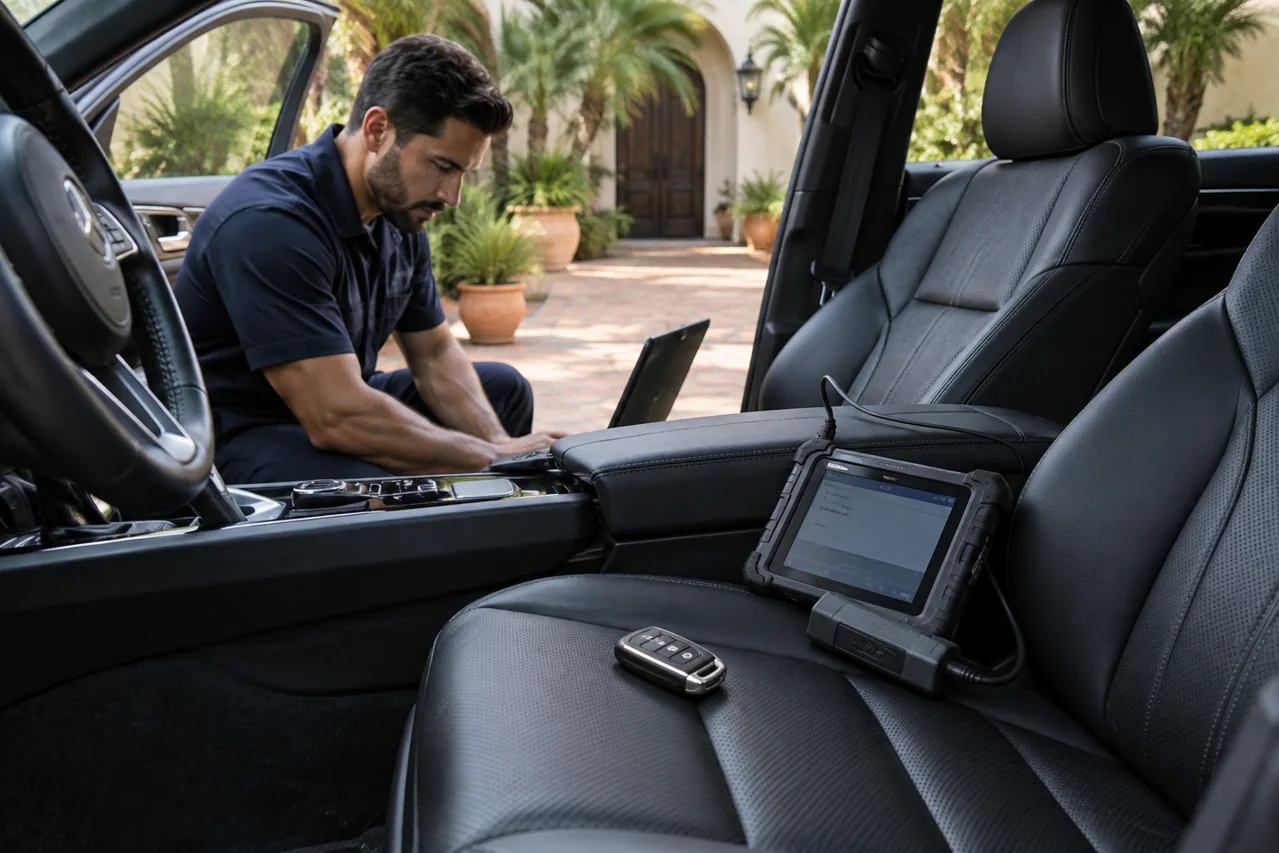
How car key problems look in a family subdivision
Atascocita grew as a collection of planned neighborhoods near Lake Houston, with winding streets, community entrances, parks, schools and shopping centers. Most households own more than one vehicle, and many own three or four. In a house like that, a car key is not a personal item. It is a shared object that passes between parents, teens, grandparents and friends, and it ends up in backpacks, gym bags, sports duffels and the pockets of whoever was driving last.
That is why the key calls in a place like Atascocita tend to be about sharing and wear rather than dramatic losses. A key that nobody remembers handing over. A fob that has been through the washing machine. A teenager who swears the key was on the hook. A spare that was never made because the original always worked. An SUV that suddenly says it cannot find the key.
This page explains how a mobile locksmith helps with these situations, what to prepare before calling, how to avoid repeating the problem and when to stop trying things at home. It does not offer methods for getting into a vehicle, which belong with trained professionals who can confirm ownership first.
Family SUVs and smart keys
Many family vehicles in this part of the Houston area are midsize or full-size SUVs and crossovers, and most recent models use smart keys that work by proximity. You keep the fob in your pocket or purse, touch the door handle, and press a button to start the engine. That is convenient, but it also means the fob can slip into a bag unnoticed, be left in a coat pocket or drop out as someone climbs into the third row.
When a smart key is lost, the car must be taught to accept a new one, and the old one should be removed from the car's memory so that whoever finds it cannot start the vehicle. A technician can program a new smart key on site for many vehicles, and can often delete lost keys from the system as part of the same visit. Ask about this on the call. Our page on smart key replacement gives the basics, and push-button start keys describes the start button side of it.
If your SUV shows a message that the key is not detected, try a few simple things before assuming the fob is lost. Replace the coin battery, hold the fob against the start button or in the spot the owner's manual describes, and make sure no other electronic device is pressed against it. If the message persists, the fob may be damaged or may need to be re-paired with the vehicle. Our page on the key not detected message explains the common causes.
Pickup trucks, towing and weekend lake trips
Atascocita sits near Lake Houston, and weekends bring boats, trailers, kayaks and trucks loaded with gear. Truck keys can have their own quirks. Many trucks use a transponder key with a thick plastic head, or a remote head key, and some of the newest have smart keys. Work trucks may even have keys that are shared among crew members, which means they are lost more often than a personal vehicle's key.
If you tow a trailer, a key problem hits at inconvenient times: when the trailer is hitched, the boat is wet and the ramp line is behind you. Tell the dispatcher about the rig when you call, because the technician will need to work around it, and you may need to move the whole setup out of the way before work begins. Do not try to roll a truck by hand, and do not let others push a locked vehicle, because that can damage the steering lock.
Truck keys are also valuable for what they unlock beyond the cab. Many trucks have a toolbox lock, a tonneau cover lock or a separate key for the tailgate. If you lost a ring that held several of these, say so. Some of these locks use different keys than the ignition. Our page on truck and box truck keys covers the larger picture for work vehicles.
- Say whether the truck has a trailer attached and where it is parked
- List any other locks on the same key ring, such as a toolbox or tonneau cover
- Never push or roll a locked vehicle, since this can damage the steering lock
- Give the dispatcher the make, model and year, and the key type if you know it
Teen drivers and the spare key problem
Teens are a big reason families need key help. A newly licensed driver borrows the car, loses the key and does not mention it until the next morning. Another teen holds a spare and loses that one too. Or a teen, understandably anxious, tells a parent the key is gone after a long search that included three friends' cars and a school locker.
A few practical steps make this easier. First, have the teen retrace the day calmly, including every stop, every car they rode in and every bag they carried. Second, check whether a spare exists and who holds it. Third, if the key cannot be found, decide whether the vehicle can stay where it is until a technician arrives or must be moved. If the teen is stuck at a school lot, a ball field or a friend's house, tell the dispatcher the exact address.
Remember that a locksmith must confirm ownership. If the vehicle is registered to a parent, the parent should be reachable by phone, and the technician may ask to speak with them. A teen alone may not be able to prove they are allowed to authorize a new key. Planning for this by keeping a photo of the registration on a parent's phone can save a lot of time. Our guide for teen driver spare keys goes into the family side of this.
A valuable choice, if the lost key might be in the wrong hands, is to have the vehicle reprogrammed so that the missing key can no longer start it. That is a matter of safety and not just convenience, and the dispatcher can explain how it works for your vehicle.
Getting service inside gated and managed communities
Many Atascocita neighborhoods have community entrances, and some are gated. A mobile technician needs a way in, which means you or a resident must be ready to tell the gate or approve the entry. Give the dispatcher the neighborhood name, the street and the house number, and let them know whether a guard, a call box or a resident list is involved. If the vehicle is parked at a community amenity such as a pool, a park or a clubhouse, mention that instead.
Homeowner associations often have rules about vehicles parked on the street or in common areas, and some have rules about service vehicles. In most cases, a locksmith working on a personal car in a driveway or a normal parking space is no issue, but it does not hurt to check if you are unsure. If you are in a driveway, make sure the technician can park without blocking a neighbor.
If you are not at home when the technician comes, make sure someone is. A technician cannot make a key for a vehicle without the owner or an authorized person present to confirm identity. If the owner is away and a family member must stand in, talk to the dispatcher beforehand about what proof is needed.
What happens during the visit
A typical visit starts with a simple check of identification and ownership. The technician looks at your photo identification and a registration, title or insurance card showing the vehicle belongs to you or a person who authorized the work. They then look at the vehicle itself and identify what kind of key it uses.
If the vehicle uses a basic mechanical key, the technician cuts a new one. If it uses a transponder key, they cut and program it so the immobilizer accepts it. If it uses a remote head key, they add remote programming. If it uses a smart key, they pair it with the vehicle. If every key is lost, the process is longer, because the technician must generate a key from the vehicle's identification information. For a plain-English outline, see our page on car key replacement.
When the new key is ready, test it thoroughly. Lock and unlock the doors with the key and with the remote. Start the engine several times. Turn the ignition fully on, off and back. Check any trunk or glove box lock that the key is supposed to open. If anything feels off, ask the technician to fix it before you pay.
The quote is always given by phone, never as a surprise on the driveway. A service call charge is explained before the technician is dispatched. A more complicated job can need an on-site visit before a final number is set, and the dispatcher explains that process during the call.
- Call with the vehicle details, the neighborhood and the key situation.
- Hear the service call charge and the quote for the work by phone.
- Arrange gate or community entry so the technician can reach you.
- Show identification and ownership paperwork to the technician.
- Test the new key fully before you pay.
Keys that are not lost but failing
Plenty of Atascocita calls are about keys that still exist but no longer work. A fob that needs three presses, a key that turns hard, a button that sticks and a remote that works only at arm's length are all signs. Family vehicles take a lot of abuse. Keys are dropped on driveways, tossed in bags, left in hot cars and soaked in rain, and Houston humidity does not help.
If a fob is unreliable, begin with a fresh battery. If that does not help, the contacts may be dirty or the fob may be worn. A technician can often replace the shell, clean the contacts or reprogram the fob. A fob that has lost its programming after a battery change or a long period without use may simply need to be re-paired. See key fob programming for an outline.
If a key turns hard in the ignition, stop pushing it. The cause could be a worn key, a worn cylinder or a steering lock that is binding. Try gently turning the steering wheel left and right while turning the key, because a steering lock under load can hold the cylinder in place. If that does not help, do not force it. A technician can inspect the ignition and decide whether repair is worth it. Our page on when a key will not turn the ignition describes the common causes.
School runs, sports and the long day in the car
A family vehicle in Atascocita often works from early morning until late evening. It does the school drop-off, a commute, a pickup line, practice, a grocery stop and a ride to a friend's house. Every stop is a chance for a key to be set down, handed off or dropped. The most common spot for a lost fob is not a dramatic place but a mundane one: the cup holder of another parent's car, a seat at a ballfield, or the bottom of a gym bag.
If you lose a key mid-day, resist the urge to drive home for a spare if the car is still running with a child inside, and never shut off a vehicle you cannot restart. With many push-button vehicles, the engine keeps running after the fob leaves the car, and the car will only warn you. Some models stop warning after a short while. Turning off the engine in that situation can leave you stranded with no way to restart it. If your key is gone, keep the vehicle where it is when it is safe to do so and call.
If you are in a pickup line or a crowded lot, tell the technician which lot and which entrance. School and sports lots can have rules about outside vehicles, and a quick call to the front office can save a delay. Be mindful that a technician cannot create a key without confirming ownership, so you will need to be present with your identification.
Habits that keep a busy household out of trouble
In a household with several drivers, a few rules help a lot. Keep one hook or bowl for keys and train everyone to use it. Keep a spare for each vehicle in a place that is not the vehicle. Take a photo of each registration and store it in a shared family folder. If a key is lost for even a day and there is any chance it left the house, consider whether the car should be reprogrammed.
Remove the key from a heavy ring when driving if the ring holds many items. The extra weight can wear the ignition cylinder and cause problems over time. A lightweight ring is far kinder to the ignition than the repair it prevents. Our guide on why you need a spare key now explains why a spare made while you still have a working key is simpler than one made after everything is lost.
Calling from Atascocita
If you are at home or at a lot somewhere around Atascocita and the key problem has you stuck, gather the vehicle details and call. The dispatcher will ask where you are, what the vehicle is and what happened. They will explain the service call charge, give you a quote by phone and tell you what is possible for your area and your hour. Call and talk it through.
Questions people ask
Can a technician come to my driveway in a gated subdivision?
Yes, as long as they can get through the entrance. Give the dispatcher your neighborhood, street and house number, and say whether there is a guard, call box or resident list. Be ready to approve entry. If the vehicle is at a pool, park or clubhouse instead, mention that location, and make sure the technician can park safely.
My teenager lost the only key. Who needs to be there?
The technician has to confirm the vehicle belongs to the person authorizing the work. If the car is registered to a parent, that parent should be reachable and able to share proof, such as a registration photo. A teen alone may not be able to authorize a key, so plan ahead with the dispatcher about what is acceptable.
Should I reprogram the car if a key is missing but might turn up?
If there is a chance the key left your control, reprogramming the car so the missing key no longer starts it is the safer choice. If you are sure it is in the house, you may not need it. A dispatcher can explain how this works for your vehicle and whether it is done during a new-key visit.
My SUV says the key is not detected. Is the fob lost?
Not necessarily. A weak coin battery is the most common cause. Try a fresh battery and hold the fob against the start button as your manual describes. If the message continues, the fob may be damaged or may need re-pairing. A technician can diagnose it. Do not keep trying random fixes, which can make the problem harder to trace.
How are quotes handled for car key work?
Quotes are given by phone only. A service call charge applies and is explained before anyone is sent. The price depends on the vehicle, the type of key and how many working keys remain. Complicated jobs may need an on-site visit before a final price. Ask questions on the call, so you know what to expect.
Can the same visit cover a spare key?
Often yes, and it is a smart time to do it. If a technician is already programming a key, adding a spare usually costs less effort than a separate visit later. Ask about it on the call so the technician brings enough blanks. You will hear the quote for both keys by phone before anyone arrives.
Describe the situation by phone and we will tell you what the job involves. Quotes are given by phone. Jobs that cannot be quoted without seeing them need a technician on site, and the service call charge is explained on the phone before anyone is dispatched.
(713) 574-7660Related pages
Written by Claude (AI) (AI) for Houston Car Key Locksmith.