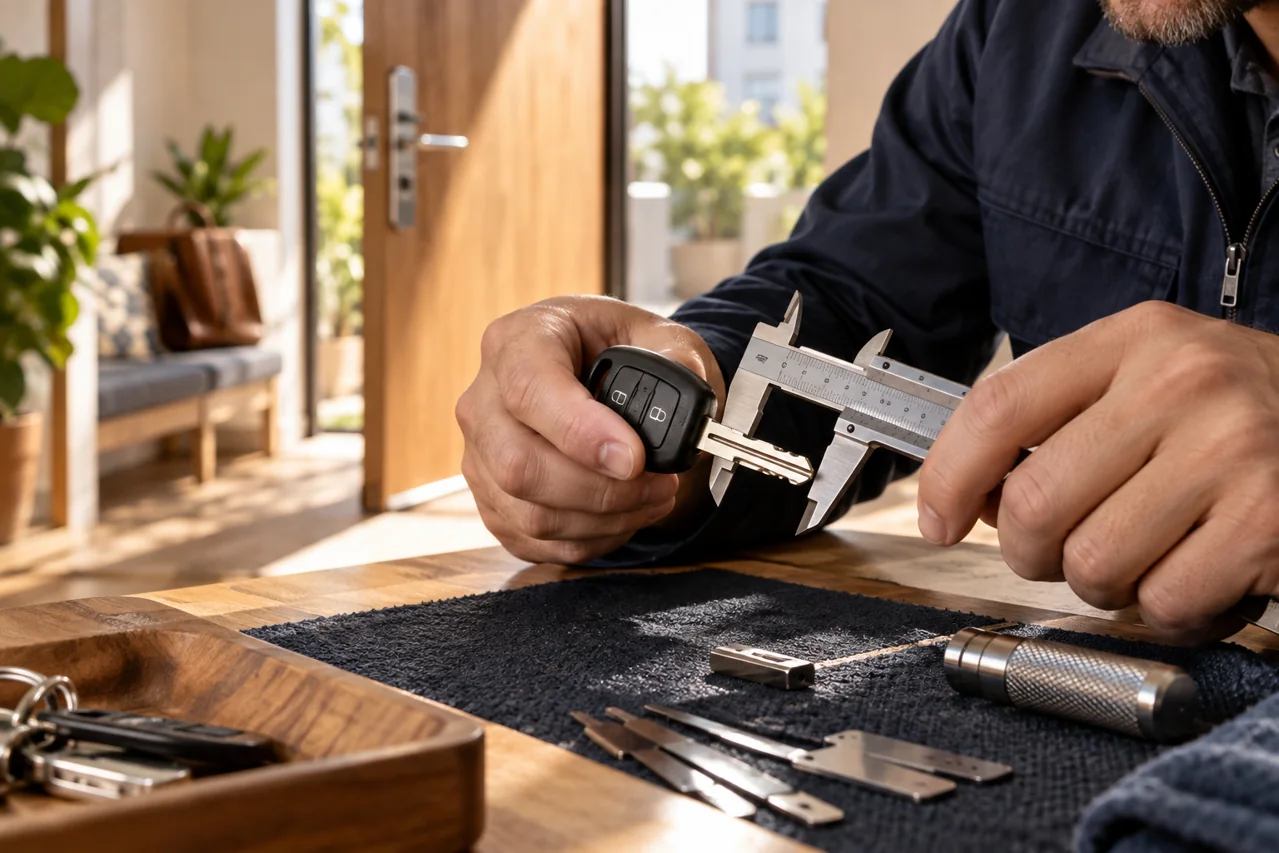
What a key finder tag is
A key finder tag is a small device that attaches to a key ring or sits inside a fob case. It contains a battery and a short range radio, most often Bluetooth. It pairs with an app on your phone so that you can see roughly where the tag is, or make it play a sound when you are nearby.
Some tags connect only to your phone. Others can also use a network of other people's phones to report their location when they are far from you. This crowdsourced approach depends on the brand and on how many compatible phones are around. In a dense area such as central Houston, there are plenty. In a quiet rural spot, there may be few.
A tag is not a part of your car's key system. It does not start the car, unlock the doors or talk to the immobilizer. It is simply a companion device that helps you locate the key ring. Understanding that clearly sets the right expectations.
What tags do well
Tags are very good at solving the ordinary problem of misplaced keys. If you have put them down somewhere in the house, in the car, or at a friend's place, a tag lets you ring it and follow the sound. For people who often lose keys in a cluttered home, that is a real convenience.
They can also help when you leave keys behind in a public place. If the tag supports a location network, the app may show where it was last seen. That can point you to a restaurant, a gym or a parking lot where the keys were left, so you can go back and ask.
Some tags also work in reverse, letting you press a button on the tag to make your phone ring. For people who often misplace the phone as well as the keys, that is a useful extra. In short, tags reduce the number of moments when you are stuck searching, which is exactly the situation that leads to rushed decisions.
- Ring the tag to find keys within a room or a house
- See the last known location of keys left in public
- Get a reminder if you walk away without the keys
- Locate a phone by pressing the tag, on models that support it
- Share a tag with family members in some apps
What tags cannot do
A tag cannot replace a key. If the key itself is lost, broken, or stolen, the tag may help you find it but cannot open your car. If the key has fallen down a storm drain, been carried off by someone else, or been left somewhere you cannot reach, the tag shows you where it is but does not solve the problem.
A tag also cannot protect the car. It does not stop theft, it does not secure the fob signal and it does not change how the car responds. In fact, a tag adds a radio to the key ring. That is not a problem in itself, but it is not a security feature.
Finally, a tag cannot work when its battery is dead, when it is out of range of any compatible phone, or when it has been shielded by a signal blocking pouch or a metal container. Keep these limits in mind, and treat the tag as a helpful tool and not a safety net.
Battery and range limits
Tags run on small batteries that last for a limited time, often months to a year or more depending on the model and how often it is used. When the battery weakens, the tag may become unreliable without warning. Check the battery on a schedule, and replace it before it fails, just as you would for a key fob.
Range is another limit. Bluetooth works over a short distance, and walls, furniture, metal and even your own body reduce it. A tag may be easy to find in the same room but difficult to find across a large building or a big parking lot. The location network helps at longer distances but is not instant and not exact.
Heat is a concern in Houston. A tag left in a hot car or a sunny dashboard can age quickly, and some batteries swell or leak when exposed to sustained high temperature. Do not leave tags or key rings in a parked car in summer. See summer heat and car keys for more on this.
A tag versus a phone app that shares location
Many phones already offer a way to find a lost device, and some car makers provide apps that show where the vehicle is parked or let you start it remotely. These are different from a key tag. A phone app helps you find the phone or the car. A tag helps you find the key ring.
If you often lose your phone, your keys and your wallet, a set of tags can solve all three. If you mostly lose your car in a big parking lot, an app from the car maker or a tracker placed in the car may be the better choice. Think about what you actually misplace and why.
Also think about privacy. A device that reports its location can be useful or intrusive depending on who has access. Review the app's settings, protect your account with a strong password and think about who you share a tag with. Do not use a tag to follow another person. That is both unethical and, in many places, illegal.
Where to attach the tag
Attach the tag so it does not interfere with the key or the fob. A tag that dangles from a heavy key ring adds weight to the ignition, which over time can wear the ignition cylinder. A smaller, lighter tag on a short loop is better. If you carry many keys, consider removing the ones you do not need daily.
Do not attach a tag in a way that blocks a fob button or covers the emergency blade slot. Some tags fit into a fob case, but check that they do not press on the buttons or loosen the battery cover.
Avoid a tag that identifies you or your address in its label. If the keys are found by a stranger, you do not want them to have a way to find your home or your car. A tag that rings is more useful than a tag that publishes your details. Read ignition repair if you notice stiffness or wear that could be linked to a heavy key ring.
Why a tag is not a spare key
People sometimes feel that once a tag is on the keys, the risk of being stranded is solved. It is not. The tag helps you find the keys when they are lost, but many lost key situations are not about location. Keys are stolen, broken, dropped in water, swallowed by a drain, or locked inside the car. None of these are fixed by knowing where the key is.
A spare key remains the real solution for being able to open and start the car when the main key is not available. A tag and a spare work together. The tag reduces the number of times you lose the keys, and the spare protects you when you lose them anyway. See why you need a spare key now and where to keep a spare key.
Put differently, a tag is a convenience and a spare is a safeguard. If you only have budget or time for one, choose the spare. If you can do both, you are well covered.
Using a tag with a smart key or fob
Smart keys and fobs are more expensive and more delicate than plain keys, so losing one is more costly and more disruptive. A tag can be especially helpful here. Because a smart fob can be dropped in a bag, left in a pocket of a jacket or lost under a car seat, the ability to ring it is valuable.
Check that the tag does not interfere with the fob's signal or battery door. Some tags are thin enough to slide into a fob holder. Others are bulkier. Choose one that does not force you to remove the fob case or carry a heavy bundle.
If your fob is lost, remember that a tag does not stop someone else from using it. If the fob falls into the wrong hands, it may still unlock the car. In that case, talk to a technician about removing the lost fob from the car's memory. See key reprogramming after theft.
Habits that beat any gadget
The simplest way to avoid losing keys is to give them a home. Choose one hook, bowl or pocket and always return the keys to it. Make it automatic. A habit like this prevents far more losses than a device.
Before you leave a place, pat your pockets or check your bag. Make this part of how you stand up from a table or leave a car. Many lost key incidents come from a moment of distraction, such as answering a call or carrying shopping, and a quick check closes that gap.
Keep your spare and your main key apart, and keep them in the right places. A tag is a handy extra on top of these habits, not a replacement for them.
A few realistic scenarios
A teacher in Humble leaves her keys on a classroom desk on a Friday and realizes in the parking lot that they are missing. The tag on the ring plays a sound when she returns to the building, and she is on her way within minutes. In that case, the tag saved her a long wait and a call for help.
A visitor at a Galveston beach sets keys on a towel, and they are knocked into the sand. The tag helps her follow the sound to the spot. Yet another visitor loses keys to the surf, where a tag cannot help once the battery is waterlogged and the signal cannot travel through water. A tag has limits, and water is one of them.
A driver in Spring has keys stolen from a gym locker. The tag shows the keys moving away. That information is useful to the police, but the car is still at risk, since whoever holds the key may be able to use it. The right response is to call the police and have the lost key removed from the car's memory where possible. A tag cannot protect the car on its own.
When to call for help
If the keys are gone and the tag shows them somewhere you cannot reach, or shows nothing at all, call. A technician can often make a new key on site, remove the lost one from the car's memory where possible, and get you moving. If a key is broken or stuck, do not force it. Leave it for a professional.
If you want a spare, or advice on a smart fob, call before there is a problem. Tell us the year, make and model of your vehicle and what you carry now. We will explain the process, give you a quote by phone, and set up a visit that fits your day.
Questions people ask
Can a tag unlock or start my car?
No. A tag is a separate device that helps you find your key ring. It does not communicate with the car's lock or immobilizer, so it cannot unlock the doors or start the engine. You still need a working key or fob for that, which is why a spare remains important.
How long does a tag battery last?
It varies by model and use, often months to a year or more. A weak battery can make the tag unreliable without warning. Check it on a schedule and replace it before it fails. Avoid leaving tags in a hot car, since heat can shorten battery life.
What if the tag shows my keys but I cannot reach them?
Knowing where the keys are does not help if they are in a drain, behind a locked door or with another person. In that case, a technician can often make a new key and remove the lost one from the car's memory. Call and describe the situation, and we can explain what is possible.
Is it safe to put my address on the tag?
It is better not to. If a stranger finds your keys and sees your address, they could link the keys to your home and your car. A tag that rings or reports location is more useful than a label with personal details on it.
Will a tag wear out my ignition?
A heavy bundle on the key ring can strain the ignition cylinder over time. Use a light tag, keep the ring short and remove unneeded keys. If your ignition feels stiff or worn, have it checked rather than waiting for it to fail.
Do I still need a spare if I use a tag?
Yes. A tag helps you find keys you have misplaced, but many problems are not about location. Keys get stolen, broken, dropped in water or locked in the car. A spare solves those cases, so the two tools work best together.
Describe the situation by phone and we will tell you what the job involves. Quotes are given by phone. Jobs that cannot be quoted without seeing them need a technician on site, and the service call charge is explained on the phone before anyone is dispatched.
(713) 574-7660Related pages
Written by Claude (AI) (AI) for Houston Car Key Locksmith.