Why events are hard on keys
Concerts, football games, rodeo nights, festivals and fireworks shows all share the same pattern. Thousands of people arrive at once, spend hours in a crowd, then leave at the same time. Keys travel in back pockets, small bags and the pockets of jackets that get passed around. Standing, dancing, jostling and crowding all push keys out of places they would normally stay.
The environment makes losing a key more likely and finding it harder. Dark seating areas, loud rooms and sticky floors mean that a dropped key may slide under a seat and be unnoticeable. Some venues have bag policies that force people to leave bags in the car or carry small clear bags, which changes where keys end up. Others have a lot of walking between a distant lot and the gate, with several chances to drop something along the way.
There is also the human side. Tired people, a few drinks, a long walk and a rush for the exit are a recipe for confusion. The loss may only be noticed at the car door, long after the place the key fell has been cleared out.
None of this means you were careless. It means the situation is predictable and that a calm sequence of steps works best.
The first moments at the car
If you reach your car and cannot find the key, stop and check before you walk back. Look through the windows to see if the key is on a seat or the floor. Check the ground around the car, including under the car and between the car and its neighbors. Check the trunk, if the trunk has a separate remote or the key might be in a bag in the trunk.
Then check yourself and everyone with you. Go through every pocket twice. Ask each person if they have the key, if they picked up your jacket or if the key went into a shared bag. A key held by a friend who has already left is a very common story, and a phone call can solve the problem in a minute.
If a passenger has a key, a spare or a phone app that can unlock the car, use it. Many newer cars have a manufacturer app that can lock, unlock and sometimes start the car with a subscription or an account. If you have set one up, it may be the quickest way in. A phone app generally cannot make a new key, but it can help you get into the car or locate it.
Make a note of exactly where the car is parked: the lot name, the row or section, any signs and nearby landmarks. After a big event, a lot with hundreds of identical cars can be confusing, and you will need to describe the place clearly to anyone helping you.
Where to look and who to ask at the venue
If the key is not at the car, the next step is to look at the places you have been. Retrace your path from the gate to the seats, to the restrooms, to the concession stands and back. Ask whether the people sitting near you saw anything.
Venue staff are your best resource. Most large venues have a lost and found desk or a guest services office, and many have a process for items turned in by cleaning crews after the event. At the end of the night the crews walk the seating areas and bring back keys, phones and wallets. Staff may tell you to call the next day, because lost property is often sorted after the event is over. Take the details of where to call and which hours to call.
Security staff and ushers can also help. Ask the staff at your section, the nearest gate and the parking attendants. If a key was handed in, they may know. Give your name, your phone number and a description of the key: make, color, any key ring, any fobs or tags, and the car it belongs to. Do not offer too many identifying details publicly, because anyone listening might claim the key. The staff can ask you to describe the key and compare it with what they have.
If the event was at a public place, such as a park or a stadium plaza, the same applies: ask the nearest information point and, if needed, the local police non-emergency line about found property.
- Ask guest services, lost and found or the event office first.
- Ask the staff and ushers for your section and the nearest gate.
- Give your name, phone number and a description of the key and any ring or tag.
- Ask when and where to call the next day.
- Check with the parking operator in case the key was turned in at the lot.
Overflow lots, shuttles and what changes after hours
Houston's big venues use a mix of garages, surface lots, overflow fields and street parking, and many events use shuttles. This matters for lost keys in a few ways.
Overflow lots are often temporary. A field or an empty lot may be opened for the event and closed when it ends, with limited lighting and a few attendants. If your car is in one of these, you may be asked to move it or leave by a certain hour. Tell the attendants that you have lost your key and ask whether the car can stay while you arrange a replacement. Be ready for the answer to depend on the venue's policy and the lot operator.
Garages have their own rules. Some close at a set time or charge extra after a certain hour, and a car left overnight may have to be addressed with the garage office the next day. Ask the attendant about their policy before you assume the car can wait.
If you came on a shuttle or a rideshare, you have more flexibility. You can go home, rest and arrange a replacement the next day without worrying about the car for the night. The risk is that a car left in a busy lot may be a target for break-ins. Lock it, remove valuables and tell the lot staff.
A mobile technician can reach many event lots, but lot access may be limited right after an event when the roads are full. A technician will ask about the exact entrance, and may suggest meeting you at a safe spot. The phone call settles the plan.
Replacing a key late at night
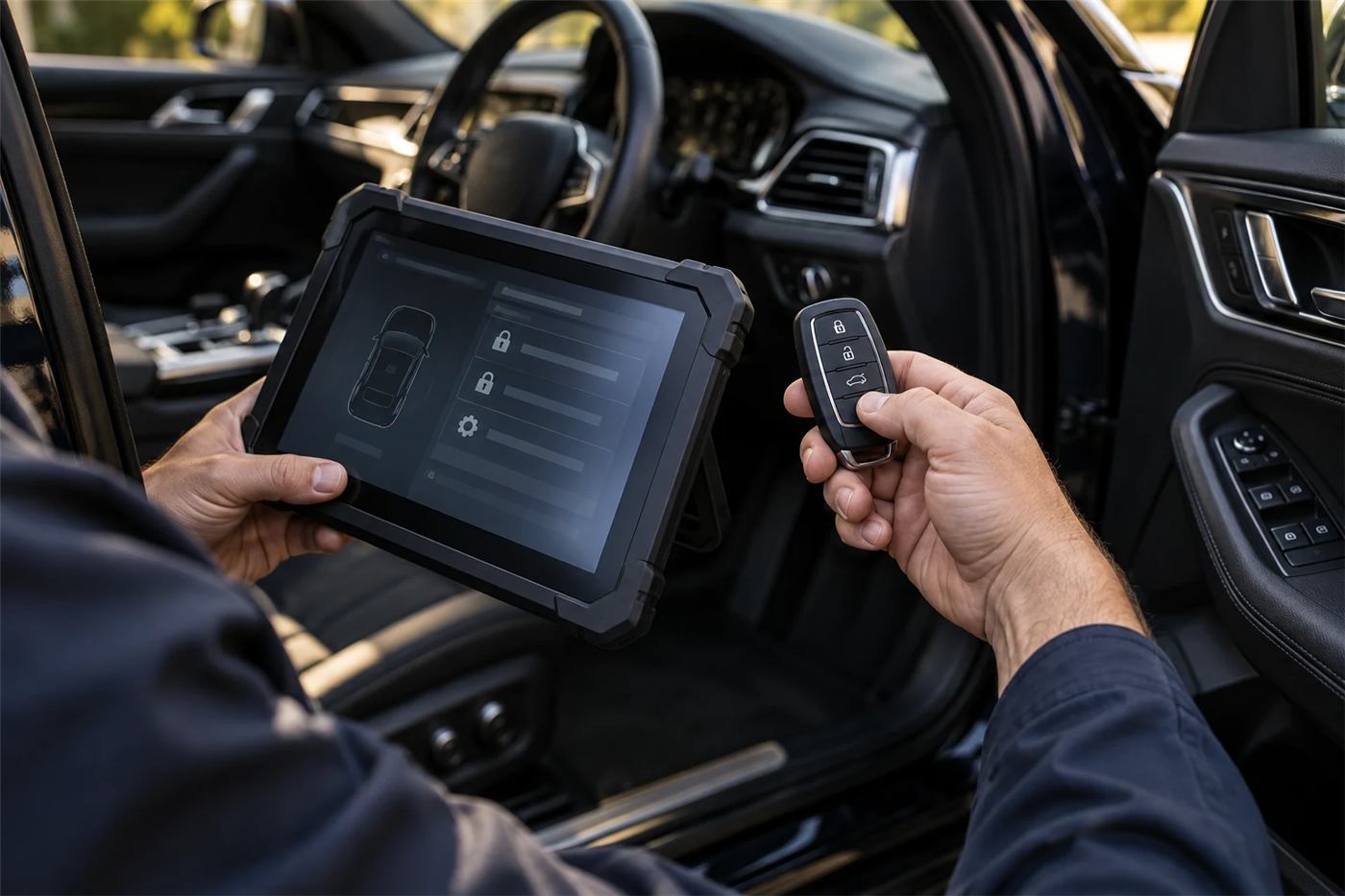
When the key cannot be found and you need to leave, a mobile locksmith can often cut and program a replacement at the car. Most modern cars need two steps: a physical key blade or a smart key shell that matches the car, and programming so the car's computer accepts the new key. Both can often be done in the lot with portable equipment.
The technician will ask for the make, model, year and whether it is a turn key or a push button start. They will also ask whether you have any key left. If you do, the work is simpler. If this was your only key, it is an all keys lost job. Our page on lost car keys at night explains what the call is like after dark.
Some vehicles take longer, and some luxury or European models need more preparation. A technician will tell you if the job is something that can be done on the spot or whether another visit is needed. Complicated jobs may need an on-site visit, and a service call charge applies and is explained on the phone before dispatch. Quotes are given only by phone.
Our after hours car key service page covers how the service concept works at night. We do not promise a technician at every hour in every place, and we will tell you plainly what is possible when you call.
Safety while you wait
Waiting in an emptying lot after dark deserves some thought. Large events draw crowds, and crowds thin out quickly. A lot that was packed an hour ago can be quiet and dim, and you may be on your own with a locked car.
Stay with a friend if you can. Wait near the venue's lit areas or near staff rather than beside the car in the middle of a dark field. If the event staff have a security office, ask whether you can wait there. Keep your phone charged and let someone know where you are.
Do not accept help from strangers who offer to open your car or make a key. Opportunists work event lots. A person walking up with a tool and a quick offer is not a service you can verify. A legitimate locksmith will arrive after you have called, will ask for proof of ownership and will confirm the work and the price on the phone first. See our guide to car key scams for signs to watch for.
If anyone feels unsafe, call 911. If a child or pet is locked in a hot or cold car, call 911 first, not a locksmith. Emergency crews can reach the vehicle quickly, and nothing about key work is more urgent than a person in danger.
Proof of ownership at an event
Making a key is only done for the owner or an authorized user. At an event you may have a photo identification in your pocket but no papers in the car, and the car's glovebox may be locked inside. Prepare for this conversation in advance.
A photo of your registration and insurance card on your phone is a sensible record to keep. Many people have these in a folder or an app. A technician will compare the vehicle, the name on the papers and your identification. The vehicle's identification number can be read from the dash through the windshield in most cases, so the technician can verify it against the paperwork.
If the car belongs to someone else, such as a friend, relative or employer, the owner's authorization will need to be confirmed. This can often be done by phone with the owner and a photo of their documents. Do not borrow a car and assume that is enough, because the technician will need a way to be sure.
Our guide on proof of ownership for keys goes through what is accepted. If you cannot show any, a technician will tell you plainly that they cannot proceed, which protects every car owner, including you.
If the key turns up later
Sometimes the venue calls the next day to say a key was found. That is good news but it does not always settle things. If you have already had a new key made, the old key may still work in the car unless the new key's programming removed it, and a lost key in someone else's hands is a security issue.
Many technicians will, if asked, program the car so that old keys are no longer recognized. This is the sensible choice if you suspect the key was taken rather than lost, for example if your bag was stolen at the event. It means anyone who finds the old key cannot start the car. The door lock may still turn with a plain blade key, so also think about whether the physical lock is a risk. If your belongings, including the key, were stolen, read our page on stolen car keys and file a police report.
If the key was found and the venue holds it, collect it as soon as you can and bring identification. Test it in the car before relying on it, and consider a spare if you do not have one.
If you are not sure whether a key was lost or stolen, ask the technician what they would do. The decision depends on your car and your risk.
Habits for the next big night
Preparation turns a bad night into an inconvenience. Before you leave home, think about where the key will travel. A zipped inner pocket, a small crossbody bag or a lanyard clipped to a belt loop is better than a loose back pocket. If you are in a group, put the key with the person least likely to dance, jump or drink too much, and tell the group where it is.
Keep a spare somewhere you can reach. A spare at home is of little help if home is far from the venue, but a friend who is not at the event can bring it. Read our spare key guide for the reasoning.
Take a photo of the car's location, the lot sign and the row. Save the photo with your registration and insurance card. Make sure your phone is charged before you leave the venue, because a dead phone makes every other step harder.
Finally, if the key does vanish, do not spend an hour in the cold hoping it will appear. Make a quick check, ask at the venue, then call. A clear description of the car, the lot and the situation is all a technician needs to start helping you.
Questions people ask
Where should I look first for a key lost at a Houston event?
Start with the car itself, looking through the windows and around the ground, then check every pocket and bag and ask friends who may have it. After that, retrace your path in the venue and ask guest services, the lost and found desk, ushers and parking staff. Keys are often turned in after the event, so ask when and where to call the next day.
Can I leave my car in the lot overnight while I arrange a key?
That depends on the venue and the lot operator. Surface lots and overflow fields may close, and garages may have closing hours or extra fees. Ask the attendant before assuming the car can stay, tell them you have lost your key and ask what they allow. If you leave the car, lock it and take valuables with you.
Can a mobile locksmith reach a stadium or festival lot?
Often yes, but access right after a big event can be limited by closed roads and traffic. The technician will ask for the exact lot, entrance and row, and may suggest a meeting spot. The phone call decides what is possible and when. We do not promise arrival times, and the quote and service call charge are explained by phone before dispatch.
What if I left my registration and wallet in the locked car?
A photo of your registration and insurance card on your phone, plus a photo identification if you have one, is a common solution. Tell the technician what you have. They can compare the vehicle identification number visible at the dash with your papers. If the owner is someone else, their authorization will need to be confirmed.
Should I worry that someone could use my lost key?
A lost key alone does not show which car it belongs to, but if your bag or wallet was stolen along with it, the risk is higher. In that case, ask the technician to program the car so old keys are no longer accepted, and file a police report. The physical door lock may still respond to a plain blade key, so keep the car in a secure place.
Is it safe to accept help from someone in the lot?
It is safer not to. Event lots attract opportunists, and you cannot verify a stranger's tools, credentials or intentions. Call a mobile locksmith yourself, confirm the work and price by phone, and be ready to show proof of ownership. If you feel unsafe, wait near venue staff or in a lit area, and call 911 for any emergency.
Describe the situation by phone and we will tell you what the job involves. Quotes are given by phone. Jobs that cannot be quoted without seeing them need a technician on site, and the service call charge is explained on the phone before anyone is dispatched.
(713) 574-7660Related pages
Written by Claude (AI) (AI) for Houston Car Key Locksmith.