Why a truck lockout feels different
A lockout from a personal sedan is annoying. A lockout from a work truck can cost a day. The truck may hold the tools a crew needs, the material for a job, the paperwork for a delivery or the only set of keys on site. If the truck sits on a busy road shoulder, a construction lot or a tight driveway, the pressure grows. People start looking for a quick fix, and quick fixes are where damage happens.
Pickups also differ from cars in ways that matter for a lockout. They sit higher. Their doors are heavier. Many have a rear sliding window, a cap or a tonneau cover, a toolbox bolted in the bed and a tailgate with its own lock. Some have a work-grade key with a plain blade and others have a transponder chip or a push-button fob. Older trucks may have a mechanical key only, while newer ones have layers of electronics.
The first thing to settle is what exactly is locked. Is it the cab door? The tailgate? A bed-mounted box? A canopy? Each uses a different lock and a different approach, and the answer determines who to call and what to say on the phone.
Cab locks versus toolbox and tailgate locks
The cab lock is the one tied to the vehicle's security system. On many trucks, the same key that opens the door also starts the engine, and a chip inside it communicates with the truck. If the key is locked inside the cab, the truck's doors are locked, and the key is out of reach, the job is a lockout. If the key is lost entirely, the job is a replacement, which is more involved. Our pages on keys locked in the car and truck and box truck keys explain both.
A toolbox lock is a separate matter. Many toolboxes use their own key, which may be a simple pin tumbler or a different pattern from the truck. A locked toolbox does not stop the truck from running and does not involve the vehicle's electronics. A technician approaches it as a standalone lock job.
Tailgates vary. Some lock with the same key as the cab and some link to the power door locks. Some trucks have a tailgate that unlocks from a button inside the cab or from the fob, so a locked cab can also mean a locked tailgate. Knowing which lock failed helps you describe the problem to the dispatcher in a way that gets the right tools sent.
Safe steps before you call
Take a breath and run through a short list. First, check every door. A passenger door, a rear door on a crew cab or a rear sliding window may be unlocked from when someone last used it. Do not climb through a window or force one that is closed. Second, confirm where the key is. If you can see it through the glass, it is a lockout. If you cannot, think about when you last held it. It may be in a jacket pocket, a toolbag or on the dashboard of another vehicle.
Third, ask the crew. On a job site, another person may have a spare, or the employer may keep a spare at the yard or the office. Calling the yard first can sometimes resolve things sooner than waiting for a technician. If the truck belongs to your employer, tell your supervisor, since there may be a policy about who is allowed to call a locksmith and who pays.
- Check all doors, including crew cab rear doors.
- Confirm where the key actually is before assuming it is inside.
- Ask whether a spare exists at the yard, the office or with another driver.
- Move yourself and any people out of traffic and away from heavy equipment.
- Keep the engine off if you can; do not leave a running truck unattended.
Window and cab cautions
People often reach for a coat hanger, a plastic strip or a wedge. We do not give instructions for bypassing a lock, because the risk of damage is high and the methods differ by truck. Doors on pickups contain wiring, side airbags in many models, power window motors and linkage rods. A wedge pushed in the wrong place can bend the door skin, tear the weather stripping or snap a link that then costs far more to repair than the lockout.
Breaking a window is a last resort for a real emergency, such as a person or animal in danger inside. It leaves the cab open to weather and theft, glass ends up in the seats, and a replacement window must be arranged. Do not break the rear sliding window to reach through, either; the frames are delicate and the glass is expensive to replace.
If a person or animal is trapped inside, call 911 first. For a lockout where only the key is inside, wait for a trained technician who can open the truck without damaging it. A mobile locksmith carries tools designed for the job and knows how the locks and door structures of common pickups are built.
What a mobile technician checks on a truck
When the technician arrives, the first step is to confirm the truck and the person asking for help. Expect to show photo identification and a document that connects you to the vehicle, such as the registration or a company authorization. If the truck belongs to an employer, a call or a message from the fleet manager can serve as proof. This step protects the owner and is standard for any reputable provider.
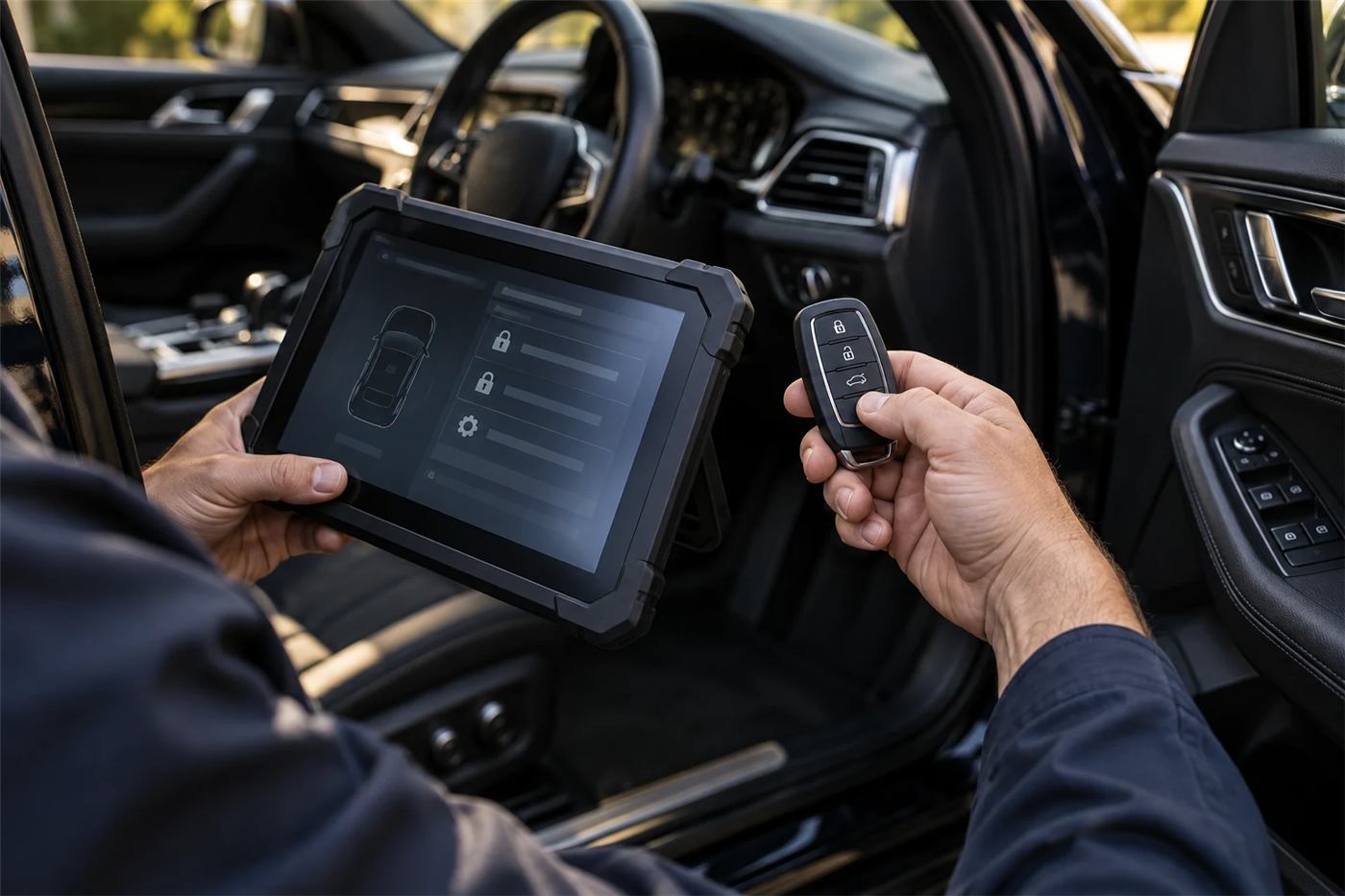
The technician then looks at the lock type, the age of the truck and whether it has a standard door, a crew cab, a power lock system or a keyless entry pad. Based on that, a method is chosen that suits the truck. Work trucks may have worn locks, mud or dust in the keyway, or a door that has been repaired, and the technician takes those into account.
After the door is open, the technician can check whether the key is simply locked inside or whether other problems exist, such as a worn key, a failing lock cylinder or a fob that has lost its programming. If a spare key or a duplicate is needed, it can often be arranged in the same visit. See fleet vehicle key service for work that involves more than one vehicle.
Employer and fleet notes
If the truck is part of a fleet, a few extra steps help. Tell the dispatcher who owns the vehicle, who is authorized to approve work and how the invoice is handled. A company that runs several trucks may want a single point of contact and a written record of each visit. Having a clear policy in place means a driver on a remote site does not have to guess whether a locksmith call is allowed.
Fleet trucks often share keys among several drivers, which raises the odds of a lockout. Keys get passed at shift changes, left on tailgates and lost in toolboxes. A tidy key-handling routine, such as a sign-out board or a lockbox at the yard, cuts those events. Some fleets add a spare key for each truck kept in a secure office cabinet.
If a driver loses a key entirely, the employer may prefer to replace it and remove the old one from the truck's memory, especially if the driver leaves the company. A technician can program a new key and remove an unaccounted one on many vehicles. Details depend on the make and model, and the dispatcher can explain what is possible when you call.
When the key is lost, not just locked in
A lockout means the key exists and is locked inside. If the key is truly gone, it is a lost key situation. On a modern pickup, that means making a new key and programming it to the truck. The technician needs the vehicle's identification information and proof of ownership, then cuts a key to match the lock and teaches the truck to accept it.
Trucks with push-button start and smart keys need a smart key to be programmed. Those jobs depend on the make and year, and some require access to the vehicle's security system. A technician can do many of them at your location, which saves a tow. If a truck must be moved, the dispatcher will tell you that on the call.
Whatever the case, say plainly on the phone whether the key is locked inside or lost. It changes the equipment and time the technician plans for. See all keys lost car key service if every key is gone.
Quotes, service call charges and job site access
Quotes are given by phone only. The dispatcher will ask for the truck's make, model and approximate year, the location, and what exactly is locked. A service call charge applies to dispatching a technician, and it is explained on the call before anyone is sent. Complicated jobs, such as a lost key on a late-model truck or a lock with damage, may require an on-site visit to assess them.
Access matters on job sites. If the truck is behind a gate, in a secured yard or in an active work zone, tell the dispatcher what the technician needs to enter. Arrange for someone to meet them at the gate if required. Mention any safety rules, such as protective footwear, a vest or check-in at a trailer. A technician will follow site rules.
Give a clear address or a nearby cross street, and say how to find the truck once inside the site. A site with dozens of similar pickups can slow a visit. If you have a color, plate number or a unit number painted on the door, say so.
Keeping crews moving: prevention that works
Most truck lockouts come from habit. Keys get left in a cup holder or on a seat while a driver climbs into the bed, shuts the door to keep out dust or steps away to a trailer. Train crews to hold the key until they are clear of the truck and the door is closed. Use a lanyard or a belt clip. Keep a spare in a secure place, not in a magnet box under the bumper, where thieves look first.
Know your truck's lock behavior. Some pickups lock automatically at a set speed or after a set time. Some lock when the fob moves away. Some allow a keypad on the door to unlock without a key, and if yours has one, make sure the crew knows the right way to use it and that the entry number is kept private.
If your crew has just been locked out of a truck, or you want to plan a spare for the next one, call and describe what you have. We will explain how the visit works, what proof to have ready and how the service call charge is handled before a technician is dispatched.
Questions people ask
Can the toolbox in my truck bed be opened by the same technician?
In many cases yes, but a toolbox lock is separate from the cab lock and may need different tools. Tell the dispatcher when you call that the box is locked as well, and describe the brand if you know it, so the technician arrives prepared.
What if the truck belongs to my employer?
That is common. The technician will ask for proof that you are authorized, such as a call or message from the fleet manager or a company letter. Tell the dispatcher who owns the truck and who approves the work, so the visit and the paperwork go smoothly.
Is it safe to break the rear sliding window to reach the lock?
It is not recommended. The glass is costly to replace, the frame is delicate and the cab is left open to weather and theft. Only in a real emergency, such as a person or animal in danger, should glass be broken, and 911 should be called first.
Do trucks with push-button start need extra care?
They can. If the smart key is locked inside, the technician opens the door and you retrieve it. If it is lost, a new smart key must be programmed, which depends on the make and year. Tell the dispatcher the model and whether the truck uses a push button.
Can you meet me at a job site behind a gate?
Mobile technicians travel to job sites, but gates, check-in rules and safety requirements matter. Tell the dispatcher about access, arrange for someone to meet the technician if needed, and share the site address and any rules, such as required vests or footwear.
How are prices handled for a work truck lockout?
Quotes are given only by phone. A service call charge for dispatching the technician is explained before anyone is sent. If the job is complicated, an on-site visit may be needed, and you will hear about that before work begins.
Describe the situation by phone and we will tell you what the job involves. Quotes are given by phone. Jobs that cannot be quoted without seeing them need a technician on site, and the service call charge is explained on the phone before anyone is dispatched.
(713) 574-7660Related pages
Written by Claude (AI) (AI) for Houston Car Key Locksmith.