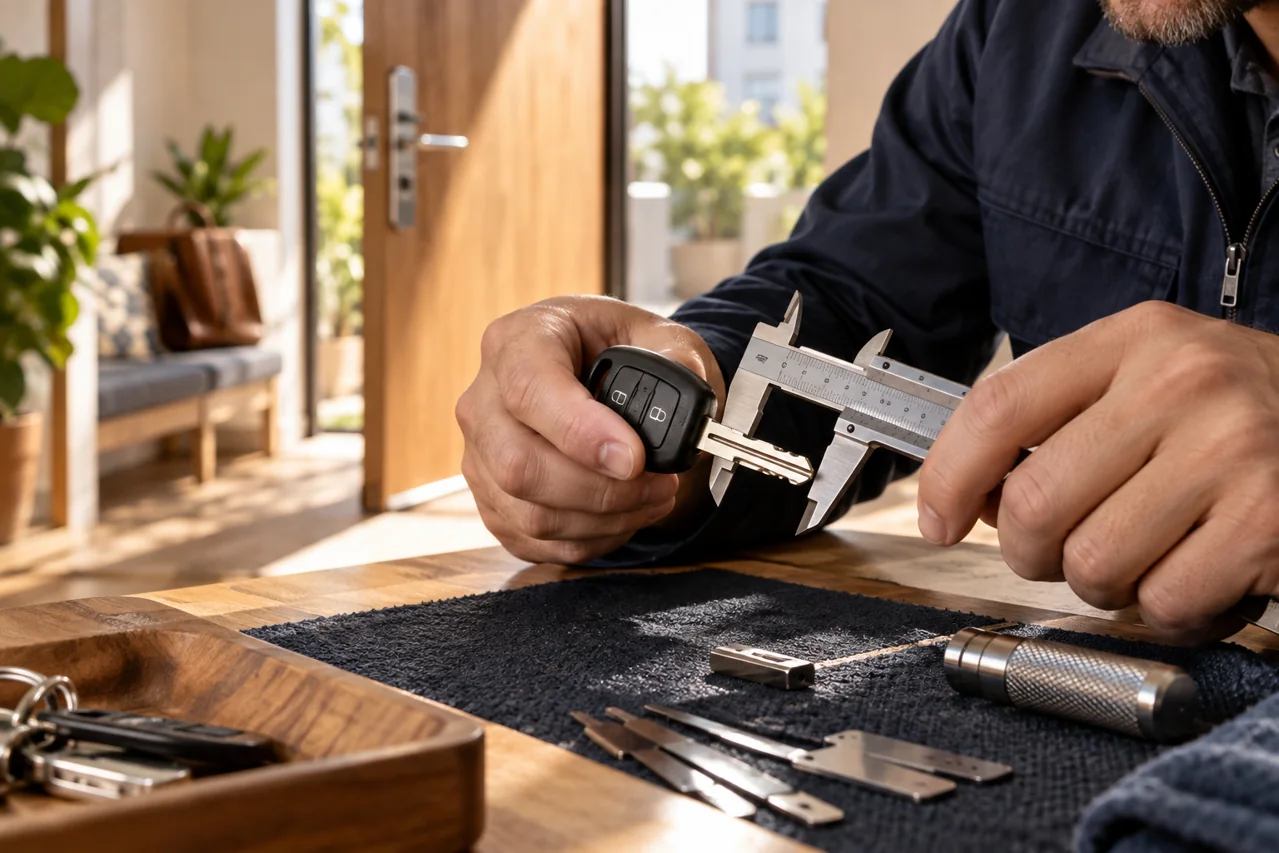
What on-site key cutting means
On-site, or mobile, key cutting means the technician brings the cutting equipment and the programming tools to the place where your vehicle is parked. That could be a driveway, an apartment lot, a parking garage, an office lot, a job site, or a safe spot at the side of a road. The key is cut and coded there, tested in your vehicle, and handed to you before the technician leaves.
The practical benefit is simple. A car with no working key cannot be driven, and moving it means arranging a tow or a flatbed. Mobile service removes that step. The work happens where the car sits, and you do not need to find a ride, arrange for the vehicle to be moved, or leave it at a shop.
It is not a different kind of key work. It is the same cutting, the same coding, and the same programming, done with a smaller footprint. What changes is the equipment that has to fit in a van and the planning that goes into making sure the right blanks and tools are on board before the visit starts.
What equipment travels with the technician
A mobile locksmith's vehicle is a workshop on wheels. The central piece is a portable key cutting machine, a compact version of a shop machine that can cut both edge cut and, on suitable models, laser cut keys. It runs from the van's power supply or a battery pack, and it is set up beside your vehicle or in the van.
Next is the blank inventory: a stock of key blanks, remote head keys, fob shells, and emergency blades for the common makes in the area. A blank has to match the vehicle's keyway, so the stock covers a wide range, though no van carries every possibility for every vehicle ever made.
The third group is programming equipment. Diagnostic tools connect to the vehicle's data port and communicate with the immobilizer and the body control modules to add, erase, or authorize keys. Alongside those are code-reading tools, a set of decoding instruments for reading locks, and extraction tools for broken keys. Power supplies protect the vehicle's battery during programming, since a battery that drops in voltage mid-procedure can cause problems. Our page on transponder key programming explains the electronic side.
How a typical visit goes
The visit follows a predictable order. First, the technician greets you, confirms the vehicle, and verifies who you are and that the vehicle is yours. Registration, title, or another proof of ownership, plus an ID, is normal, and the technician will explain why. Our guide on proof of ownership for keys goes through what is accepted.
- Confirm the vehicle: year, make, model, and VIN, and whether it uses a turn key or push button start.
- Check ownership and ID so that a key is made only for the person entitled to it.
- Inspect the existing lock, ignition, or key, if any, to decide whether the cut will come from a copy, a code, or a decode.
- Select the right blank and set up the machine.
- Cut the key and test it by hand in the door and the ignition, without starting the engine.
- Program the chip or fob if the vehicle needs it, using the diagnostic tool.
- Test every function: start, lock, unlock, trunk, and any remote features.
- Explain what was done, hand over the keys, and answer questions.
What can usually be finished at the curb
A great many jobs fit comfortably into a single mobile visit. A duplicate key from a working original is among the quickest. A replacement key for a vehicle with a lost key, using a code or a decode, is a standard mobile job. Programming a transponder key, a remote head key, or a smart key on common makes is routine for a technician with the right tools.
Other work that often finishes on site includes cutting a replacement for a worn key, making a spare for a vehicle that has only one, clearing an old lost key from the car's memory where the system allows it, and removing a broken key from a lock or ignition. Fobs can be programmed, and fob batteries and shells can be replaced.
The list is not exhaustive. If a job sits close to the edge of what can be done on site, the technician will tell you before starting. A planned job is one that finishes in a single visit. A surprise discovered halfway through is not, and a call before the visit helps avoid it.
What cannot always be done roadside
Honesty about limits is part of the service. Some vehicles use security systems that need dealer-only equipment or an authorization that cannot be obtained at the curb. A few newer or low-volume models, particularly certain premium imports, restrict key programming to the manufacturer's own network.
Other limits are physical. A lock that has been damaged by a prior break-in may need parts. A badly corroded cylinder may not decode. A vehicle with an unusual aftermarket alarm or remote start may interfere with programming and need the aftermarket system dealt with first. A vehicle in a place where a technician cannot safely work, such as a busy shoulder or a narrow lane, may need to be moved.
Weather and light matter too. Programming involves a laptop or tablet and sensitive electronics, and a heavy Houston downpour or a lot with no safe place to set up equipment can make work impractical. In those cases the technician may suggest moving the vehicle under cover or finishing at another time. If a job cannot be completed on site, you will be told what the next step is, whether that is ordering a part, moving the car, or involving the dealer.
Where the visit can happen
Mobile service is built around the idea that the technician can come to a reasonable, safe place. Home driveways and apartment parking lots are the most common. Office lots, retail lots, hospital garages, university campuses, and work sites are frequent too. Parking garages work when there is room to stand and space to work, though some have height limits that a service van cannot clear, and some require a call ahead.
Roadside work is possible when the vehicle is somewhere safe, such as a wide shoulder, a quiet residential street, or a parking spot. If your car is on a busy highway, do not stand beside it. Move to a safe location and call 911 if there is any danger. A locksmith visit can wait until you are somewhere protected.
Tell the person on the phone exactly where the vehicle is and any access issues: a gate code, a garage clearance, a paid lot, or a locked yard. Our service areas page lists the communities we serve around Houston, and a call will confirm whether your location is within reach.
Cutting from a key, from a code, or from the lock
There are three ways the cut pattern can be found, and the choice shapes the visit. When you have a working key, the simplest approach is to cut a copy from it, or to read its pattern and cut a new blank. When you have no key, the pattern can be looked up by code, using the VIN and proper authorization. When a lookup is not possible, the lock itself can be decoded.
Each route has strengths. A copy is fast but inherits any wear in the original. A code lookup produces a factory-accurate cut, assuming the lookup is available for your vehicle. A decode reads what is actually in the lock, which is useful when a lock has been changed or the records are unavailable.
A technician will choose the path that is likely to give the best result for your vehicle and tell you what it is. For a deeper look at the code route, see key cutting by code and VIN, and for high-security keys see laser cut and sidewinder car key service.
Getting the visit to finish in one trip
Most repeat visits are caused by missing information, not missing skill. A technician who arrives knowing the exact year, make, model, and key type can bring the right blank and tools. One who arrives with a vague description may have to guess, and a wrong guess means a return trip.
Help the visit along by giving specifics on the phone. State the year, make, and model, the trim if you know it, and whether the vehicle has push button start. Say how many keys you have, and whether any of them still work. Describe the key you have, or the one that is missing: a plain metal key, a key with a plastic head, a key with buttons, or a fob.
Have your ID and proof of ownership ready before the technician arrives, and make sure the vehicle is accessible. If you are leaving a car for someone else to meet the technician, make sure that person has the documents. Where there is a gate, a garage clearance, or a parking permit, mention it on the call.
A little preparation turns a two-trip job into a one-trip job, and it keeps the visit short.
Weather, heat and Houston conditions
Working outdoors in this area means working with the weather. Summer heat can climb high enough to make a parked car's interior uncomfortable and to make electronics run warm. A technician working on a laptop in direct sun may have to shade the equipment to keep it running reliably, and you may be asked to move the car into shade if possible.
Rain is the other constant. Programming equipment and plug-in diagnostic tools do not do well when soaked, and an open car door in a downpour fills the cabin with water. Light rain can be handled with a cover or a canopy. Heavy rain, storms, and flooding conditions often mean the job has to wait, or the vehicle has to be moved under cover, such as a garage, a carport, or a covered level of a parking structure.
Flooded streets and standing water are their own concern. If your vehicle has been in floodwater, do not try to start it, and tell the person on the phone. Water in the electronics is a different problem from a lost key, and a technician will want to know about it before working on anything. Our guide on flood damaged vehicle keys explains why.
None of this is meant to put you off. It is meant to make the visit predictable. A clear description of where the car is and what the weather is doing helps the technician bring what is needed and plan the work.
Safety, courtesy and what to expect from the technician
A professional technician identifies themselves, confirms what the job is, and explains each step before doing it. They do not start work before checking ownership, and they do not ask you to sign over anything beyond what was discussed on the phone. If anything about the visit feels wrong, you may stop it at any point and call back.
Working at the curb also means the technician is a guest on your property or a public street. Expect careful handling of your vehicle, protection for the paint and trim, and a clean workspace when the job is finished. Expect the technician to test the key with you watching, and to leave you with every key that was cut.
You should also expect the paperwork to be straightforward. Quotes are given by phone before dispatch, and the amount is not a mystery when the technician arrives. Our guide on preparing for your key visit lists what to have ready, and our page on car key scams to avoid describes the warning signs of a service that is not what it claims.
How quotes work and what to ask
Quotes are given only by phone. We do not publish prices on this site, and we do not give number ranges before we know your vehicle. For a straightforward cut or programming job, the phone quote is the figure you are working with. For a complicated job, an on-site visit may be needed before a firm number can be given, and a service call charge applies, which is explained on the phone before anyone is dispatched.
Useful questions to ask are simple. What does the quote include? Is the key cut and programmed in one visit? What happens if the technician arrives and the job turns out to be different from what was described? Who do I ask for if something does not work after the visit? A straight answer to each is a good sign.
We do not promise arrival windows, because conditions across the Houston area change from hour to hour. We can tell you honestly on the call whether a job is realistic for that day and what the technician will need from you.
When you are ready, call, describe your vehicle and the situation, and we will explain what can be done on site.
Questions people ask
Can a car key really be cut at my vehicle?
Yes, in most cases. A mobile technician brings a portable cutting machine, blanks, and programming tools, then cuts and programs the key beside your vehicle and tests it in front of you. A few vehicles need dealer-only equipment for a step, and the technician will say so at the start.
Do I need to move my car to a shop?
No. Mobile service comes to wherever the vehicle is parked, whether that is a driveway, an apartment lot, an office lot, or a safe roadside spot. Moving a car with no key often means a tow, which mobile service avoids. If a job needs shop equipment, you will be told first.
What does the technician need from me at the visit?
An ID and proof the vehicle is yours, such as a registration, title, or bill of sale. Any keys you still have should be on hand. The technician will confirm the vehicle's details and check ownership before cutting. This protects you from someone else having a key made to your car.
Is every key job finished in one visit?
Many are, including copies, replacements, and chip programming on common makes. Some jobs need a part, a dealer-only step, or repair of a damaged lock first. Giving exact details on the phone helps the technician bring the right blank and tools so the visit can finish in one trip.
Can you work in a parking garage?
Often yes, if there is room to stand and work and the van can enter. Some garages have height limits that a service van cannot clear. Tell us the garage, the level, and any access requirements when you call, and we will say whether it is workable.
How are on-site key jobs priced?
Quotes are given only by phone, based on your vehicle and what you need. We do not post prices or give ranges beforehand. For complicated jobs, an on-site visit may be needed first, and a service call charge applies, explained on the phone before anyone is dispatched.
Describe the situation by phone and we will tell you what the job involves. Quotes are given by phone. Jobs that cannot be quoted without seeing them need a technician on site, and the service call charge is explained on the phone before anyone is dispatched.
(713) 574-7660Related pages
Written by Claude (AI) (AI) for Houston Car Key Locksmith.