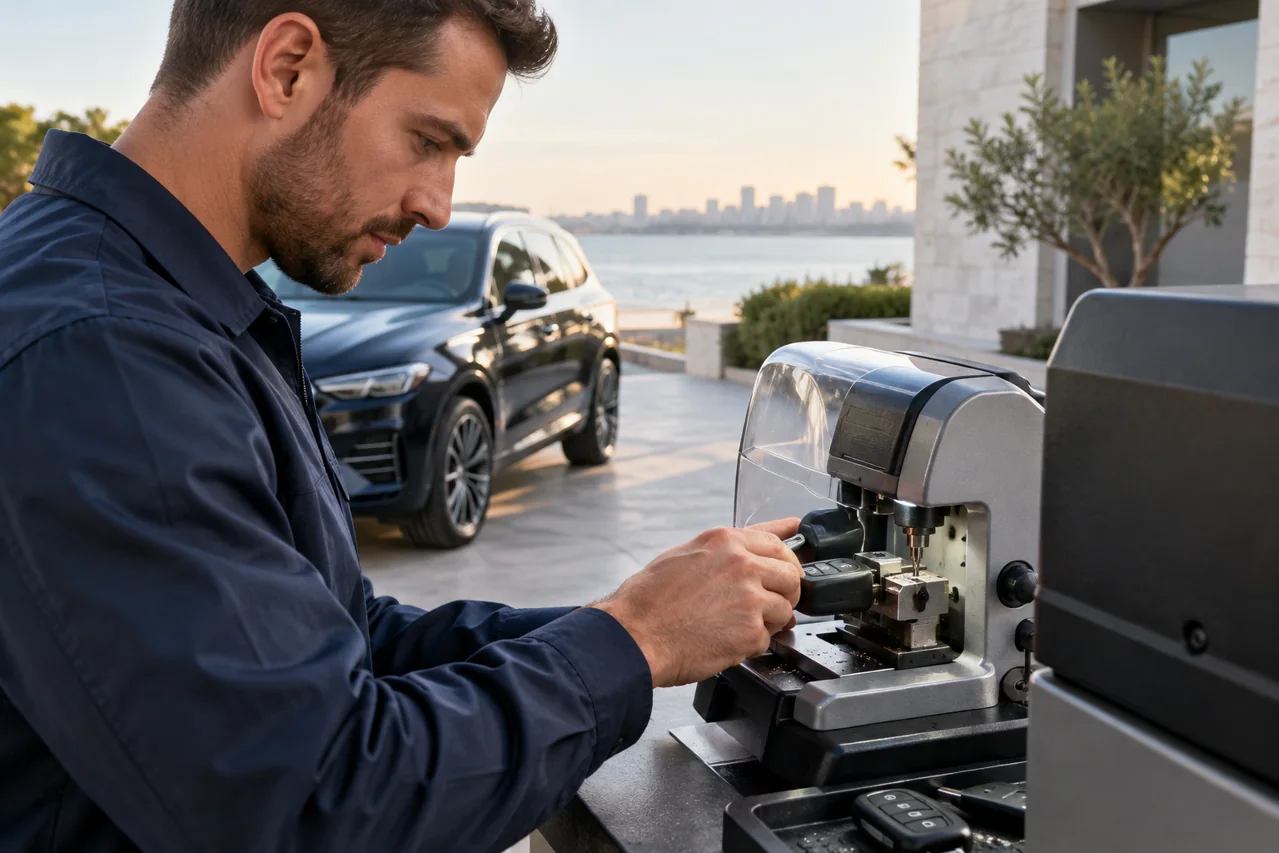
Why a copy is simpler than starting from nothing
A working key is a map. It shows the exact pattern of the blade, it carries a chip that the car already recognizes, and it often includes a remote whose settings can be read. A technician who holds that key does not have to look up cutting data, prove the car's identity through a secured database or open the immobilizer to a first key. The job becomes a matter of matching what already exists.
That is why spare key requests are typically the least stressful call a locksmith takes. You are not stranded, the car still runs, and nobody has to hurry. The visit can be scheduled for a convenient time, in your driveway, at the office or in a parking lot near work. If you have ever read about the more demanding process of making a key with no original, our page on all keys lost service shows how much more is involved when the last key is gone.
The difference also matters for planning. A car with two keys can survive losing one, because you can use the other to start the car and call a technician at your leisure. A car with a single key is one pocket accident away from a long, stressful day. Making a copy now turns a possible crisis into a small errand.
Cloning versus programming, in plain terms
People often use the words clone and program as if they were the same thing, but they describe two different methods. Cloning copies the identity of the chip in your existing key onto a compatible blank chip, so the new key presents exactly the same signal to the car. The car sees two keys that look identical, and in some systems it cannot tell them apart. Cloning works on certain chip families and is not available for all makes.
Programming adds a new key to the car's memory as a separate, additional key. The new chip has its own identity, and the car's computer is told to accept it alongside the existing one. This approach is available on most late-model vehicles and has an advantage: the car knows how many keys exist, and a lost key can later be removed from the list without touching the others.
Which method applies depends on the make, the chip and the security design of the car. A technician will tell you on the phone whether your vehicle is a cloning candidate, a programming candidate or both. If you want to understand the chips themselves, see our page on transponder key cutting and programming, which describes the families in more detail.
| Method | What happens | Good to know |
|---|---|---|
| Cloning | The chip identity is copied onto a compatible blank | Only some chip families allow it; the car cannot distinguish the copy |
| Programming | The car learns the new key as an additional key | Common on late-model cars; lost keys can be removed later |
| Blade only | A plain blade is cut to open doors | Does not start a car with an immobilizer |
What the technician checks before cutting anything
Before a blade is cut, the technician looks at your existing key and at the vehicle. They identify the blade type, such as a traditional edge-cut key or a laser-cut key with a groove down the side, and they check whether the chip is a type that can be cloned, programmed or both. They also look at the condition of the key. A worn key can produce a worn copy, because the new blade follows the shape of the old one, wear and all.
If your key is badly worn, the technician may instead cut the blade from the vehicle's identification data, which gives a fresh, accurate cut rather than a copy of a tired one. This is an important detail for older cars where the original key has been in a pocket for years. A copy of a worn key can feel sticky in the lock and may eventually fail, so asking for a clean cut can be worthwhile.
The technician will also check the ignition and the door locks. If a lock is already rough or sticky, a new key may not fix that, and a lock repair may be a better first step. Our page on door lock cylinder repair explains when a cylinder, not a key, is the real problem.
The remote buttons are a separate question
Many modern keys include lock, unlock, trunk and panic buttons. The remote part of the key is not the same as the chip that lets the engine start. A copy may be able to start the car but not operate the remote functions, or the other way around, unless both parts are paired. When you request a spare, say whether you want the remote buttons to work as well, since that affects the key type and the programming time.
Some remote heads can be paired from inside the car with a sequence of key turns, door switches or button presses. Others require a diagnostic tool. A few makes limit the number of remotes that can be added, and the technician can tell you if your vehicle has such a limit. Our page on remote head key replacement covers keys that combine the blade and remote.
Be aware that unbranded look-alike remotes sold online may use unusual frequencies or chips that do not pair reliably. A technician who sees a poor quality part will say so, and can supply a suitable blank instead.
How the visit usually goes
You call, describe the car and the key you have, and the technician explains what is possible, what the visit involves and what to have ready. Quotes are given by phone only. If the car has an unusual system, the technician may recommend an on-site visit first, and there is a service call charge explained before dispatch.
On arrival, the technician will ask for proof of ownership before making a key. This is routine, and it protects you. A government photo identification and a registration or insurance card that shows the vehicle identification number are the usual documents. Our guide to proof of ownership for keys lists what is accepted.
Then the work begins. The technician reads your key, selects a blank, cuts the blade and runs the pairing. When the copy is ready, you will be asked to try it in the door and the ignition while the technician watches. Most spare key visits are over quickly compared with origination work, though the exact time depends on the vehicle.
- Describe the car and your existing key on the phone.
- Receive the quote and the service call explanation before dispatch.
- Show identification and ownership documents on arrival.
- The technician cuts and pairs the new key.
- Test the copy in the doors, trunk, ignition and remote functions.
Testing the copy properly
A new key should be tested like a new tire, with a real drive rather than a quick glance. Start with the doors. Use the new blade to unlock the driver door manually, if your car has a traditional lock, and check that it turns smoothly without catching. Try the trunk or hatch lock if it has one, and the glove box if it is keyed.
Then test the ignition or start button. Turn the key to the on position and confirm that the dash lights behave normally and that no security light stays lit. Start the engine and let it idle for a short time. Shut it down and start it again, then do this a third time. A key that works once but fails on the second start can indicate a pairing or chip problem, and the technician should fix it before leaving.
Finally, test every remote function. Lock and unlock the doors from a few steps away, then from farther away. Press the trunk release and the panic button briefly if appropriate. If something does not work, tell the technician at once rather than hoping it will fix itself. Problems found while the technician is still there are easy to fix.
- Turn the blade in each manual lock without forcing it.
- Start the engine three separate times with the new key.
- Check that no security or key light stays on after starting.
- Test lock, unlock, trunk and panic functions at several distances.
- Confirm that your original key still works after the new one is added.
Common reasons Houston drivers order a spare
Many drivers order a spare after a close call. A key left in a beach bag after a day in Galveston, a set dropped at a ballgame or a pocket emptied on a flooded street can make the need very clear. Others order a spare because a household has two drivers and one key, or because a teenager is about to start driving. Our teen driver spare key guide covers that case.
Business owners and fleet managers order duplicates as part of routine planning. A delivery vehicle with one key is a risk to the whole schedule, and a spare kept in a locked box at the office protects the work day. Our fleet vehicle key service page explains how multiple vehicles can be handled in one visit.
Buyers of used cars often discover they were handed only one key. That single key is a warning sign, and the safest time to add a spare is before the first one goes missing. Our used car buyer key checklist explains what to look for when you first take ownership.
Where the spare should live
A spare key is only useful if you can reach it when the main key is gone. Keeping it in the glove box fails the moment the car is locked or stolen. Keeping it in the same bag as the main key fails the moment the bag is lost. The best locations are secure and separate: a drawer at home, a trusted relative's house or a locked cabinet at work.
Avoid magnetic boxes under the bumper. They fall off, rust in Houston humidity and are among the first places a thief checks. If your spare is a smart key with a proximity signal, it may need protection from relay theft, a topic covered in our guide on the Faraday pouch.
Once the spare is in place, make a note of where it is, and tell one other trusted person. A spare nobody can find is no better than no spare at all.
Questions to settle on the phone before the visit
A few details make the call go faster and the visit go smoother. Know the make, model and year of the car, and whether the key you hold is a plain metal blade, a blade with a plastic head, a key with buttons or a fob that you carry in a pocket. If you can read a name or number stamped on the key head, mention it. If the key has a green, black or grey plastic head, that detail can help the technician guess the chip family before arriving.
Say where the car will be parked and whether it can be reached easily. A technician working in a covered garage needs space for a van and a tablet, and a car on a crowded street may need a few minutes to find a safe spot. If the car is in a gated community or a workplace lot, mention any access steps so the technician is not stuck at the gate.
Ask how many keys the car can hold. Some vehicles allow a long list of keys, while others accept only a few. If you already have three keys, adding a fourth may not be possible without removing one. It is better to learn this on the phone than at the curb.
Finally, ask what the technician needs to see. In most cases that is your working key, your identification and a document that links you to the car. If any of those will be hard to produce, say so. A short conversation now can prevent a wasted trip later, and it lets the technician tell you honestly whether the visit will accomplish what you want.
Keeping the original key healthy
Once you have two keys, treat the pair as a system. Alternate between them so that neither wears out first, and keep the unused one somewhere safe. A key that lives on a heavy ring wears the ignition and the key itself, and a copy made from a worn key inherits the damage. Our guide on how to care for your key fob offers simple habits that extend the life of both keys.
If the remote battery in your original key is weak, replace it before making the copy so that the technician can test the remote properly. Replacement is a simple job, covered on our page about key fob battery replacement.
Keep a photo of both sides of each key, along with the vehicle identification number. If a key is ever lost, the photos help the technician identify the type quickly.
When a spare is the wrong first step
Sometimes a copy is not the right answer. If your only key is cracked, bent or failing, a fresh key cut from the vehicle's data may serve you better than a copy of a tired blade. If the car has a history of hard starting, an ignition inspection is worth doing before anyone adds more keys to a failing system. And if a key has been stolen, the priority is to erase that key from the car, not to make another.
In any of these cases, a short call is the best way to decide. Describe what you have, what has happened and what you want, and the technician will tell you plainly which route fits. When you are ready to schedule a spare, call and talk through the car, the key and the location.
Questions people ask
Is a duplicate key as good as the original?
A well-made duplicate works the same way as the original for the doors and the engine. The remote buttons need to be paired separately and should be tested. If your original is worn, the technician may cut a fresh blade from vehicle data instead of copying the wear, which gives a cleaner result.
Can any key be cloned?
No. Cloning works only on certain chip families, and many late-model cars use security systems that do not allow it. In those cases the new key is programmed as an additional key. The technician can tell you which method fits your vehicle once you describe the make, model and year on the phone.
Do I need to bring my car anywhere?
Usually not. A mobile technician comes to your location with cutting and programming equipment. You will need to have your existing key, identification and proof of ownership ready. A few vehicles with unusual systems may need an on-site inspection first, and the technician will say so on the call.
Will adding a spare erase my existing key?
It should not. Adding a key is meant to keep the existing keys working. Some systems do erase old keys during certain procedures, which is why the technician checks and tests your original key after the new one is added. If anything stops working, report it before the technician leaves.
How many spare keys should I make?
One spare is a good minimum for a single driver. Households with several drivers often keep one spare per driver, stored safely and separately. Some cars limit the number of keys that can be paired, so the technician can tell you the limit for your vehicle.
How are prices handled?
Quotes are given only by phone, after the technician hears the make, model, year and key type. If the job turns out to be complicated, an on-site visit may be needed first. There is a service call charge, and it is explained on the phone before anyone is dispatched.
Describe the situation by phone and we will tell you what the job involves. Quotes are given by phone. Jobs that cannot be quoted without seeing them need a technician on site, and the service call charge is explained on the phone before anyone is dispatched.
(713) 574-7660Related pages
Written by Claude (AI) (AI) for Houston Car Key Locksmith.