First, breathe and sort out what kind of problem you have
Before anything else, decide which situation you are in. Many people say they have lost their key when it is actually misplaced, locked in the car, or in a bag that has not been fully checked. Others have truly lost it. The steps differ, and spending ten calm minutes on sorting this out can save money and time.
Ask yourself a few plain questions. When did you last use the key for certain? Where were you after that? Did you take it out of a pocket, set it down, hand it to anyone or drop it? Is the car in front of you, or somewhere else? Is anyone or anything inside the car that needs attention? If a child or a pet is inside, stop reading and call 911 first.
Think about the type of key too. A fob with push button start behaves differently from a turn key with a transponder chip. If you have lost the only working key, the situation is often called all keys lost, and it requires a different approach to making a new key than copying a key you still have. Our page on all keys lost car key service explains the work in general terms.
Last, take a moment about safety. If you are in a dark or unfamiliar place, or if your keys went missing along with a purse or wallet, personal safety comes before the car. Move somewhere well lit and busy, and deal with the vehicle once you are settled.
A methodical search before you assume the worst
Most lost keys are found within a few feet of where you stopped looking. A methodical search is worth doing before you arrange a new key. Retrace your last hours slowly, and check each place physically rather than from memory.
Look in the obvious spots first: pockets of every jacket and pair of pants worn that day, bags and their inside compartments, the car seats and floor, cup holders and the center console. Then check the less obvious ones: the kitchen counter under mail, the bathroom, laundry, the couch cushions, a coat pocket from last week, and the lock on the front door. Keys are often left in an exterior lock or in a gym locker.
If you were out, call the places you visited. Restaurants, shops, gyms and offices have lost and found boxes. Ask a clear question, give a description of the key or fob and your phone number. If you were at a ride share or a taxi, contact the service. Some people have luck with a key tracking tag or a phone locator app if one was attached, and our guide to key tracking tags explains how they work.
Do the search in a set order, so you do not circle back.
- Pockets, bags and the clothes you wore.
- The car, if you can get into it, including seats, floor and trunk.
- Home: door, counters, furniture, and any place you tend to drop things.
- Workplace or last stop: desk, locker, coat check.
- Calls to places you visited, and to any ride service you used.
- A second pass over the places you think are already cleared.
Security first: what a missing key could mean
Once the search has failed, consider who might have the key. A key lost at home is a nuisance. A key lost in a public place along with your address, in a wallet or a bag with a registration card, is a different matter. If the key and an identifying document were taken together, someone could in theory find the car.
If you think the key was stolen, not just lost, take it seriously. Report it, and consider the steps in our pages on stolen keys or a purse and on a police report for stolen keys. A report may also matter for an insurance claim, which our guide to car key insurance claims covers.
If the vehicle is parked and the key may be in someone else's hands, consider moving it or checking on it. Where possible, make sure the car is locked and park it somewhere visible. Think about whether the key could be used by someone with the car's location. Some owners ask that the old key be disabled when a new one is made. A technician can often remove a lost key from the vehicle's memory when programming a replacement, so that the lost one will no longer start the car. Ask about this when you call.
Do not post details about your lost key, your address or the car's location on public social media. It can attract the wrong attention.
The order to make your calls
Once you are sure the key is gone, a sensible sequence of calls saves time. Start with the practical question: is the vehicle safe where it is? If it is in a public lot or at the roadside, decide whether it can stay put or needs to be moved, and note that a vehicle without a key may need to be towed if it cannot be started.
Next, call a mobile locksmith to ask what is possible. A mobile service comes to the car, so you do not have to arrange a tow in many cases. When you call, give the make, model and year, say whether the key is a fob or a turn key, and say how many working keys remain, which in this case is none. Ask for a quote by phone, and ask what the service call charge is and what is covered by it. Quotes are given only by phone, and a more complicated job may need an on-site visit.
If you prefer, you can also contact the dealer, but be aware that a dealer may need the vehicle brought to them, which can mean a tow. Our guide on dealer versus locksmith keys compares the two routes honestly.
Then, if your insurance or a roadside plan may cover part of the cost, check. Do this before you approve work, since some plans have steps to follow.
- Safety first: if anyone is in danger, call 911.
- Locksmith: ask for a phone quote and the service call charge.
- Dealer: ask whether the car must be towed there.
- Insurance or roadside plan: ask what is covered and what steps are required.
- Lender or rental company, if the vehicle is not yours outright.
Documents and proof of ownership
Any reputable technician will ask you to prove the vehicle is yours before making a new key. This is a safeguard for you, because it prevents a stranger from having a key made to your car. It can feel like an inconvenience, but it is a sign you are dealing with a careful professional.
Have your government photo ID ready, and have one of the following: the vehicle registration, the title, or other documents that tie your name to the car, such as an insurance card showing the vehicle. The vehicle identification number, or VIN, is usually on a plate at the base of the windshield on the driver's side and on the door jamb sticker. Our guides on what a VIN is and on proof of ownership for keys explain what is needed and why.
If the registration was in the car, and you cannot get in, think about other places: a photo on your phone, an online account with your insurer, or a copy at home. If the car is a rental or a company vehicle, the owner may need to authorize the work, and a technician will explain the process.
If you cannot prove ownership at the time, a responsible technician will not make a key. This is not a dead end. Gather what you need, and call back when you have it.
What happens at the visit
Knowing what to expect makes the visit less stressful. A technician arrives at your vehicle with tools to read the lock and the vehicle's key system. After checking your ID and proof of ownership, they confirm the make, model and year, and the type of key your vehicle uses.
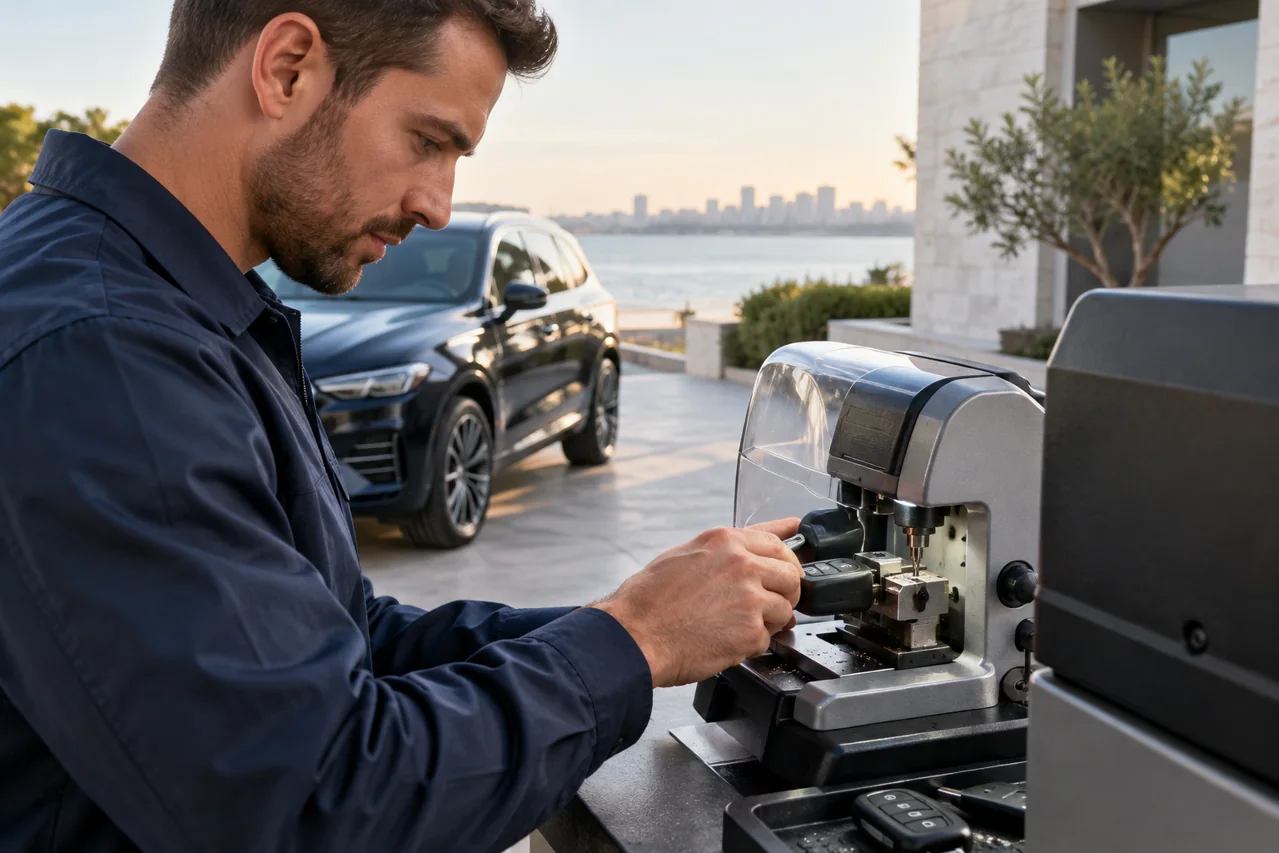
For a turn key vehicle with a transponder chip, the technician cuts a new key, using the vehicle's lock or the VIN to determine the pattern, and programs the transponder chip so the car recognizes it. For a push button start vehicle, the technician provides and programs a new smart key. Our pages on car key replacement and on how key programming works give more background.
The process may involve connecting a programming tool to the vehicle's diagnostic port, and it can take some time. Some vehicles are simpler than others, and some newer models have extra security steps. If your vehicle requires extra handling, the technician will tell you on the phone or at the visit. A job that cannot be completed on site, for example, because of an unusual security system, should be explained to you before you agree to anything.
Before they leave, test everything. Make sure the new key starts the car, locks and unlocks the doors, and works for each button. Ask whether the lost key was removed from the vehicle's memory.
- The technician checks your ID and proof of ownership.
- They identify the key type and confirm the quote and charges.
- They cut or supply the new key and program it to the vehicle.
- They test starting, locking, unlocking and each fob button.
- They ask about removing the lost key from the vehicle's memory.
- You review the work before you pay.
Getting a second key made at the same time
If you are already paying for a visit, consider having a spare key made in the same session. Making an additional key at the same time as a replacement is usually much more efficient than doing two separate jobs, and it protects you from facing the same situation again. When you call, mention that you want to discuss a spare, and ask what that would involve.
A spare also lowers the stress. The second time a key is lost, you will be glad to have one in a drawer. Our guide on why you need a spare key now explains the reasoning, and our page on spare car key duplication describes how copies are made when a working key still exists.
Where to store the spare matters too. A spare kept in the car, in a magnetic box under the bumper, or in a bag with the main key defeats the point. Read our guide to where to keep a spare key for ideas, and remember that a good spot is one that you can reach and a stranger cannot easily find.
Test the spare after the visit. Confirm that it starts the car and that the fob buttons work.
Avoiding scams when you are stressed
People who have just lost a key are in a hurry, and some operators take advantage of that. Be careful with any ad that lists a very low number and then adds charges at the door. Be careful with a company that will not give a business name, or that answers the phone with a generic greeting. Be careful with anyone who arrives in an unmarked vehicle or who will not show ID.
A few simple checks protect you. Ask for the business name and the location it serves. Ask for a quote by phone, with the service call charge explained, before anyone is dispatched. Ask whether the person who arrives will show identification. Take your time and do not agree under pressure. If the quote changes dramatically at the vehicle, you can say no and ask for the reasons in writing.
Our guide to common car key service scams goes into detail, and our guide on questions to ask before booking gives you a ready list. Please verify the credentials of any locksmith before you let them work on your car.
Never hand over your ID, registration or payment details to someone who has not first explained the work and the charges to you.
If you are away from home, at night or in a hard place
A lost key far from home, late at night or in a place you do not know raises the stakes. The right move is to put your safety first, then your car. Stay in a lit, busy place, tell someone where you are, and do not leave valuables unattended.
Our pages on lost car keys at night and on a lost rental car key cover those situations, including what to do with a rental. If you are at a venue, an airport or a large lot, security staff can often help you stay safe while you wait.
Do not accept help from a stranger who offers to open the car or to drive you off, and do not sign anything you have not read. A mobile locksmith can come to you, but you should arrange it by phone, with a quote given in advance.
Calling for help
When you have searched, taken stock and gathered your papers, the next step is simple. Call and describe your vehicle and what has happened. A technician will ask a few questions, explain the options, and give you a quote by phone. If the job is more involved, an on-site visit may be needed, and the service call charge will be explained before dispatch.
Have your location, the vehicle make, model and year, your ID and your proof of ownership ready. If you can, tell us whether the car is a turn key or push button start. Then, when you are ready, call, and we will take it from there.
Questions people ask
Can a new key be made if I have no working key at all?
In most cases, yes. A technician uses the vehicle's lock or VIN to make a key that fits, then programs it to the car. The exact approach depends on the make and the type of key. Some vehicles are simple and some have extra security steps. A phone call will tell you what applies to yours.
Do I have to tow my car to get a new key?
Often not. A mobile locksmith can come to the vehicle and make and program a key on site for many makes and models. Some vehicles with unusual security systems may need more equipment or a different approach. Ask on the phone, and a technician will tell you whether the job can be done where the car is parked.
What proof do I need to show that the car is mine?
You will need a government photo ID, and a registration, title or similar document that ties your name to the vehicle. The VIN on the windshield plate or door jamb is also checked. If a technician cannot confirm ownership, they should not make a key, and you can come back when you have the papers.
Will my old lost key still be able to start the car?
It might, unless it is removed from the vehicle's memory during programming. On many vehicles, a technician can erase lost keys when they program the new one, so the lost one no longer works. It is worth asking about this when you call, particularly if you think someone else may have your key.
Should I call the dealer or a locksmith first?
Either can help, and the right choice depends on your situation. A mobile locksmith comes to you and may save you a tow. A dealer may need the car brought in. Ask each for a quote by phone and compare what the visit involves. Our guide on dealer versus locksmith keys explains the differences.
What if the key was in my purse and it was stolen?
Treat it as a security issue. Report the theft, and consider having the old key removed from the car's memory when a new one is made. Think about whether your address or registration was in the purse. A technician can discuss the steps with you by phone, and a police report may matter for insurance.
Describe the situation by phone and we will tell you what the job involves. Quotes are given by phone. Jobs that cannot be quoted without seeing them need a technician on site, and the service call charge is explained on the phone before anyone is dispatched.
(713) 574-7660Related pages
Written by Claude (AI) (AI) for Houston Car Key Locksmith.