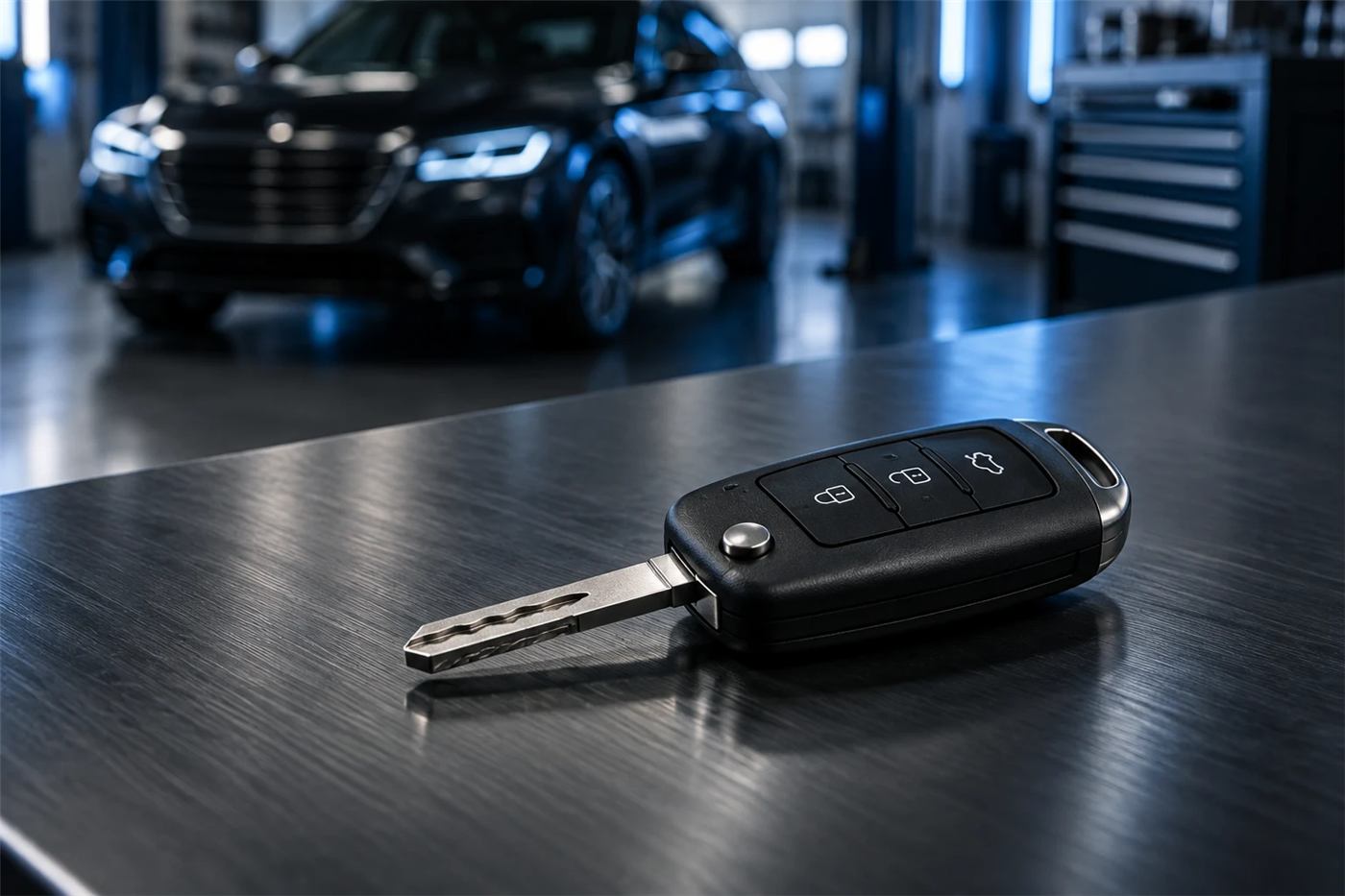
What makes a smart key different from an ordinary key
A traditional key turns a lock, and a transponder key adds a chip that the ignition reads when the key is inside it. A smart key goes further. It contains a battery-powered radio that answers when the car asks, from a short distance, whether a valid key is nearby. Antennas in the doors, the trunk and the cabin listen for that answer. When the car hears the right reply, it allows the doors to unlock when you touch a handle and lets the engine start when you press the button.
Because the exchange is encrypted and changes from moment to moment, the key and the car must share a secret that was set when they were paired. A smart key from another car will not work, even if it looks identical, and a blank smart key from a parts supplier will do nothing until a technician teaches the car to accept it. That teaching step is what most people are paying for when they replace a smart key.
Smart keys are also called proximity keys, keyless entry keys or intelligent keys, depending on the manufacturer. Names vary, but the idea is the same. If you have a car with a start button and no ignition slot, or a car that unlocks as you walk up with the key in a bag, you almost certainly own one. Our guide to transponder keys versus smart keys compares the two designs side by side.
The emergency blade hidden inside
Most smart keys hide a small metal blade inside the plastic body. A release button or slider frees it, and it exists so that you can still open the driver door if the key's battery is dead or the car's battery is flat. The blade usually works only on the door lock, which is sometimes hidden under a cap on the handle. It does not start the engine, because starting depends on the electronic exchange, not the metal cut.
If your car will not detect the key and the battery is the reason, many cars offer a backup start method, such as holding the key fob against the start button or placing it in a marked pocket in the console. The owner's manual shows the location. This backup works because the car can read the chip in the key at very close range, even without a working battery. If this method works, you have learned that the key is alive and that the battery is the likely problem.
The emergency blade also matters for replacement. If you have lost the whole key, the blade must be cut for the new key as well, and the cut must match the lock. Our guide on the emergency key blade explains where it hides on common designs.
How the car pairs a new smart key
Pairing begins with a diagnostic tool that talks to the car through the port under the dash. The technician identifies the vehicle, enters the security procedure that lets the car accept new keys and then introduces the new key. Some cars need a short sequence at the start button and the door, and others need the tool to write the key information directly. During this process the car stores the new key's identity and checks that all antennas hear it.
On some vehicles, the car requires a security authorization that the technician must obtain through a secured channel. This step verifies that the person requesting the key has a right to the vehicle and that the technician is authorized. It is not a favor the locksmith can skip. It is built into the car, and it is why a legitimate technician will ask for proof of ownership before starting.
After pairing, the technician tests all functions: the door unlock at each handle, the trunk release, the remote buttons, the push to start and the dash messages. Smart key systems have more moving parts than a simple key, so more tests are needed. A good technician does not leave until every function has worked at least twice.
Why the car may allow only a limited number of keys
Every smart key system has a memory with a fixed number of slots. A common design allows a handful of keys, and when the memory is full a new key cannot be added unless an old one is erased. This is especially relevant when you buy a used car that has been through several owners, each of whom may have added keys. The slots may be full of keys you have never seen.
That limit is why technicians often ask how many keys you currently have, and why some will suggest erasing the whole list before adding new keys. Erasing the list removes every key the car has ever known and then adds back only the ones you are holding. It is a clean way to protect the car from a lost or stolen key, but it means that every key you want to keep must be present during the procedure.
If you have two working smart keys and want a third, bring both to the appointment. If the technician erases the list, both existing keys can be re-added. If one is left behind, it will not work afterward. This is the single most common surprise in smart key work, and a quick phone call can prevent it.
- Bring every smart key you want to keep to the appointment.
- Tell the technician how many keys you believe exist for the car.
- Ask whether the list will be erased and re-built.
- Confirm the number of keys the car can store.
- Test each key at the end, not just the new one.
Why old keys can be erased, and why that is useful
If a smart key was stolen or lost somewhere public, the safest approach is to remove it from the car's memory. Once erased, that key is only a piece of plastic. It will not unlock the doors by proximity and will not start the engine, even if someone finds it. This matters more with smart keys than with plain keys, since the thief may be able to unlock the car without any physical attempt.
Erasing keys also helps with a used vehicle. A previous owner, a dealership employee or a repair shop may still hold a working key. Starting with a clean list makes the keys in your hand the only ones that count. Our used car buyer key checklist suggests asking about this at the time of purchase.
One caution applies. If the key list is erased and the new keys do not complete pairing, the car may be left with no working key at all. This is why the work should be done by a technician with the right tools, in a place where the car can be left safely while the process finishes, and with a stable power supply. A weak battery during pairing can ruin the process.
What to do when the smart key is lost
Start by confirming that it is really lost. Smart keys are small, and they like to hide in bags, coat pockets and between seat cushions. Check the places you have been, call the businesses you visited and look at the car carefully. If the car is unlocked, a key left inside may allow the engine to start but not to lock the car, and the dash may show a message about a missing key.
If the key is gone, do not leave the car sitting with an unknown key in the world. Call a locksmith, and mention that the key is a smart key. Share the make, model and year, and be ready to prove ownership. If the car is parked in a safe place, no rush is required, but leaving a car unattended with a missing smart key in a public area is a risk.
If you still have one working smart key, bring it. The job becomes an addition, much like a spare, and our page on spare car key duplication describes that simpler path. If no key remains, the process is closer to origination, and our page on all keys lost service shows the added steps.
When the smart key is damaged rather than lost
Water, a crack in the case, worn buttons or a failing circuit board can make a smart key unreliable. Signs include intermittent unlocking, a dash message that says the key was not detected, a need to hold the key right against the button, or a battery that drains quickly. Sometimes the fault is the battery, which is a simple replacement. Our page on key fob battery replacement covers that.
If the battery is fine, the circuit board may be damaged, and the whole key may need replacing. In some cases the old key can be moved into a new shell if the board is healthy but the case is broken. That repair is described on our page about key fob shells. Moving a healthy board into a new shell can save a replacement, but it requires careful work, since the board is delicate.
A smart key that went through the washing machine or sat in salt water at the beach often fails slowly. It may work for a few days and then stop. If this happened to you, tell the technician, because a drowned board may corrode further and become unreadable. Replace it rather than waiting for it to fail on a day when you need the car.
Dash messages and symptoms that point to the key
Smart key systems talk to you through the instrument cluster, and the messages are worth reading closely. A message that says no key detected, key not found or a similar phrase means the car is not hearing the key at that moment. A message that says key battery low is a direct hint to replace the battery. A message that says the key is not recognized or that service is needed for the security system suggests pairing trouble rather than a weak battery.
Other symptoms are quieter. The car may unlock on one side but not the other, which can point to an antenna problem rather than the key. The engine may crank but refuse to run, which can indicate that the immobilizer is not accepting the key. The start button may light up and then go dark, or the steering lock may release and the car may not start. Each pattern tells a technician where to look first.
Write down what the dash says, take a photo if you can, and mention any recent events such as a battery replacement, a jump start or water exposure. A car that lost power during a battery change sometimes forgets its key learning, and a car that was jump started badly may have a damaged module. Giving the technician this history on the phone helps them bring the right tools and decide whether to start with the key or with the car.
Hybrid, electric and newer vehicles
Hybrid and electric cars often use smart keys with additional layers. The key may also act as a trigger for the high-voltage system, so a missing or weak key can leave the car in a ready state that does not move. Some newer models can also accept a phone as a digital key, but the physical key is typically still the backup and must be paired and kept in a safe place.
Newer vehicles from many manufacturers tie their key programming to online security systems, so the technician may need a connection and an authorization that is tied to the specific car. This is a normal part of working on recent models and is one reason that a phone call about the exact year and trim is more useful than a general description.
If your car is very new, ask the technician whether the work can be done on site. Some of the latest systems are difficult for any independent technician and a dealer visit may be the honest answer. A reputable provider will tell you so rather than start a job that cannot be finished. Calling first protects your time.
Aftermarket and used smart keys, and what to watch for
Online listings offer smart keys at wildly different quality levels. Some are genuine parts from the manufacturer, some are quality aftermarket units, and some are poor copies that pair unreliably or die early. A used key taken from another car may be locked to that car and unusable. A technician who sees a part that will not work will say so, and it is better to find that out before the appointment than during it.
If you want to supply your own key, call first and describe it. The technician can tell you whether that model is likely to work with your vehicle and whether it can be paired. Do not assume that a key that looks the same will behave the same. The frequency, the chip and the software inside can all differ even when the plastic is identical.
Buying the key through the locksmith usually removes the guesswork. The technician knows which brands pair reliably and can match the key to your vehicle's exact system. Quotes are given only by phone, and the phone conversation is the right moment to ask about the type of key that will be supplied.
Protecting a smart key from relay theft
Smart keys introduced a type of theft that did not exist before: relay attacks. A thief uses a device to capture the key's signal from inside your home and relay it to an accomplice standing next to your car, which then believes the key is nearby. The car unlocks and starts without the thief ever touching the key. Houston neighborhoods with driveway parking and keys left on a hook by the front door are common targets.
Simple habits reduce the risk. Keep the key away from the front door, in a drawer or a metal container. A signal blocking pouch can stop the radio from reaching outside. Some keys can be put into a sleep mode with a button sequence described in the owner's manual. Our guides on relay attack protection and the Faraday pouch go into detail.
When a technician programs a replacement key, you can ask whether the key supports a sleep mode or another protective feature. Not every key offers this, but it is a worthwhile question. When you are ready to arrange a replacement, call and describe the make, model, year and what you have for a key, and the technician will walk you through the next steps.
Questions people ask
Can I program a smart key myself?
Sometimes a spare can be added with a sequence of steps in the owner's manual if you already hold working keys. Many vehicles, especially when all keys are lost, need a diagnostic tool and a security procedure. Mistakes can lock the car out of key learning, so most owners prefer to leave the work to a technician.
Why does my car say key not detected?
The most common cause is a weak battery in the key. Other causes include interference from other devices, a damaged key board or a car battery that is low. Try the backup start position described in your manual. If the message continues, the key or the car's antenna system may need testing.
Do I need to bring the car anywhere?
Usually not. A mobile technician can work wherever the car is parked, as long as there is room to set up and the car can be powered safely. A few vehicles need on-site inspection before a plan can be set, and the technician will say so during the call.
Will my old smart key stop working?
That depends on the procedure. Some pairing methods keep all existing keys, while others erase the list first and then re-add the keys that are present. Tell the technician which keys you have and bring every one you want to keep, so none are left out.
Is the metal blade enough to drive the car?
No. The blade opens the door lock only. Starting the engine depends on the electronic exchange between the key and the car, which the blade cannot provide. If the key battery is weak, the backup position near the start button may still let you start the car.
How do I get a quote?
Quotes are given only by phone, after the technician hears the make, model and year and what keys you have. Complicated jobs may need an on-site visit first. There is a service call charge, and it is explained on the phone before anyone is dispatched.
Describe the situation by phone and we will tell you what the job involves. Quotes are given by phone. Jobs that cannot be quoted without seeing them need a technician on site, and the service call charge is explained on the phone before anyone is dispatched.
(713) 574-7660Related pages
Written by Claude (AI) (AI) for Houston Car Key Locksmith.