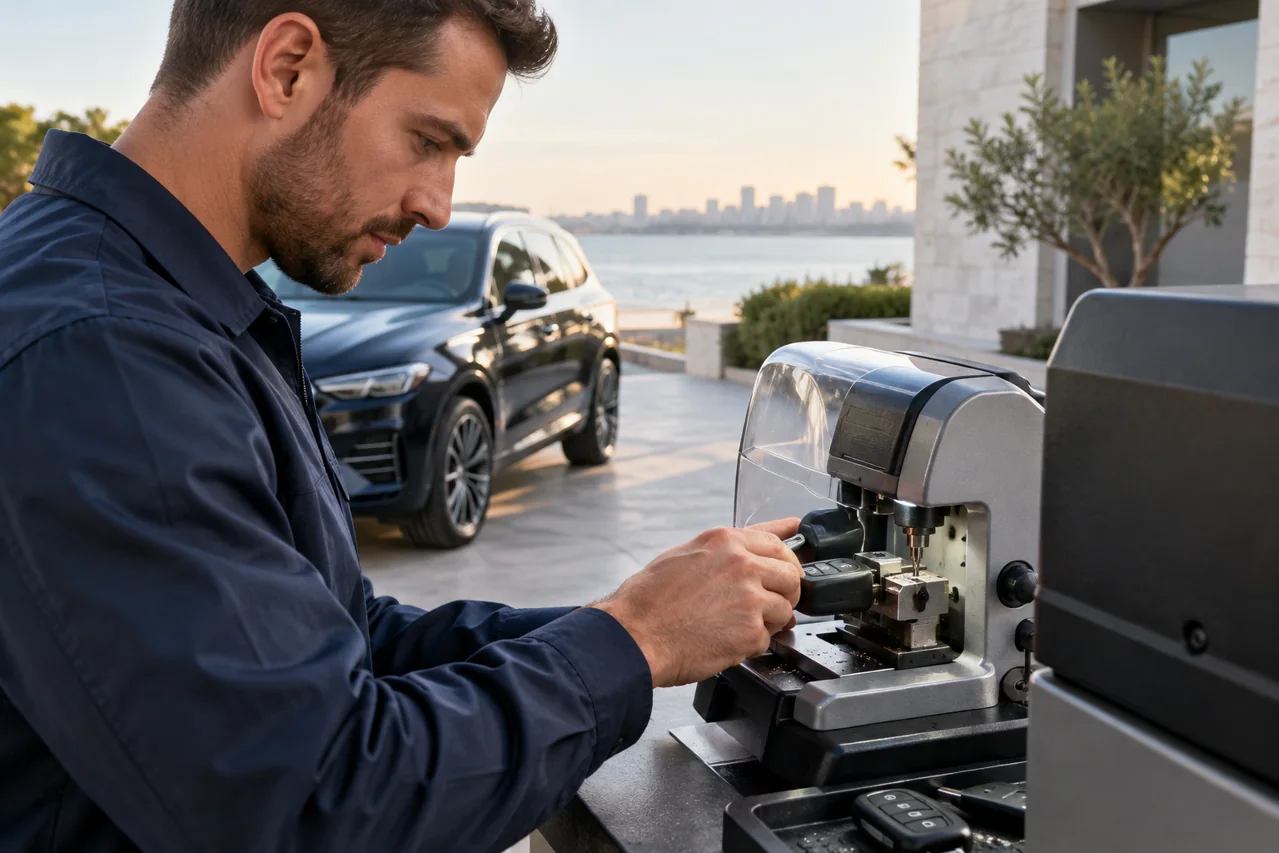
The Heights and the kind of cars parked there
The Heights is a residential neighborhood with a strong sense of place. Tree-lined streets, restored bungalows and newer townhomes sit side by side, and a busy commercial strip draws people to shops, restaurants and fitness studios. Many residents walk or cycle for short trips, so cars may sit for days between drives.
That pattern has consequences for keys. A vehicle that is used infrequently has a battery that drains, and a fob that is carried only occasionally may be forgotten at the bottom of a bag or a drawer. A key that has been in a kitchen junk drawer for a year may have a weak battery or an unnoticed crack in the shell.
The vehicle mix is varied. Many households keep an older car for years, taking care of it, and may use a second newer vehicle for longer trips. Older vehicles often have plain keys or early transponder systems. Newer ones have smart keys. A locksmith serving the Heights needs to be comfortable with both, and a caller should expect to be asked which kind of key the vehicle uses.
Bungalow blocks, driveways and street parking
Many Heights homes sit on lots with narrow driveways, and some have no driveway at all. Cars park on the street, in the front or on a pad at the back of the lot. Street parking in the older blocks can be tight, with vehicles close together and mature trees overhead.
Trees matter more than people think. A vehicle parked under an oak will collect leaves, sap and the occasional falling branch. Sap on a door lock can gum it up, and debris in a door handle recess can interfere with a smart key's sensors. A careful rinse and a clean lock go a long way.
When a visit is planned, tell the technician how the vehicle is parked. A car on the street in front of a house is easy to reach. A vehicle in a rear drive behind a fence needs directions and perhaps a gate to be opened. If a neighbor's car is blocking yours, let them know in advance.
Lighting also matters in the evenings, since older blocks may have fewer street lights. If the work is after dark, a technician will carry lights, but a porch light turned on helps. Be present when the technician arrives so that the right vehicle and the right location are confirmed.
- Say whether the vehicle is on the street, in a driveway or behind a fence.
- Mention any tree cover, tight spacing or neighboring vehicles.
- Open any gate and turn on a porch light for evening visits.
- Have your photo identification and registration ready.
- Be present, so that the vehicle and the owner are confirmed.
White Oak Drive and the commercial corridors
The commercial strips on and near White Oak Drive bring a different crowd. Diners, shoppers and people visiting for an appointment park in small lots and on side streets, often for an hour or two. Staff park nearby for long shifts.
For a visitor, a lost key means being away from home with a vehicle in a lot that may close or fill up. Check with the business whose lot you used before acting. Many will help you check a lost-and-found and may let a locksmith work in the lot with permission.
For staff, the issue is the working day. A key lost on a shift is awkward, and a vehicle that cannot move may be in a spot reserved for customers. Tell the manager and arrange the work around the business hours if you can.
A mobile visit to a commercial lot is usually simple. The technician needs room around the vehicle, light and a reasonably level spot. If the lot is crowded, a short wait for space may be needed. Our guide on preparing for your key visit lists the things that make the work go smoothly.
The cyclist with one key
The Heights has a noticeable cycling culture, with a trail network and many residents who commute or exercise by bike. A cyclist who also owns a car often has a habit that creates risk: carrying the single car key in a pocket, a saddle bag or a hip pack.
A single key carried on a ride is exposed to sweat, rain, vibration and loss. Fobs and keys slip out of pockets on rough surfaces, and a smart key in a damp jersey pocket may get soaked. A key that falls onto a trail is hard to find, and the vehicle at home is left with no working key.
If this sounds familiar, the best step is a spare key that never goes on the ride. Keep it at home in a secure spot, and make sure someone you trust can reach it. A spare is far simpler than a replacement made from nothing. See our page on spare car key duplication for how a copy is made.
If the key has already gone on a ride and is gone, call and explain. If you hold no working key, a technician can make one at the vehicle with proof of ownership. Our page on all keys lost car key service explains the process.
Older vehicles and spare key habits
People who hold on to older vehicles in the Heights often keep one key from the day they bought it. Over years, that key wears, and each copy made from a worn key inherits the wear. Eventually the key turns the ignition poorly, or the door lock sticks, and the owner puts up with it until it fails.
The habit that causes the most trouble is having only one key. A second key is often lost, forgotten or left with a former partner or a previous owner. If you bought the vehicle used, you may not know how many keys exist. That unknown is itself a reason to have a technician check and, if needed, reset the vehicle's key list.
A key cut fresh from the vehicle's information is often better than a copy of a worn one. Our guide on used car buyer key checklist describes what to check when a vehicle comes with an uncertain key history.
If the ignition itself shows wear, a new key may not cure it. A worn cylinder may need repair. Our page on ignition repair explains what a technician looks for, and quotes for repair are given by phone.
Newer smart-key vehicles in the neighborhood
Plenty of Heights residents drive newer vehicles with smart keys, and these have their own failure modes. A smart key that sits next to a phone or other electronics may show interference. A fob left in a bag near the front door may be picked up by the vehicle's antennas from inside the house in some setups, which can drain the battery faster.
When a smart key stops working, check the battery first, and try the backup start method in your owner's manual. If the key is not detected at all, there may be a pairing issue or a hardware fault. Our page on key not detected message walks through the usual causes.
A replacement smart key must be programmed to the vehicle, and for many models a technician can do that at your location. Some models require extra security steps, and a few need the manufacturer's own process. A technician will tell you which applies when you describe the vehicle.
If you own a smart key vehicle, consider whether you hold two working fobs. A single fob is a single point of failure. Having a second keeps a lost or damaged fob from becoming a stranded vehicle.
Weather, trees and the everyday wear on keys
Heat, humidity and sudden storms are part of life here. Keys carried through them age faster than keys that live in a drawer. A plastic fob shell can crack from repeated flexing, a rubber button pad can wear through and a battery cover can loosen.
Humid conditions encourage corrosion on battery contacts and in the lock cylinder. A fob that stops working after a very wet week may have a damp circuit board. If this happens, avoid heat, remove the battery and let the fob dry in open air before testing. Our page on key fob water damage explains what to do and what not to do.
Storm season brings its own risks. After heavy rain or a power outage, a vehicle's battery may be drained, which can cause a fob to appear dead. Check the vehicle battery before assuming the fob is at fault. See hurricane season key prep for planning ahead.
Regular care costs little. Replace the fob battery before it leaks, clean sap or grit from locks and keep keys away from moisture where practical. Small habits prevent the larger problem of a key that fails at a bad moment.
What the visit looks like
Start with a phone call. Say what happened, give the make, model and year, and describe where the vehicle is. Tell the technician how many keys you hold, even if the answer is none. A clear description lets the technician say whether the job suits a mobile visit.
Quotes are given only by phone. If the job is simple, a visit is arranged. If it is complicated, an on-site visit may be needed to assess it before a final quote, and a service call charge applies, explained on the phone before dispatch. Arrival depends on the day, traffic and earlier jobs, so ask for the technician's own estimate.
At the vehicle, the technician checks identification and ownership, connects to the diagnostic port, reads the security information, cuts the blade if needed and programs the key. Each function is tested in front of you before the visit ends.
If anything unexpected turns up, such as a worn ignition or a faulty receiver, the technician explains it and what it would take to fix. You decide what to do next with the facts in hand.
Making the next loss a small one
The best time to deal with a lost key is before it happens. If you hold only one key, make a spare. If you hold two, check that both work and that one is stored somewhere safe. Write down how many keys exist and where they are.
Think about where you keep keys at home. A hook by the door is convenient and also visible to anyone who looks in. A drawer is less visible but easy to forget. A small lockbox or a trusted neighbor can be a reasonable choice, depending on your comfort. Our guide on where to keep a spare key covers the trade-offs, including the places to avoid.
Do not hide a key on or under the vehicle. Thieves know those spots, and a key hidden there is an open invitation. That advice is worth following even in a quiet neighborhood.
If you need help now, call. Tell the technician the make, model and year, where the vehicle is, and how many keys you hold. You will hear what can be done, what the visit involves and how the quote works.
Questions people ask
Can you make a key for a car parked on a Heights street?
Yes, in many cases. A mobile technician works at the vehicle, whether it is on the street, in a driveway or behind a fence. Tell the technician how it is parked and whether trees, neighbors or tight spacing limit access. Quotes are given by phone before a visit is arranged.
I carry my only car key on bike rides. Is that a problem?
It is a risk. A single key exposed to sweat, rain and falls can fail or be lost. Keep a spare at home that never goes on the ride, ideally somewhere secure and reachable. A copy is simpler than a replacement made after every key is gone.
My older car has a worn key. Should I just copy it?
A copy of a worn key carries the wear. A key cut fresh from the vehicle's information often works better. A technician can cut and test one, and check whether the ignition cylinder itself is worn. Repair quotes are given by phone, and complicated cases may need an on-site visit.
My smart key quit after a very wet week. What now?
Avoid heat. Remove the battery if you can safely, let the fob dry in open air and test the battery contacts for corrosion. Try the backup start method in your manual. If it still fails, a technician can test whether the fob is repairable or needs replacing.
Is it safe to hide a spare key on the car?
No. Thieves know the usual hiding places, such as wheel arches and bumpers. Keep a spare at home in a secure spot or with a trusted person. A hidden key on the vehicle can be found by anyone, and it undermines the security of your whole vehicle.
Why can you not quote online?
Key work depends on the vehicle, the key type, how many keys remain and where the car is. A technician needs those details to quote accurately. For complicated jobs an on-site visit may be needed first, with a service call charge explained on the phone before dispatch.
Describe the situation by phone and we will tell you what the job involves. Quotes are given by phone. Jobs that cannot be quoted without seeing them need a technician on site, and the service call charge is explained on the phone before anyone is dispatched.
(713) 574-7660Related pages
Written by Claude (AI) (AI) for Houston Car Key Locksmith.