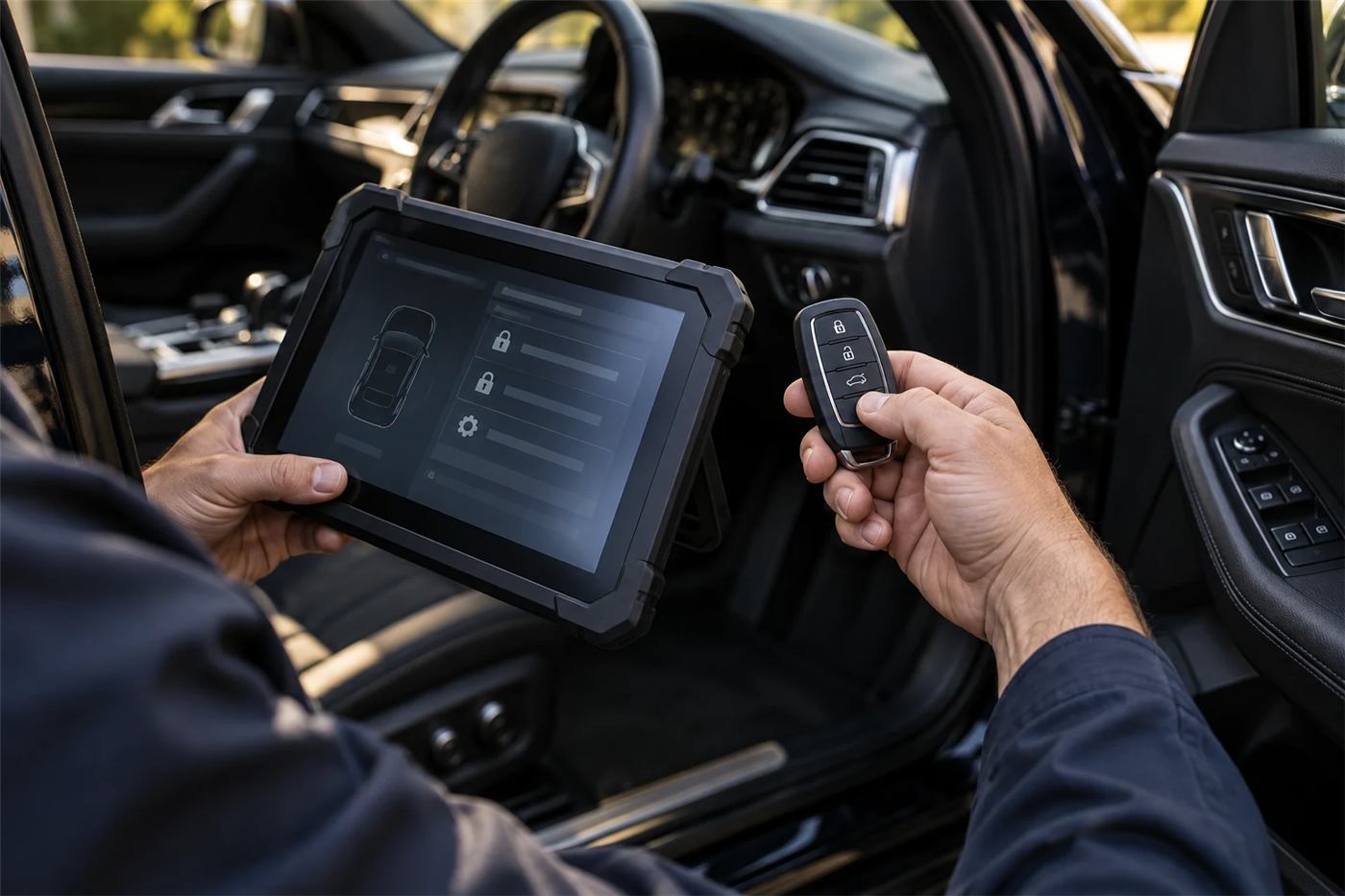
What a valet key is
A valet key is a limited version of your main car key. The idea is simple: when you hand your car to a parking attendant at a hotel, restaurant or event, you do not want them to have access to the trunk or the glovebox, where bags, papers and valuables may be. A valet key opens the driver's door and starts the engine, and does little else.
Valet keys come in different forms. On some older and some current vehicles, the valet key is a plain metal key that is cut differently from the main key so it does not open the trunk or glovebox lock. On others, it is a transponder key that starts the car but has a smaller set of cuts. On many cars with smart keys, there is no true valet key. Instead, the car has a valet mode that can be turned on in the settings, or the owner uses the small emergency blade that comes inside the fob.
The key may look similar to your main key, which is why it is easy to mix them up. Some valet keys are marked by a different color, a shorter head or a missing remote. Many owners find it in a drawer or the glovebox of a car they bought used, and have no idea it is a valet key until it fails to open the trunk.
What a valet key can and cannot do
The exact limits depend on the make and the model, so check your owner's manual. Common patterns include the following. A valet key usually starts the engine, because the valet must move the car. It usually opens the driver's door. It often does not open the trunk or the glovebox, which have separate locks that the valet key does not fit.
On some cars, the key does not open the passenger doors. On some, it does not work the power locks or the remote. On a few vehicles, the valet key may start the car only for a limited distance or limit the speed or the engine power, though this is more common with electronic valet modes than with physical keys.
A valet key is not a spare in the full sense. It is a limited tool, and you may find it cannot do something you need. If you rely on it as your only spare, you may be stuck when the main key is lost. For example, you may be able to drive the car but not open the trunk where your belongings are, or open the glovebox where the registration is.
Know what your valet key can do before you need it. Try it once at home in a safe setting. Check the door, the ignition, the trunk and the glovebox. Write down what works and what does not and keep that note with the key.
- Usually opens the driver door and starts the engine.
- Often will not open the trunk or glovebox.
- May lack remote buttons, so power locks and the trunk release may not work.
- May not open the passenger or rear doors on some models.
- Is not a full spare when the main key is lost.
Valet keys on smart key cars
Many newer cars have push button start and a proximity fob. Instead of a valet key, they often provide a valet mode or a limited fob feature. In a valet mode, the owner sets a PIN or a switch so that the glovebox, trunk or infotainment data is locked while the car is in someone else's hands. Details differ by make, and your manual is the place to look.
A smart key fob usually contains a hidden metal blade that can open the driver's door if the fob battery dies. That blade is an emergency tool and it does not start the car by itself. On most vehicles, you use the blade to open the door, then hold the fob against a marked spot on the steering column or console so the car reads the chip inside the fob. This is not a valet key, though people sometimes treat it as one.
If you hand a valet your full smart key, they have the whole fob, with every function. The car may be locked and unlocked, the trunk opened and, in some cases, the car's settings changed. It is worth knowing what your car offers. Our guide on transponder keys versus smart keys explains the difference between the two main kinds.
If your car has no real valet key and no valet mode, the safest approach is to remove valuables from the car before you hand it over, and keep papers and personal items with you.
When a valet key is lost
Losing a valet key is less alarming than losing a main key, but it still matters. A valet key that goes missing may be sitting in a drawer, in a previous owner's possession or in a hotel's key box. Because it starts the car, it can be used to drive the car away. Anyone holding it, plus the car, has what they need to take it.
The first step is to be clear which key is lost. If you still have your main key and the valet key is gone, you have the full set of what you need to drive. You may want a replacement for the sake of having a spare, but it is not urgent. If the valet key is all you have and the main key is lost, you are in a more serious situation, and our page on all keys lost applies.
Many technicians can make a replacement valet key for cars that use them, but availability depends on the vehicle. For some models, it is simpler and more useful to make a full key, which works in every lock and costs a similar amount of effort. Ask the technician on the call whether a limited key is practical for your car, or whether a full key makes more sense.
If you think the lost valet key could be in someone else's hands, for example if you left it with a valet, a mechanic or a previous owner, it is reasonable to have the car reprogrammed so the old key no longer starts it. See our page on key reprogramming after theft for how that works.
Handing the full key to a valet safely
Many cars do not have a valet key, and many owners hand their only key to the attendant. That is normal. It is worth doing a few things to reduce risk.
Take everything of value out of the car before you hand it over, including bags, electronics, mail with your address, and any papers. Keep the registration and insurance card with you if the glovebox is a concern. Remove any garage door opener, as it can reveal where you live. Take a photo of the dashboard and the car's condition if you like.
Remove house keys and other keys from the ring. A valet needs the car key only, and a ring with your house key, mailbox key and office key is a bigger risk. A separate car key ring that can be removed from the main keychain takes seconds and is a worthwhile habit.
Check that you get a claim ticket and that the ticket matches the car. Note the name of the valet company. When you return, check the car for damage before you leave.
Be careful about a valet who asks for a spare key as well. A valet should need only one key. Do not hand over a spare, or the full set, unless you have a good reason.
Valet keys and the glovebox or trunk emergency
A common complaint involves a trunk or glovebox that cannot be opened because the only key available is a valet key. For example, you bought a used car with one key, discovered it was a valet key and found that the trunk would not open. Or you lost your main key and found the valet key in a drawer, only to realize it cannot reach the spare tire or your luggage.
On cars with a trunk release inside, there may be a lever or button by the driver's seat, which does not need a key. On many cars the glovebox can be opened from the inside, and some have an emergency release. Your manual shows what exists.
If the trunk or glovebox lock needs a full key and you do not have one, a technician can make a key that fits those locks. The work involves reading the lock or using the vehicle's information and proof of ownership. See our pages on trunk lock repair and VIN key cutting for the approach.
Note that we do not give steps for defeating locks, and a legitimate technician will not either. If you cannot reach your belongings, the right path is a proper key made for the car, after proof of ownership, not a trick.
Used cars and the mystery key
A used car often comes with a mixed set of keys. The seller may hand you one full key and one valet key, or two keys of unknown type. It is easy to assume both are equal. Check them. Try each key in the door, ignition, trunk and glovebox.
If one key does less than the other, you have found a valet key or a key that has been rekeyed. If neither opens everything, the car may have mismatched locks from a past repair. This matters because if you lose the full key, the valet key will not rescue you completely.
Our guide on the used car buyer key checklist explains what to ask the seller and what to test. A related page, used car with only one key, covers the case where you got only one key at all.
A good rule is to have a technician make a fresh full key for any used car, from the vehicle's original information, and to have old keys, including valet keys, removed from the car's memory if you do not know where they have been. A previous owner who still has a key can start the car. Reprogramming the car so that only your keys work is a sensible step for peace of mind.
What happens on the phone and at the car
If you call about a valet key, a few questions help the technician. What make, model and year is the car? What does the key do and not do? Is it a plain key, a transponder key or a smart key? Do you have a main key? Is the main key lost, or are you trying to make a second key?
The technician will explain what is possible. For some cars, a replacement valet key is straightforward. For others, a full key is the better product. For smart key cars, the options differ. Once you have chosen, you will be asked for proof of ownership, such as registration or title and photo identification, and the vehicle details.
On site, the technician cuts the key from the original information, programs the chip if the car needs it and tests it in each lock you want it to work in. If you want old keys erased from the car's memory, this can often be done in the same visit.
The quote is given by phone. If the job is complicated, an on-site visit may be needed first, and a service call charge applies, explained before dispatch. Technicians do not promise arrival times, and the service is described as 24-hour only as a concept, not a promise at every hour and place. Call, describe your key and ask what makes sense for your car.
Habits that keep valet situations simple
Preparation makes valet days easy. Learn what your car's valet key or valet mode does, and keep the valet key in a known place, not loose in a drawer. If you use it, test it first so you know it works.
Keep a full spare key somewhere safe. A valet key is not a spare. See our guide on why you need a spare key now and where to keep a spare key. A full spare, kept at home or with a trusted person, protects you when the main key is lost.
Get used to removing valuables before you hand over the car. Teach family members who drive the car the same habit. A teen driver who uses a valet at a restaurant should know what to take. Our guide on the teen driver spare key looks at that side.
If a valet key has gone missing, or you have found one and do not know what it opens, call and ask. A short conversation can sort out what you have and what you need.
Questions people ask
What can a valet key not open?
On many cars with a physical valet key, it starts the engine and opens the driver's door but does not open the trunk or glovebox. Some also lack remote buttons or do not open other doors. The exact limits depend on the make and model, so check your owner's manual and test the key once at home to see what it does.
Do all cars come with a valet key?
No. Many cars, especially those with smart keys and push button start, have no separate valet key. Some offer a valet mode in the settings that locks the glovebox or trunk, and others offer nothing, so owners hand the full key to the attendant. Your manual lists what your car has. If it offers no valet option, remove valuables before handing it over.
Can a locksmith make a valet key?
For some vehicles, yes, but it depends on the make and the key system. In many cases it is more useful to make a full key, which works in every lock. Ask on the call whether a limited key is practical for your car and what the technician would recommend. Proof of ownership is required for any key.
What if my valet key is lost and someone else has it?
A valet key can usually start the car, so a lost one in the wrong hands is a risk. A technician can often reprogram the car so older keys no longer start it, which leaves only the keys you choose. Tell the technician on the call if you think the key may be with a valet, a previous owner or a mechanic.
How do I get into the trunk if I only have a valet key?
Check for an interior trunk release by the driver's seat, which does not need a key on many cars, and look in your manual. If the trunk lock needs a full key, a technician can make one after proof of ownership. A legitimate technician does not offer shortcuts or tricks for defeating a lock, and you should be wary of anyone who does.
Is it safe to give a valet my only key?
It is normal, but reduce the risk. Remove valuables, papers and your garage door opener, and take house keys off the ring. Keep your claim ticket and check the car on return. Do not give a spare as well. If your car has a valet mode, turn it on first, and keep a full spare key somewhere safe.
Describe the situation by phone and we will tell you what the job involves. Quotes are given by phone. Jobs that cannot be quoted without seeing them need a technician on site, and the service call charge is explained on the phone before anyone is dispatched.
(713) 574-7660Related pages
Written by Claude (AI) (AI) for Houston Car Key Locksmith.