Historic blocks, campuses and a lot of street parking
Third Ward is one of Houston's long-established neighborhoods, with a strong sense of history and community. Many blocks have older homes, some well kept for generations and some recently renovated. Churches, small businesses, restaurants and cultural institutions sit among the houses. Near the edge of the neighborhood, the activity of nearby university campuses spills into the surrounding streets.
Parking in a neighborhood like this is often on the street. Older houses may have short driveways or none at all, so vehicles line the curb. Students and campus workers add to the demand and often park in whatever space they can find. A vehicle may sit for days in the same place, exposed to heat, humidity and rain, and a key may be used by several people in a household or in a shared student house.
Those conditions produce a recognizable set of key problems. An older car with a worn key and a tired ignition. A student who loses the only key to a vehicle that belongs to a parent. A household where one key is passed among family members. A key lost in the walk between a campus building and a car parked several blocks away. This page covers those situations and explains how a mobile technician helps.
Older cars that have served for years
Many households in Third Ward rely on vehicles that have been in the family for a long time. These cars are valued for their reliability, and owners often prefer to keep them running rather than replace them. That is a sensible choice, and it comes with a key issue: the key and the ignition age together.
A key that has been used every day for years becomes smooth at the edges. A copy of a copy of a copy loses accuracy. The ignition cylinder wears, and the key may turn only with a wiggle. These are warnings that the key may eventually fail or break in the lock.
The best time to act is before the failure. A technician can cut a fresh key from the vehicle information, or from the lock itself, and test it. If the cylinder is worn, the technician will explain whether it needs repair. Our pages on key worn out, worn ignition cylinder signs and ignition repair describe the signs and the options.
- A key that sticks, needs a wiggle or turns only part of the way.
- A key that looks smooth or rounded at the cuts.
- An engine that starts only when the key is held in a certain position.
- A key that has been copied many times from earlier copies.
- A spare key that no longer works as well as the original.
Spare keys: the habit that saves a bad day
For an older car with a single key, the most useful step is making a spare while the original still works. When one key exists and it is lost, the job becomes an all keys lost situation, which takes more time and care. When a working key exists, a technician can copy it more simply.
Where you keep the spare matters. A spare in the same bag as the main key is no protection against losing the bag. A spare hidden on the vehicle can be found by a thief. A spare kept in a secure drawer at home, or with a trusted relative nearby, is a better choice. Our guide on where to keep a spare key goes through the options.
If you drive a vehicle with a smart key, a spare can be programmed in a visit. If you drive an older vehicle with a simple key, a spare can often be cut quickly. Our page on spare car key duplication explains the process, and the guide to why you need a spare key now gives the reasoning.
Student vehicles and keys that belong to someone else
Students living near campus often drive a vehicle that belongs to a parent or guardian. This creates a question about ownership when a key is lost. A technician has to confirm that the vehicle belongs to the person asking for the key. If the student is not on the registration, the registered owner may need to be involved, either by phone or by providing documents.
If you are a student and have lost the only key, call home first. The owner can send a photo of the registration or title and may need to speak with the dispatcher. Have your own photo identification as well. If you are a parent helping from a distance, be ready to answer questions about the vehicle and to confirm by phone.
Students share houses and apartments, and keys can pass between roommates. If a key is lost in a shared house, ask everyone to check their bags and rooms. If the key cannot be found and could be in the wrong hands, consider asking for the vehicle to be reprogrammed so the old key no longer works. Our teen driver spare key guide offers ideas that apply to young drivers of any kind.
Parking near campus and the walk to the car
A student or worker who parks several blocks away and walks to campus carries a key through a day of classes, labs, libraries and cafeterias. A key can fall out in a lecture hall or be left in a library carrel. A fob can slip out of an unzipped bag on a bus.
If you notice the key is gone, retrace your day. Check the last room you were in, and ask the office or the security desk for the building. Many campus buildings have a lost-and-found, and some campuses have a central one. Check the vehicle for a key left on a seat. Ask friends to look in their bags.
If the vehicle is parked on a street with time limits or permit rules, check the signs, since an overnight stay may lead to a ticket or tow. Tell the dispatcher so a visit can be planned promptly. A technician can meet you at the vehicle when you are available, and the work can often be done at the curb.
Street parking: weather, wear and what a technician needs
A vehicle parked on the street faces heat, humidity, rain and passing traffic. A fob left in the cabin can suffer from heat. A lock exposed to damp air can corrode. A key that sees a lot of moisture can pick up grit and wear faster.
When a technician works at the curb, a few details help. Tell the dispatcher the street, the nearest cross street and any landmark, such as a church or a corner store. If other vehicles are parked close, mention it, so the technician can plan how to open the door and work safely. If the street is busy, a safe position matters.
In summer heat, work goes better in shade or early in the day, so mention if you have a choice. In wet weather, the technician may need cover to protect the programming equipment. If you have a garage or a carport nearby, it can help. Our page on corroded locks and humidity explains how moisture affects locks and keys.
Households with several drivers and one set of keys
In many Third Ward homes, several adults share a vehicle, and a key may move among them several times in a day. A grandparent drives to church, a parent drives to work, a teenager takes the car to practice. When a key goes missing, it is not always clear who last had it.
The first step is a calm family check. Ask each person where they went and when. Look in bags, coat pockets and the places where the key is usually set down. Check the car, the driveway and the porch. Many lost keys turn up within hours.
If the key does not turn up, decide together whether to make a new key, to disable the missing one or both. A technician can explain how each works for your vehicle. Our page on what to do if you lose your only key walks through the steps.
What a technician does at your home or curb
The technician arrives, introduces themselves and checks your photo identification and your proof of ownership. Expect to show a registration or title. If the vehicle is registered to someone else, be ready to explain, and have the owner available by phone.
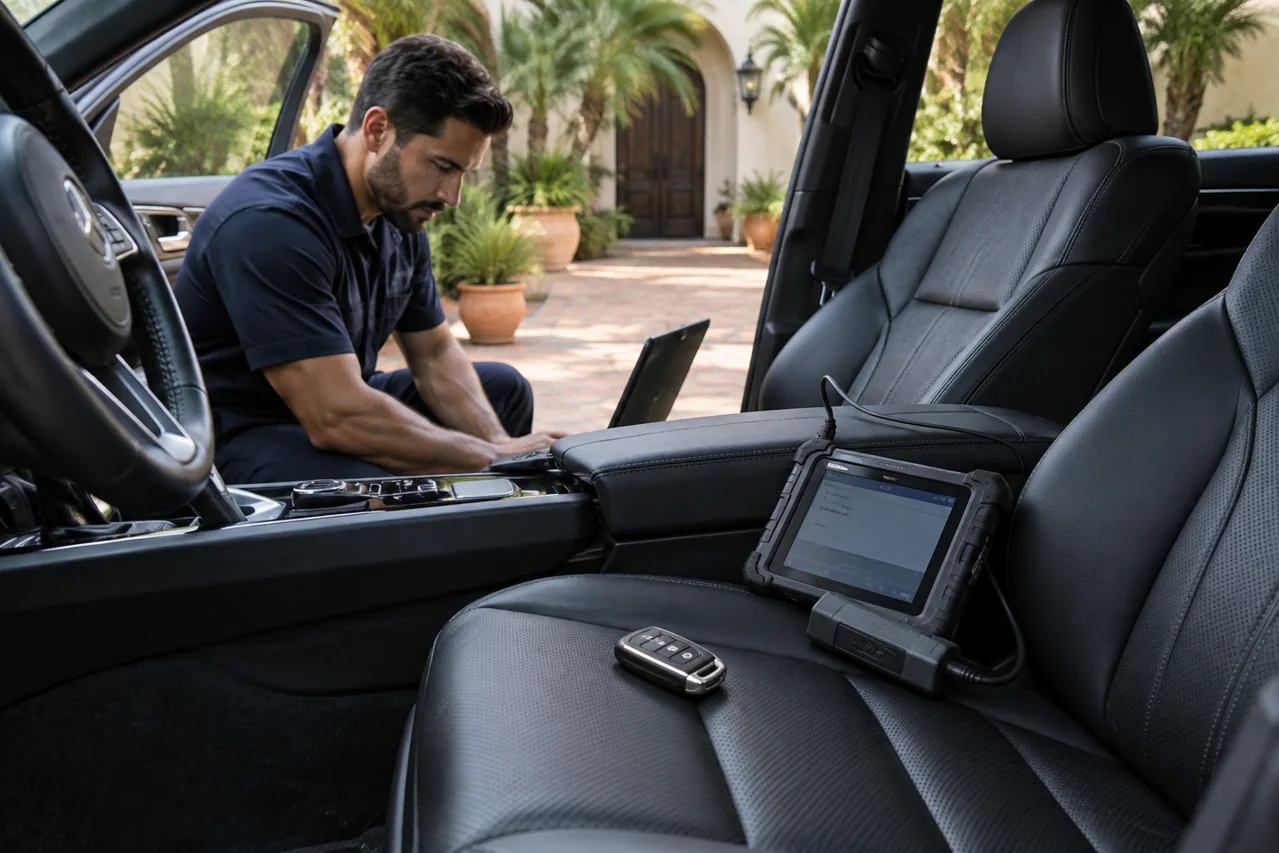
The technician identifies the key type and checks how many keys the vehicle has registered, if the make allows it. A new blade is cut if needed, and the key is programmed to the vehicle through the data port. For older vehicles with simple keys, the work can be quick. For newer ones with smart keys, it takes more steps.
At the end, the technician tests the key with you: doors, trunk, ignition and any remote buttons. If you have a spare, test that. You should ask questions at any stage.
- You call and describe the vehicle, the key problem and the location.
- A quote is given by phone and the service call charge is explained.
- The technician arrives and confirms identity and ownership.
- The key is cut and programmed.
- All functions are tested with you present.
- Old or missing keys are disabled if you ask.
Quotes, charges and honest expectations
Quotes are given only by phone. The cost of a key depends on the vehicle, the key type and the work needed, so we do not post prices. A simple spare is a different job from a smart key or a vehicle with no remaining keys.
For complicated jobs, an on-site visit may be needed before a final figure is given. There is a service call charge, and it is explained on the phone before a technician is dispatched. You can decide whether to go ahead after hearing the details.
We do not promise arrival times, because traffic and conditions change. We will tell you honestly what to expect on the call. See how quotes work for key jobs for a plain explanation.
Looking after keys in a neighborhood with history
Small habits protect a household. Choose one place at home for the key and keep it there. Make a spare and keep it somewhere secure. Replace a weak fob battery early. Avoid hanging a heavy bunch of keys from the ignition, since the weight wears the cylinder. Keep a photo of your registration on your phone.
If you have an older vehicle that matters to your family, treat the key as part of its care. A fresh key and a healthy ignition are a small investment in keeping the vehicle dependable. Pay attention to signs of wear and act early.
When you need help, call and describe the vehicle and where it is. We will explain what is possible and what to have ready, and we will help you get back on the road anywhere in Third Ward.
Church days, family gatherings and keys that go missing in a busy house
Third Ward households often gather: after services, for family meals, for celebrations that fill a house with relatives. On those days coats pile up on beds, purses are set on kitchen counters and keys end up in places nobody will think to look. A guest picks up the wrong set. A child plays with a fob and drops it behind a cushion. A key that was in a coat pocket leaves with the coat.
If a key goes missing after a gathering, do not assume the worst. Ask a few trusted people to check their coats and bags, and call relatives who left early. Check under furniture, in couch cushions, in the yard and on the porch. Look in the vehicle, the trunk and the glove box. Many keys are found within a day or two, and a calm search saves the cost of a new one.
If the key does not turn up and you are not sure who could have it, think about how comfortable you are with an unknown key being out there. A technician can reprogram the vehicle so the missing key no longer starts the engine, and add a replacement. It is a practical step when a key may have left the house with a person you do not know well.
After the new key works, take a moment to set a simple household rule: one hook, one bowl or one drawer where the key lives. A rule like that sounds small, and it prevents most of the searches that follow a busy day. When you are ready to arrange a visit, call and describe what happened.
Questions people ask
Can you make a key for an older car with only one worn key?
In many cases yes. A technician can cut a fresh key from the vehicle information or from the lock, and program a chip if the vehicle needs one. It is easier while a key still works. If the ignition is worn, the technician will explain whether it needs repair, and what that involves.
I am a student and the car belongs to my parent. Can I get a key made?
A technician must confirm that the vehicle belongs to the person asking, so the registered owner will usually need to be involved. Have your own photo identification, and ask the owner to send a photo of the registration or title and be reachable by phone. The dispatcher can explain what is accepted.
I park on the street and lost the key. Can the work be done at the curb?
Usually yes. Tell the dispatcher the street, the nearest cross street and any landmark. If other vehicles are parked close, mention it so the technician can plan. Weather and light can affect the work, so shade or a carport nearby helps. The key is cut and programmed at the vehicle.
A roommate may have taken my key. What can I do?
Try to reach them first and ask where the key is. If you cannot recover it, a technician can make a new key and disable the old one, so it no longer starts the engine. You will need to show proof of ownership. Describe the situation on the call and we will explain the options.
Is a spare key worth making for an older car?
Yes. Making a spare while a key still works is simpler than replacing everything after the only key is lost. Keep the spare in a secure place at home, not in the vehicle and not in the same bag as the main key. It can save a long and stressful day.
How are prices handled?
Quotes are given only by phone, because cost depends on the vehicle, key type and work needed. Some jobs need an on-site visit first. There is a service call charge, and it is explained on the phone before a technician is dispatched, so you know the arrangement before anyone arrives at your home.
Describe the situation by phone and we will tell you what the job involves. Quotes are given by phone. Jobs that cannot be quoted without seeing them need a technician on site, and the service call charge is explained on the phone before anyone is dispatched.
(713) 574-7660Related pages
Written by Claude (AI) (AI) for Houston Car Key Locksmith.